
OpenGL ES - The Standard for Embedded 3D Graphics Acceleration
OpenGL ES is a royalty-free, cross-platform API for rendering advanced 2D and 3D graphics on embedded and mobile systems.
OpenGL ES (Open Graphics Library for Embedded Systems) is a streamlined version of the OpenGL API designed for mobile and embedded devices. It consists of a well-defined subset of desktop OpenGL suitable for low-power devices, and provides a flexible and powerful interface between software and graphics acceleration hardware. OpenGL ES is widely deployed across smartphones, tablets, smart TVs, and wearable devices, and is supported on Android. It also powers web graphics through WebGL, which is built on top of OpenGL ES, making it one of the most widely deployed graphics standards in the world.
The Evolution of OpenGL ES
OpenGL ES API Versions at a Glance
- OpenGL ES 3.2 - Additional OpenGL functionality
- OpenGL ES 3.2 adds functionality based on the Android Extension Pack for OpenGL ES 3.1, which brought the mobile API's functionality significantly closer to its desktop counterpart - OpenGL. View OpenGL ES 3.2 Reference Pages.
- OpenGL ES 3.1 - Bringing Compute to Mobile Graphics
- Despite being only a bump in the minor revision of the API, OpenGL ES 3.1 was an enormous milestone for the API, as it added the ability to do general purpose compute in the API, bringing compute to mobile graphics. View OpenGL ES 3.1 Reference Pages.
- OpenGL ES 3.0 - Enhanced Graphics
- OpenGL ES 3.0 was another evolutionary step for OpenGL ES, notably including multiple render targets, additional texturing capabilities, uniform buffers, instancing and transform feedback. OpenGL 3.0 Reference Pages.
- OpenGL ES 2.0 - Programmable Shading
- OpenGL ES 2.0 was the first portable mobile graphics API to expose programmable shaders in the then latest generation of graphics hardware. It remains a prevalent API today, and still is the most widely available 3D graphics API, and remains a solid choice to target the widest range of devices in the market. View OpenGL ES 2.0 Reference Pages.
- OpenGL ES 1.x - Fixed Function Graphics
- OpenGL ES 1.0 and 1.1 were the first portable mobile graphics APIs, defined relative to the OpenGL 1.5 specification, providing fixed function graphics acceleration. View OpenGL ES 1.1 Reference Pages.
Specifications, Headers and Dev Tools
Key OpenGL ES Resources
Thanks to the support of the Khronos membership and our passionate developer community, there is a full set of well-supported developer tools and resources to help quickly get you up and running with your OpenGl ES application development.
- Registry - specifications, headers, reference pages ...
- SDK - The OpenGL ES Software Development Kit
- GLSlang - compiler front end for the shading language
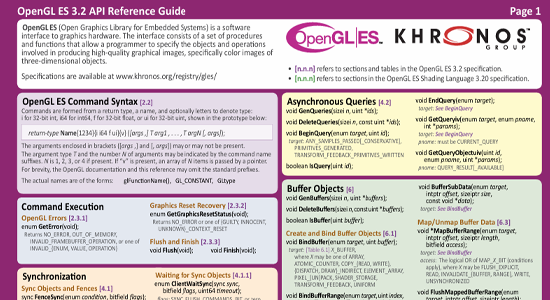
- API Reference Guides - see example card
- KTX - a lightweight file format for OpenGL textures
- General OpenGL Suport Forum
- Stackoverflow - 'opengles' tag
- OpenGL ES Support on Android
Popular Books and Tutorials for Getting Started
OpenGL ES Academy
Several excellent OpenGL ES specific, and Shading Language resources exist to help you get started with your OpenGL ES Development and help get you productive quickly.
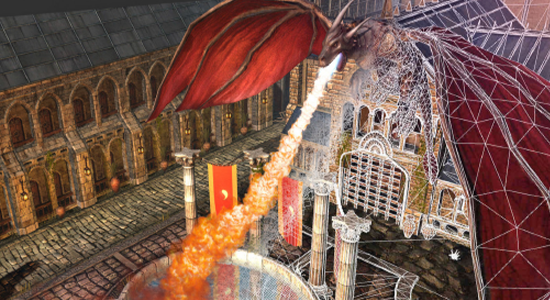
Image from the OpenGL ES 3.0 Programming Guide by Dan Ginsburg, Budirijanto Purnomo, Dave Shreiner, Aaftab Munshi.
- OpenGL ES 3.0 Programming Guide - book
- OpenGL ES 2.0 Programming Guide - book
- OpenGL ES 2 for Android - book
- Pro OpenGL ES 2 for Android - book
- OpenGL Insights - book
- OpenGL Shading Language - book
- Android Developers Guide - tutorial
- Kodeco Course - tutorials
Khronos Event
Shading Languages Symposium
Join the shading languages community in San Diego on February 12-13, 2026 where Randi Rost, author of the OpenGL Shading Language book will be our keynote presenter, plus additional talks on GLSlang, porting GLSL to Slang and more.
Learn More
Broad Deployment
Implementers of OpenGL ES
The following companies are known to have implemented openGL ES. View a complete list of companies and their Conformant OpenGL ES Products.
- Apple
- Arm Limited
- Broadcom Corporation
- Creative Technology Ltd
- Digital Media Professionals
- Fujitsu
- HiSilicon Technologies
- Huawei Technologies
- Imagination Technologies
- Intel
- ITRI
- Marvell
- MediaTek Inc
- Nintendo Co., Ltd.
- NOKIA
- NVIDIA
- Panasonic
- Qualcomm
- Raspberry Pi Ltd
- Samsung Electronics
- Socionext, Inc.
- Software Freedom Conservancy
- Software in the Public Interest
- Sony Computer Entertainment
- Takumi Corporation
- Verisilicon
- Vivante Corporation
Khronos Standard Additional links and information
Related Discussions
Related News
- Taming the Panthor: OpenGL ES 3.1 conformance achieved on Mali-G610
- Software in the Public Interest announces Apple M1 and M2 as being OpenGL 4.6 Conformant
- First OpenGL ES 3.1 Conformant M1 GPU Driver
- Meta Uses Khronos Open Standards in New Intermediate Graphics Library
- Automotive HMI Graphics Need Vulkan