Academia.eduAcademia.edu

Naval and Maritime Activities of Alexander the Great in South Mesopotamia and the Gulf

Abstract
sparkles

AI

The paper examines the naval and maritime activities conducted by Alexander the Great in South Mesopotamia and the Gulf region. It analyzes routes taken, strategies employed, and the socio-political implications of these maritime endeavors on the broader context of Hellenistic expansion. The findings highlight the importance of naval power in Alexander's military campaigns and the significant impact of his maritime activities on the cultural and economic landscapes of the areas involved.

Key takeaways
sparkles

AI

  1. Alexander's naval strategy aimed to control trade routes and facilitate economic growth in Mesopotamia.
  2. He assembled a fleet of up to 500 ships for his Arabian expedition, emphasizing naval dominance.
  3. Plans included establishing naval bases and improving irrigation to support military and trade ambitions.
  4. Nearchos' voyage provided essential intelligence on the Arabian coast and navigation for future campaigns.
  5. Alexander sought to integrate his naval empire from the Gulf to the Mediterranean, expanding his reach.

References (232)

  1. 2.10) Nearchos' return trip from the mouth of the Euphrates to meet Alexander -78 (2.11) Alexander's trip from Susa to Opis -Identification of the site of Alexandria on the Tigris -80 (2.12) Construction and transport of warships from Phoenicia to Babylon -86 (2.13) Construction of harbour at Babylon -94 (2.14) Alexander's first Babylonian War Fleet -95 (2.15) Construction of river fleet of small punts Inspection of waterways and canals -99 (2.16) Alexandria on the Tigris -104 (2.17) Alexandria on the Euphrates or in Babylonia -105 (2.18) Alexander's plans to conquer Arabia -108 (2.19) The strength of the expeditionary force against Arabia -116 (2.20) Food and water needs for the army and navy, logistics and communication lines -117 went to Medios' drinking party that led to his death. The last we hear of him is in 313/312 B.C. with Demetrios Poliorketes. Most probably, afterwards he retired to write his memoirs. For further details and information on Nearchos, the reader is referred to Heckel (1992), pp. 228-233.
  2. The naval commander of the navy was Onesikritos [Heckel (1992), p. 230]. According to Ernst Badian: "Nearchus was in overall command. Onesicritus was in charge of navigation; i.e. it would be Nearchus' job to decide where the expedition was going and Onesicritus' to see that it got there." [Potts (1990 Vol. II), p. 3, note 9]
  3. Hauben (1976), p. 92: "The number of vessels that took part in the expedition is unknown but may, as Tarn believes (n. 99), have been in the vicinity of 100 to 150 (n. 100)."
  4. Arr. Indica 19.7; Arr. 6.18.3
  5. Arr. Indica 18.1-10
  6. Lane Fox (1986), p. 386
  7. Hammond (1980), p. 238: Hammond believes that "the marines hardly exceeded a thousand".
  8. Arr. Indica 40.11; Hammond (1980), p. 239
  9. Arr. Indica 32.10-12
  10. Arr. Indica 36-37.10. According to Arrian (Indica 38.1), the length of the voyage along the Karmanian coast was 3,700 stades.
  11. Brunt (1983), p. 403
  12. Arr. Indica 37.2; Str. 16.3 NOTES
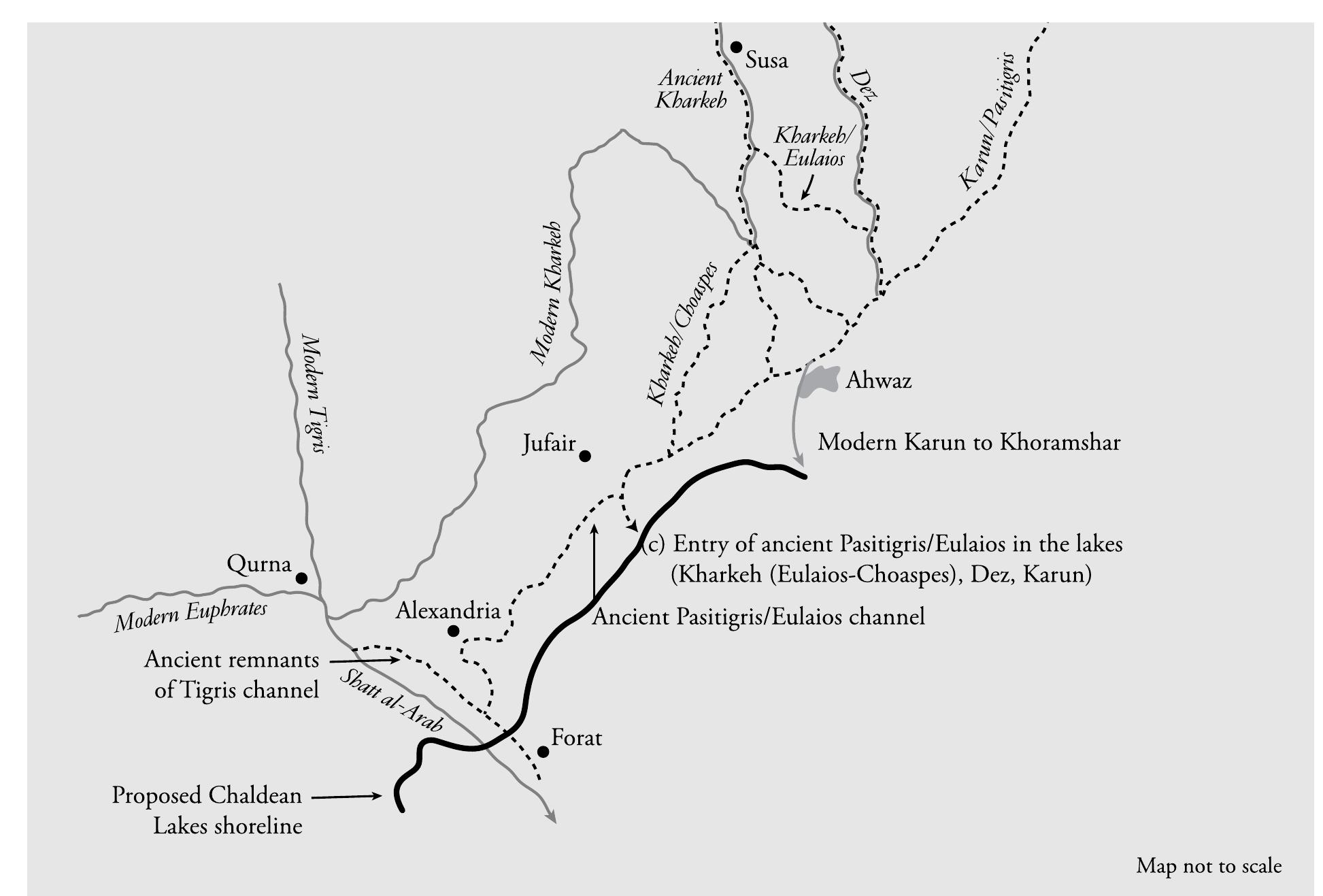
  13. Dr. Fahed Al-Wohaibi; Potts (2009), p. 38
  14. Huntingford (1976), p. 104
  15. Huntingford (1976), p. 105. Semiramis might be Larak island some 40 km north of Cape Musandam at the entrance of the Gulf.
  16. The length of the voyage was 4,400 stades (Arr. Indica 40.2).
  17. For more details on the trip, see Potts (2014), pp. 135-145.
  18. Brunt (1983), p. 420, note 1
  19. Potts (2009), p. 38, note 133
  20. Whitehouse (1996), p. 342
  21. Arr. Indica 40-42.10
  22. The length of the voyage was 2,000 stades (Arr. Indica 42.4-5).
  23. Cole and Gasche (2007), p. 41, note 213
  24. Cole and Gasche (2007), p. 41, note 211. Pliny moves Teredon more to the north, when Euphrates was emptying into the Tigris (Plin. 6.32.145);
  25. Potts (1990 Vol. II), p. 7, note 25 and p. 8, note 30. Although trade through Teredon was greatly reduced due to Alexander's and Seleukid foundations. According to Juba, Teredon was still visited by Parthian merchants around his time (Plin. 7.145).
  26. Salles (2012), p. 299
  27. Cole and Gasche (2007), p. 42, Fig. 73
  28. Arr. Indica 41.8. The distance of 3,300 stades agrees with today's actual distance of about 600 km from Babylon to the southern tip of Khawar Sabiya.
  29. Cole and Gasche (2007), p. 45, note 216
  30. Arr. 7.7.6-7. This is also attested in Strabo: "[…] on account of the cataracts, purposely constructed, the rivers cannot receive the merchandise that comes in from the sea nor bring down any either, and that all traffic is carried on by land."
  31. Potts (1990 Vol. II), p. 2
  32. Parpas (2014), p. 191, note 6 and p. 193, note 20
  33. Curt. 10.1.19. The septemremes were introduced for sea warfare by the Phoenicians at a later date. They were used extensively in the Roman wars. It is highly unlikely that Alexander had taken delivery of such warships at that time.
  34. "Aristobulus says that Alexander also found the fleet at Babylon; the part which was with Nearchus had sailed up the Euphrates from the Persian Sea, but the rest had been brought up from Phoenicia, two Phoenician quinqueremes, three quadriremes, twelve triremes and some thirty triacontoroi, which had been broken up and carried across from Phoenicia to the Euphrates, to the city of Thapsacus, put together again there, and sailed down to Babylon." (Arr. 7.19.3-6)
  35. penteres = singular, pentereis = plural, same for dieres, trieres and tetreres)
  36. triakontoros = singular, triakontoroi= plural, same for pentekontoros) 105) Meijer (1986), p. 14
  37. Parpas (2013), pp. 194-199
  38. Murray (2012), p. 24
  39. Parpas (2013), pp. 199-201 110) Meijer (1986), p. 119
  40. Murray (2012), p. 30
  41. Murray (2012), p. 15
  42. Cole and Gasher (2007), p. 47 NOTES have taken 100 to 500 tons." [Available at: https://www.academia.edu/21391893/ Phoenician_Shipwrecks_of_the_8_th_to_the_6_th_century_B.C._Overview_ and_Interim_Conclusions (Accessed 10 May 2016)]
  43. Meijer (1986), pp. 227-228
  44. Engels (1978), Appendix 5, Table 7, p. 153
  45. Engels (1978), p. 15 188) Engels (1978), p. 145
  46. C H A P T E R I I I HELLENISTIC NAVAL PRESENCE IN THE GULF
  47. Possehl (1996), p. 133
  48. Potts (2009), p. 32
  49. Potts (1996), p. 282
  50. Plut. Alex. 34.1; Parpas (2014), pp. 141-155
  51. Parpas (2014), p. 165, notes 10a, 10b
  52. Strootman (2015a), p. 6
  53. Strootman (2015a), p. 11
  54. Shipley (2000), p. 294
  55. Potts (1990 Vol. II), p. 10
  56. Bosworth (2002), p. 215
  57. Newell 1978, Plate XXI 16) Newell 1978, Plate XXXV
  58. Newell 1978, Plate XXXVIII 18) Newell 1978, Plate XXXI
  59. Thonemann (2015), p. 21, Fig. 1.24
  60. Thonemann (2015), p. 146, Fig. 8.1
  61. Thonemann (2015), p. 54, Fig. 3.13
  62. Thonemann (2015), p. 27, Fig. 2.2
  63. Thonemann (2015), p. 156, Fig. 8.19 NOTES B I B L I O G R A P H Y Agius (2005) Agius, D.A., Seafaring in the Arabian Gulf and Oman. The People of the Dow, New york: Routledge 2005.
  64. Al-Nashef (1986) Al-Nashef, K., "The Deities of Dilmun", in H.A. Al Khalifa and M. Rice (eds.), Bahrain Through the Ages: The Archaeology, London: KPI, 1986.
  65. Al-Wohaibi Al-Wohaibi, F., Studio Storico-Archaeologico della Costa (1980) Occidentale del Golfo Arabico in Età Ellenistica, Rome: L'Erma di Bretschneider, 1980.
  66. Andersen (1986) Andersen, H.H., "The Barbar Temple: Stratigraphy, Architecture and Interpretation", in H.A. Al Khalifa and M. Rice (eds.), Bahrain Through the Ages: The Archaeology, London: KPI, 1986.
  67. Aperghis (2004) Aperghis, G.G., The Seleukid Royal Economy: The Financial and Administration of the Seleukid Empire, Cambridge: Cambridge University Press, 2004.
  68. Apicella (2006) Apicella, C., "Asklépios, Dionysos et Eshmun de Sidon: la Création D'une Identité Religieuse Originale", in J.C. Couvenhes and B. Legras (eds.), Transferts Culturels et Politique dans le Monde Hellénistique, Paris: Publications de la Sorbonne, 2006.
  69. Austin (2006) Austin, M.M., The Hellenistic World from Alexander to the Roman Conquest: A Selection of Ancient Sources in Translation, 2nd edition, Cambridge: Cambridge University Press, 2006.
  70. Bar-Kochva Bar-Kochva, B., The Seleukid Army: Organization and Tactics (1976) in the Great Campaigns, Cambridge: Cambridge University Press, 1976.
  71. Basch (1969) Basch, M.L., "Phoenician Oared Ships", The Mariner's Mirror 55 (1969): 139-162.
  72. Bellinger (1963) Bellinger, A.R., Essays on the Coinage of Alexander the Great, New york: American Numismatic Society, 1963.
  73. Benedikova Benedikova, L., Al-Khidr 2004-2009. Primary Scientific (2010) Report on the Activities of the Kuwaiti-Slovak Archaeological Mission, Kuwait City: NCCAL, 2010.
  74. Bibby (1970) Bibby, G., Looking for Dilmun, Middlesex: Penguin Books Ltd., 1970.
  75. Bibby (1986) Bibby, G., "The Land of Dilmun is Holy", in H.A. Al Khalifa and M. Rice (eds.), Bahrain Through the Ages: The Archaeology, London: KPI, 1986.
  76. Boiy (2004) Boiy, T., Late Achaemenid and Hellenistic Babylon, Orientalia Lovaniensia Analecta, Louvain: Peeters Publishers & Department of Oriental Studies, 2004.
  77. Bose (2003) Bose, P., Alexander the Great's Art of Strategy, New york: Penguin's -Gotham Books, 2003.
  78. Bosworth (1975) Bosworth, A.B., "The Mission of Amphoterus and the Outbreak of Agis' War", Phoenix 29 (1975): 27-43.
  79. Bosworth (1998) Bosworth, A.B., Conquest and Empire: The Reign of Alexander the Great. Cambridge: Cambridge University Press, 1988. Greek Edition: Κατακτήσεις και Αυτοκρατορία του Μ. Αλεξάνδρου, Athens: Odysseas Editions, 1998.
  80. Bosworth (2002) Bosworth, A.B., The Legacy of Alexander: Politics, Warfare, and Propaganda under the Successors, Oxford: Oxford University Press, 2002.
  81. Boucharlat Boucharlat, R., "Some Notes about Qal'at al Bahrain During (1986) the Hellenistic Period", in H.A. Al Khalifa and M. Rice (eds.), Bahrain Through the Ages: The Archaeology, London: KPI, 1986, pp. 435-444.
  82. Bourke (2008) Bourke, S., The Middle East: The Cradle of Civilization Revealed, Lane Gove, NSW: Global Book Publishing, 2008. Bowersock Bowersock, G.W., "Tylos and Tyre: Bahrain in the Graeco- (1986) Roman World", in H.A. Al Khalifa and M. Rice (eds.), Bahrain Through the Ages: The Archaeology, London: KPI, 1986. Briant (1996) Briant, P., From Cyrus to Alexander: A History of the Persian Empire, Winona Lake, IN: Eisenbrauns, 2002. Brunt (1983) Brunt, P.A. (trans.), Arrian: Anabasis of Alexander - Books V-VII and Indica, Loeb Classical Library (1983). Reprint. Cambridge, MA: Harvard University Press, 2000. Callieri (2014) Callieri, P., "The Cultural Heritage of the Aristocracy of Persis During the Hellenistic Period", in D.A. Touraj, A. Mousavi, K., Rezakhani, Excavating an Empire: Achaemenid Persia in Longue Durée, Costa Mesa: Mazda Publishers Inc., 2014.
  83. Callot (2010) Callot, O., "A New Chronology for Arabian Alexanders", in M. Huth, M. and P.G. Van Allen, Coinage of the Caravan Kingdoms: Studies in Ancient Arabian Monetization, New york: American Numismatic Society, 2010, pp. 383-402.
  84. Carter (2008) Carter, R., et al., Athar Sharjah: Highlights from the Collection of the Sharjah Archaeological Museum, Sharjah: Sharjah Museum Department, 2008.
  85. Casson (1971) Casson, L., Ships and Seamanship in the Ancient World, Princeton: Princeton University Press, 1971.
  86. Casson (1991) Casson, L., The Ancient Mariners, Princeton: Princeton University Press, 1991.
  87. Cohen (2006) Cohen, G.M., The Hellenistic Settlements in Syria, the Red Sea Basin and North Africa, Los Angeles: The University of California Press, 2006.
  88. Cohen (2013) Cohen, G.M., "The Hellenistic Settlements in the East from Armenia and Mesopotamia to Bactria and India", Hellenistic Culture and Society, 54, Berkeley, Los Angeles and London: University of California Press, 2013.
  89. Cole (1994)
  90. Cole, S.W., "Marsh Formation in the Borsippa Region and the Course of the Lower Euphrates", Journal of Near Eastern Studies, Vol. 53/2 (1994): 81-109.
  91. Cole, Gasche Cole, S.W., Gasche, H., "Levees, Floods and the River (1999) Network of Northern Babylonia: 2000-1500 and 1000-500 BC: A Preliminary Report", in J. Renger, Deutsche Orient-Gesellschaft (eds.), Babylon: Focus Mesopotamischer Geschichte, Wiege Früher Gelehrsamkeit Mythos in der Moderne, Berlin, 1999, pp. 87-100.
  92. Cole, Gasche Cole, S.W., Gasche, H., "The Persian Gulf Shorelines and (2007) the Karkeh, Karun, and Jarrahi Rivers: A Geo-Archaeological Approach", First Progress Report: Part 3, Akkadica 128 (2007): 1-62.
  93. Crawford (1998) Crawford, H., Dilmun and its Gulf Neighbours, Cambridge: Cambridge University Press, 1998.
  94. Cuny, Azpeitia Cuny, H.D., Azpeitia, J., Failaka Seals Catalogue Volume I: (2012) Al-Khidr. Edited by S.A.H Shehab, Kuwait: National Council for Culture, Arts and Letters, 2012.
  95. Dabrowa (2013) Dabrowa, E., "The Parthian Aristocracy: its Social Position and Political Activity", Parthica 15 (2013): 53-62.
  96. Dalley (1989) Dalley, S., Myths from Mesopotamia: Creation, The Gilgamesh, and Others, Oxford: Oxford University Press, Oxford, 1989.
  97. Dauphin (1999) Dauphin, C., "From Apollo and Asclepius to Christ: Pilgrimage and Healing at the Temple and Episcopal Basilica at Dor", SBFLA 49 (1999): 397-430.
  98. Engels (2013) Engels, D.W., "A New Frataraka Chronology", Latomus 72/1 (2013): 28-80.
  99. Engels (1978) Engels, D.W., Alexander the Great and the Logistics of the Macedonian Army, Berkeley and Los Angeles: University of California Press, 1978.
  100. Erskine (2014) Erskine, A., "Ruler Cult and the Early Hellenistic City", in H. Hauben, A. Meeus (eds.), The Age of the Successors and the Creation of the Hellenistic Kingdoms (323-276 B.C.), Studia Hellenistica, Leuven: Peeters, 2014.
  101. Fuller (2004) Fuller, J.F.C., The Generalship of Alexander the Great, London: Eyre & Spottiswoode, 1958. Greek edition: Η Ιδιοφυής Στρατηγική του Μεγάλου Αλεξάνδρου. Translated by K. Koliopoulos, Athens: Poiotita Editions, 2004.
  102. Gatier (2007) Gatier, P-L., "Soteles l'Athénien", Arabian Archaeology and Epigraphy 18 (2007): 75-79.
  103. Gatier, Lombard, Gatier P-L., Lombard, P., Al-Sindi, K.M., "Greek Inscriptions Al-Sindi (2002) From Bahrain", Arabian Archaeology and Epigraphy 13 (2002): 223-233.
  104. Geller (2007) Geller, M.J., "Incantations within Akkadian Medical Texts", in G. Leick (ed.), The Babylonian World, New york: Routledge, 2007, pp. 389-399.
  105. Gill (2008) Gill, A., The Rise and Fall of Babylon, London: Quercus Publishing, 2008.
  106. Grainger (1990) Grainger, J.D., The Cities of Seleukid Syria, Oxford: Oxford University Press, 1990.
  107. Grainger (1991) Grainger, J.D., Hellenistic Phoenicia, Oxford: Clarendon Press, 1991.
  108. Grainger (2010) Grainger, J.D., The Syrian Wars, Leiden and Boston: Brill, 2010.
  109. Grainger (2011) Grainger, J.D., Hellenistic and Roman Naval Wars (336-31 B.C.), South yorkshire: Pen & Sword Maritime, 2011.
  110. Grainger (2014) Grainger, J.D., The Rise of the Seleukid Empire (323-223 B.C.) Seleucus I to Seleucus III, South yorkshire: Pen & Sword Military, 2014.
  111. Grainger (2015) Grainger, J.D., The Seleukid Empire of Antiochus III (223-187 B.C.), South yorkshire: Pen & Sword Military 2014.
  112. Gregoratti (2011) Gregoratti, L., "A Parthian Port in the Persian Gulf: Characene and its Trade", Anabasis, Studia Classica et Orientalia 2 (2011): 209-229.
  113. Gregoratti (2015) Gregoratti, L., "The Kings of Parthia and Persia: Some Considerations on the 'Iranic' Identity in Parthian Empire", Dabir 1/1 (2015): 14-16.
  114. Griffith (1935)
  115. Griffith, G.T., The Mercenaries of the Hellenistic World, Cambridge: Cambridge University Press, 1935.
  116. Groom (1995) Groom, N, "The Periplus, Pliny and Arabia", Arab Archaeology and Epigraphy 6/3 (1995): 180-195.
  117. Hammond Hammond, N.G.L., Alexander the Great: King, Commander (1980) and Statesman, 3rd edition, Bristol: Bristol Press, 1989.
  118. Hammond Hammond, N.G.L., The Genius of Alexander the Great, (1997) Chapel Hill: University of North Carolina Press, 1997. Greek edition: Μέγας Αλέξανδρος Ένας Ιδιοφυής. Translated by P. Theodorides, Athens: Malliaris Paideia, 1997.
  119. Hansman (1967) Hansman, J., "Charax and Karkeh", Iranica Antiqua 7 (1967): 21-58.
  120. Hansman (1991) Hansman, J., "Characene and Charax", Encyclopaedia Iranica 1991.
  121. Hauben (1976) Hauben, H., "Expansion of Macedonian Sea-Power under Alexander the Great", Ancient Society 7 (1976): 79-105.
  122. Heckel (1992) Heckel, W., The Marshals of Alexander's Empire, London and New york: Routledge 1992.
  123. Hilton (2014) Hilton, A., "Failaka/Dilmun: The Second Millennium Settlements, Volume 4: The Stone Vessels", Aarhus Jutland Archaeological Society in cooperation with Aarhus Moesgard Museum and the National Council for Culture, Arts and Letters, Kuwait, Hoejbjerg: Jutland Archaeological Society, 2014.
  124. Hojlund, Hojlund, F., Andersen, H.H., Qala'at Al-Bahrain, Volume 1: Andersen (1994) The Northern City Wall and the Islamic Fortress, Aarhus: Jutland Archaeological Society Publications 30/1 (1994): 459-462.
  125. Hourani (1995) Hourani, G.F., Arab Seafaring: Expanded Edition, Princeton: Princeton University Press, 1995.
  126. Huntingford Huntingford, G.W.B., The Periplus of the Erythrean Sea by (1976) an Unknown Author, London: Ashgate Publishing Ltd., 1976.
  127. Huth, Potts, Huth, M., Potts, D.T., Hoover, O.D., "Two Seleukid Notes", Hoover (2002) American Journal of Numismatics 2/14, New york: The American Numismatic Society, 2002, pp. 73-81.
  128. Huth, Huth, M., Van Alfen, P.G. (eds.), Coinage of the Caravan Van Alfen (2010) Kingdoms: Studies in Ancient Arabian Monetization, Numismatic Studies 25, New york: The American Numismatic Society, 2010.
  129. Iossif, Lorber Iossif, P.P., Lorber C.C., "The Cult of Helios in the Seleucid (2009) East", Topoi 16/1 (2009): 19-42.
  130. Jeppesen (1989) Jeppesen, K., Ikaros: The Hellenistic Settlements, Volume 3: The Sacred Enclosure in the Early Hellenistic Period, Aarhus: Jutland Archaeological Society and Kuwait: Kuwait National Museum, 1989.
  131. Jouguet (1928) Jouguet, P., Alexander the Great and the Hellenistic World, Chicago: Ares Publishers, 1928.
  132. Keegan (1988)
  133. Keegan, J., The Mask of Command, London: Penguin Books, 1988.
  134. Kervran (1996) Kervran, M., "Qal'at al-Bahrain: A Strategic Position from the Hellenistic Period until Modern Times", in J.E. Reade (ed.), The Indian Ocean in Antiquity, London and New york: Kegan Paul International in association with The British Museum 1996, pp. 462-468.
  135. Kervran, Hiebert, Kervran, M., Hiebert, F., Rougeulle, A., Qal'at Al-Bahrain: Rougeulle (2005) A Trading and Military Outpost, 3rd Millennium B.C. -17th century A.D., Turnout: Brepols 2005.
  136. Khalifa, Rice Khalifa, H.A., Rice, M. (eds.), Bahrain Through the Ages: (1986) The Archaeology, London: KPI, 1986.
  137. Kosmin (2013)
  138. Kosmin, P.J., "Rethinking the Hellenistic Gulf: The New Greek Inscription from Bahrain", JHS 133 (2013): 61-79.
  139. Kosmin (2013a) Kosmin, P.J., "Alexander the Great and the Seleucids in Iran", in D.T. Potts, D.T. (ed.), The Oxford Handbook of Ancient Iran, Chapter 34, Oxford: Oxford University Press, 2013.
  140. Kosmin (2013b) Kosmin, P.J., "Seleukid Ethnography and Indigenous Kingship: The Babylonian Education of Antiochus I", in J. Haubold, G.B. Lanfranchi, R. Rolinger, J. Steele (eds.), "The World of Berossos", Classica et Orientalia 5 (2013):193-206.
  141. Kosmin (2014)
  142. Kosmin, P.J., The Land of the Elephant Kings, London: Harvard University Press, 2014.
  143. Kramer (1963) Kramer, N.S., The Sumerians: Their History, Culture and Character, Chicago: The University of Chicago Press, 1963.
  144. Kramer (1972) Kramer, N.S., Sumerian Mythology, Philadelphia: University of Philadelphia Press, 1972.
  145. Kriwaczek (2012) Kriwaczek, P., Babylon: Mesopotamia and the Birth of Civilization, London: Atlantic Books, 2012.
  146. KSAM (2008) KSAM, Kuwaiti Slovak Archaeological Mission to Failaka 2004- 2008, Kuwait: National Council for Culture Arts and Letters, 2008. Kuhrt (2010) Kuhrt, A., The Persian Empire: A Corpus of Sources from the Achaemenid Period, London and New york: Routledge, 2010.
  147. Kuhrt, Kuhrt, A., Sherwin-White, S., From Samarkhand to Sardis: Sherwin-White A New Approach to the Seleucid Empire, London: (1993) Duckworth, 1993.
  148. Kuwait Kuwait Department of Antiquities and Museums, Department of Archaeological Investigations in the Island of Failaka Antiquity and 1958-1964, Kuwait: Ministry of Guidance and Information, Museums (1964) 1964.
  149. Lane Fox (1973) Lane Fox, R., Alexander the Great, London: Penguin Books, 1973.
  150. Le Rider (1959) Le Rider, G., "Monnaies de Characene", Syria 36 (1959): 229-253.
  151. Macadam (1990) Macadam, H.I., "Dilmun Revisited", Arabian Archaeology and Epigraphy 1/2-3 (1990): 49-87.
  152. Macdonald Macdonald, M.C.A., "The Abiel' Coins of Eastern Arabia", (2010) in M. Huth, M., P.G. Van Alfen P.G. (eds.), Coinage of the Caravan Kingdoms: Studies in Ancient Arabian Monetization, Numismatic Studies 25, New york: The American Numismatic Society, 2010.
  153. Mairs (2013) Mairs, R., "The Hellenistic Far East: From the 'Oikoumene' to the Community", in E. Stavrianopoulou (ed.), Shifting Social Imaginaries in the Hellenistic Period: Narrations, Practices and Images, Leiden and Boston: Brill, 2013.
  154. Martinez-Seve Martinez-Seve, L., "Antiochos IV en Susiane, dans le Golfe (2014) Persique et en Élymaide", in C. Feyel and L. Graslin (eds.), Le Projet Politique d'Antiochos IV, Nancy: Presses Universitaires de Nancy, 2014, pp. 363-393.
  155. Mathiessen Mathiessen, H.E., Ikaros: The Hellenistic Settlements, (1982) Volume 1: The Terracotta Figurines, Copenhagen: Jutland Archaeological Society Publications, 1982.
  156. Mazzuca (2014) Mazzuca, V., "Asclepius with Egg Type Nea Paphos- Alexandria-Trier: New Data and Some New Reflections", Arheologia Moldovei, 37 (2014): 291-298.
  157. McCasland McCasland, S.V., "The Asklepios Cult in Palestine", (1939) Journal of Biblical Literature 58 (1939): 221-227.
  158. Medows (2014) Medows, A., "The Spread of Coins in the Hellenistic World", in P. Benholz, R. Vaubel (eds.), Explaining Monetary and Financial Innovation: A Historical Analysis, Financial and Monetary Policy Studies, Cham: Springer International Publishing, 2014, pp. 169-194.
  159. Meijer (1986) Meijer, F., A History of Seafaring in the Classical World, London and Sydney: Croom Helm, 1996.
  160. Millard (1973)
  161. Millard, A., "Cypriot Copper in Babylonia c. 1745 BC, JCS 25 (1973): 211-213.
  162. Morkholm Morkholm, O., Early Hellenistic Coinage. From the Accession (1991) of Alexander to the Peace of Apamea (336-186 B.C.), Cambridge: Cambridge University Press 1991.
  163. Murray (1995) Murray, W., "Ancient Sailing Winds in the Eastern Mediterranean: The Case of Cyprus", in V. Karageorghis, D. Michaelides (eds.), International Symposium "Cyprus and the Sea", Nicosia: University of Cyprus, 1995, pp. 33-44.
  164. Murray (2012) Murray, W.M., The Age of Titans: The Rise and Fall of the Great Hellenistic Navies, Oxford: Oxford University Press, 2012. Mylonopoulos Mylonopoulos, J., "Greek Sanctuaries as Places of (2006) Communication Through Rituals: An Archaeological Perspective", in E. Stavrianopoulou (ed.), Ritual and Communication in the Graeco-Roman World, Kernos, Supplément 116 (2006): 69-110.
  165. Nawotka (2010) Nawotka, K., Alexander the Great, Newcastle upon Tyre: Cambridge Scholars Publishing, 2010.
  166. Newell (1978)
  167. Newell, E.T., The Coinage of Eastern Seleukid Mints. From Seleucus I to Antiochus III, New york: The American Numismatic Society, 1978.
  168. Nodelman Nodelman, S.A., "A Preliminary History of Characene", (1960) Berytus 13 (1960): 83-121.
  169. Olbrycht (2011) Olbrycht, M.J., "Ethnicity of Settlers in the Colonies of Alexander the Great in Iran and Central Asia", IICAS 14 (2011): 22-35.
  170. Parpas (2013) Parpas, A.P., Alexander the Great: The Dissolution of the Persian Naval Supremacy 334-331 B.C., Charleston, SC: CreateSpace Independent Publishing Platform, 2013. Greek edition: Μέγας Αλέξανδρος και Κύπρος: Διάλυση της Περσικής Θαλασσοκρατίας 334-331 π.Χ., Λευκωσία: Έκδοση συγγραφέα, 2012.
  171. Parpas (2014) Parpas, A.P., Alexander the Great in Erbil: The Military Battle of Gaugamela -The Political Victory at Arbela (331 B.C.), Charleston, SC: CreateSpace Independent Publishing Platform, 2014.
  172. Peters (1972) Peters, F.E. The Harvest of Hellenism, London: George Allen & Unwin Ltd., 1972.
  173. Piejko (1988) Piejko, F., "The Inscriptions of Icarus-Failaka", Classica et Medievalia 39 (1988): 89-116.
  174. Possehl (1996) Possehl, G.L., "Meluha", in J.E. Reade (ed.), The Indian Ocean in Antiquity, London and New york: Kegan Paul International in association with The British Museum, 1996.
  175. Potter (2009) Potter, L.G., The Persian Gulf in History, New york: Palgrave Macmillan, 2009.
  176. Potts (1983) Potts, D.T., "Dilmun: Where and When" Dilmun: Journal of the Bahrain Historical and Archaeological Society 11 (1983): 15-19.
  177. Potts (1984) Potts, D.T., "Thaj and the Location of Gerrha" in the Proceedings of the Seminar for Arabian Studies, Institute of Archaeology London, 14 (1984): 87-91.
  178. Potts (1985) Potts, D.T., "From Qade to Mazun : Four Notes on Oman, c. 700 BC to 700 A.D.", The Journal of Oman Studies 8/1 (1985): 81-95.
  179. Potts Potts, D.T., The Arabian Gulf in Antiquity, Volume I, (1990 Vol. I) From Prehistory to the Fall of the Achaemenid Empire, Oxford: Oxford University Press, 1990.
  180. Potts Potts, D.T., The Arabian Gulf in Antiquity, Volume II, (1990 Vol. II) From Alexander the Great to the Coming of the Islam, Oxford: Oxford University Press, 1990.
  181. Potts (1996) Potts, D.T., "The Parthian Presence in the Arabian Gulf ", in J. Reade (ed.), The Indian Ocean in Antiquity, London and New york: Kegan Paul International in association with The British Museum, 1996, pp. 269-285.
  182. Potts (2009) Potts D.T., "The Archaeology and Early History of the Persian Gulf ", in L.G. Potter, The Persian Gulf in History, New york: Palgrave Macmillan, 2009, pp. 27-56.
  183. Potts (2010) Potts, D.T., "The Renaissance of North East Arabia in the Hellenistic Period", in A.I. Al-Ghabban, Roads of Arabia: Archaeology and History of the Kingdom of Saudi Arabia", Paris: Editions du Louvre, 2010.
  184. Potts (2014) Potts, D.T., "Sailing to Pasargadae", in D.A. Touraj, A. Mousavi, K. Rezakhani, Excavating an Empire: Achaemenid Persia in Longue Durée, Costa Mesa, CA: Mazda Publishing Co., 2014, pp.133-145.
  185. Radner (2010) Radner, K., "The Stele of Sargon II of Assyria at Kition: A Focus for an Emerging Cypriot Identity?", in R. Rollinger, B. Gufler, M. Lang, I. Madreiter (eds.), Interkulturalität in Der Alten Welt, Wiesbaden: Harrassowitz Verlag, 2010, pp. 429-450.
  186. Rawlinson (1880) Rawlinson, Sir H.C.H., "Notes on Capt. Durand's Report Upon the Islands of Bahrain", Journal of the Royal Asiatic Society 12 (1880): 13-39.
  187. Rea (2013)
  188. Rea, C., The Rise of Parthia in the East. From the Seleucid Empire to the Arrival of Rome, Charleston: CreateSpace, 2013. Reade (1996) Reade, J.E. (ed.), The Indian Ocean in Antiquity, London and New york: Kegan Paul International in association with The British Museum, 1996.
  189. Retso (2003) Retso, J., The Arabs in Antiquity, London: Routledge, 2003.
  190. Rostovtzef (1953) Rostovtzef, M., The Social and Economic History of the Hellenistic World, Oxford: Oxford Clarendon Press, 1953.
  191. Roueché, Roueché, C., Sherwin-White, S., "Some Aspects of the Sherwin-White Seleukid Empire: The Greek Inscriptions from Failaka in the (1985) Arabian Gulf ", Chiron 15 (1985): 1-39.
  192. Safar, Mustafa, Safar, F., Mustafa, M.A., Lloyd, S., Eridu, Baghdad: Lloyd (1981) Republic of Iraq, Ministry of Culture and Information, State Organization of Antiquities and Heritage, 1981.
  193. Salles (1987) Salles, J.F., "The Arab-Persian Gulf under the Seleucids", in A. Kuhrt and S. Sherwin-White (eds.), Hellenism in the East, Berkeley and Los Angeles: University of California Press, 1987. Salles (1996) Salles, J.F., "Achaemenid and Hellenistic Trade in the Indian Ocean", in J. Reade (ed.), The Indian Ocean in Antiquity, London and New york: Kegan Paul International in association with The British Museum, 1996, pp. 251-267.
  194. Salles (2012) Salles, J.F., "Le Golfe Persique dans le Périple de la Mer Érythrée: Connaissances Fondées et Ignorances Réelles?", Lyon: Topoi, Supplément 11 (2012): 293-328.
  195. Samuel (1965) Samuel, A.E., "Alexander's Royal Journals", Historia 14 (1965): 1-12.
  196. Sarfaraz (1973) Sarfaraz, A.A., "Borazjan", Iran, 11 (1973): 188-189.
  197. Schneider (2001) Schneider, P., "Η Μεγάλη Θάλασσα: Un Autre Nom del' Erythrée?", Persée 114 (2001/2): 626-636.
  198. Schuckburgh Schuckburgh, E.S., The Histories of Polybius, (1974) Westport: Greenwood Press, 1974.
  199. Seland (2013)
  200. Seland, E.H., "Ancient Afghanistan and the Indian Ocean: Maritime Links of the Kushan Empire ca 50-200 CE", Journal of Indian Ocean Archaeology 9 (2013): 66-74.
  201. Seland (2015)
  202. Seland, E.H., "Palmyrene Long-distance Trade: Land River, and Maritime Routes in the First Three Centuries CE.", in M.N. Walter, J.P. Ito-Adler (eds.), The Silk Road: Interwoven History, Volume 1: Long-distance Trade, Culture, and Society", Cambridge: Cambridge Institute Press, 2015, pp. 101-131.
  203. Shipley (2000) Shipley, G., The Greek World after Alexander 323-30 BC, London and New york: Routledge, 2000.
  204. Stager (2003) Stager, E.L., "Phoenician Shipwrecks in the Deep Sea", in V. Karageorghis, N.C. Stambolides, (eds.), Ploes: Sea Routes: Interconnections in the Mediterranean, 16th-6th c. B.C.: Proceedings of the International Symposium held at Rethymnon, Crete, September 29th-October 2nd, 2002, Athens: University of Crete and the A. G. Leventis Foundation, 2003, pp. 233-247.
  205. Stavrianopoulou Stavrianopoulou, E. (ed.), Shifting Social Imaginaries in the (2013) Hellenistic Period: Narrations, Practices and Images, Leiden and Boston: Brill, 2013.
  206. Strootman, R., "The Seleukid Empire between Orientalism (2011-2012) and Hellenocentrism: Writing the History of Iran in the Third and Second Centuries BCE", Nāme-ye Irān-e Bāstān: The International Journal of Ancient Iranian Studies, 11/1-2 (2011-2012): 17-35.
  207. Strootman Strootman, R., "Babylonian, Macedonian, King of the World: (2013) The Antiochos Cylinder from Borsippa and Seleukid Imperial Integration", in E. Stavrianopoulou, (ed.), Shifting Social Imaginaries in the Hellenistic Period: Narrations, Practices and Images, Leiden and Boston: Brill, 2013.
  208. Strootman, R., "Men to Whose Rapacity Neither Sea Nor (2014) Mountain Sets a Limit. The Aims of the Diadochs", in H. Hauben, A. Meeus (eds.), The Age of the Successors and the Creation of the Hellenistic Kingdoms (323-276 B.C.), Studia Hellenistica, Leuven: Peeters, 2014.
  209. Strootman Strootman, R., "Hellenistic Imperialism and the Ideal of (2015) World Unity", in C. Rapp, H.A. Drake (eds.), The City in the Classical and Post-Classical World: Changing Contexts of Power and Identity, Cambridge: Cambridge University Press, 2015, pp. 38-61.
  210. Strootman Strootman, R., "The Great Kings of Asia. Universalistic (2015a) Titulature in the Seleukid and Post-Seleukid East", in [http://academia.edu], 2015.
  211. Strootman Strootman, R., A Western Empire in the East? Historiographical (2016) Approaches to the Seleukid Empire and the Cultural Boundaries of Modern Europe, Utrecht: University of Utrecht, 2016.
  212. Suwaileh (2009) Suwaileh, A., In the Light of the Results of Archaeological Excavations Between 1879-2000, Bahrain, 2009.
  213. Tarn (1901) Tarn, W.W., "Patrocles and the Oxo-Caspian Trade Route", JHS 21 (1901): 11-29.
  214. Tarn (1930) Tarn, W.W., Hellenistic Military & Naval Developments, Cambridge: Cambridge University Press, 1930.
  215. Tarn (1948) Tarn, W.W., Alexander the Great I-II: Sources and Studies, Cambridge: Cambridge University Press, 1948.
  216. Taylor (2013) Taylor, M., Antiochus the Great, South yorkshire: Pen & Sword Military, 2013.
  217. Thonemann, P., The Hellenistic World Using Coins As Sources, (2015) Cambridge: Cambridge University Press, 2015.
  218. Van De Mieroop Van De Mieroop, M., "Revenge Assyrian Style", (2003) Past and Present 179 (2003): 3-23.
  219. Van de Mieroop Van de Mieroop, M., A History of the Ancient Near East, (2004) Oxford, UK and Malden, MA: Blackwell Publishing, 2004.
  220. Van Der Spek Van Der Spek, R.J., "The Babylonian Temple during (1985) the Macedonian and Parthian Domination", Bibliotheca Orientalis 42/5-6 (1985): 541-562.
  221. Van Der Spek Van Der Spek, R.J., "The Astronomical Diaries as a Source (1993) for Achaemenid and Seleucid History" Bibliotheca Orientalis 50/1-2 (1993): 921-1021.
  222. Van Der Spek Van Der Spek, R.J., "Palace, Temple, and Market in Seleucid (2004) Babylonia", in V. Chankowski and F. Duyrat (eds.), Le Roi et l'Économie. Autonomies Locales et Structures Royales dans l' Economie de l'Empire Séleucide", Lyon: Topoi, Supplément 6 (2004): 303-332.
  223. Van Der Spek Van Der Spek, R.J., "The Hellenistic Near East", in
  224. W. Scheide, I. Morris, R. Saller (eds.), The Cambridge Economic History of the Greco-Roman World, Cambridge: Cambridge University Press, 2007, pp. 409-433.
  225. Van Der Spek Van Der Spek, R.J., "Seleukos self Appointed General (2014) (Strategos) of Asia (311-305 B.C.) and the satrapy of Babylonia", in H. Hauben, A. Meeus (eds.), The Ages of the Successors and the Creation of the Hellenistic Kingdoms (323-276 B.C.), Studia Hellenistica, Leuven: Peeters, 2014.
  226. Whitehouse, D., "Sasanian Maritime Activity", in J.E. Reade (1996) (ed.), The Indian Ocean in Antiquity, London and New york: Kegan Paul International in association with The British Museum, 1996.
  227. Wickkiser (2008) Wickkiser, B.L., Asklepios, Medicine, and the Politics of Healing in Fifth-Century Greece, Baltimore: The Johns Hopkins University Press, 2008.
  228. Wiesehöfer Wiesehöfer, J., Ancient Persia from 550 BC to 650 BC, (2014) London and New york: I. B. Tauris, 2014.
  229. Wijk (2013) Wijk, R. Van, "Asklepios' Arrival at Athens", Master Thesis, Research Master Ancient Studies, Utrecht University, July 2013.
  230. Wilcken (1931) Wilcken, U., Alexander the Great. Translated by G. C. Richards, with introduction by E. N. Borza, New york: Norton, 1967.
  231. Wright (2011) Wright, N.L., Coins from Asia Minor and the East, Selection from the Colin E. Pitchfork Collection Adelaide: The Numismatic Association of Australia, 2011.
  232. Zorzos (1998) Zorzos, G., Περί τεχνικών Μεγάλου Αλεξάνδρου (Technical of Alexander the Great), "Athens: Technical Chamber of Greece, 1998.

FAQs

sparkles

AI

What was Alexander's naval strategy for the Gulf region?add

The study demonstrates that Alexander aimed to integrate Mediterranean naval supremacy with Gulf dominance, planning to control trade routes and communication with Arabia and India.

How did Alexander's forces grow during his campaigns?add

Initially commanding 22 warships, Alexander's fleet grew to 224 warships post-siege of Tyros, showcasing his naval superiority over the Persians.

What economic structures did Alexander plan to maintain in Mesopotamia?add

The research reveals that Alexander prioritized sustaining local trade and irrigation, recognizing them as critical to Mesopotamian economic stability and his imperial ambitions.

What were the characteristics of Alexander's proposed fleet?add

Alexander's fleet included 500 ships during his Arabian expedition, comprising a mix of warfare vessels and support ships for transporting troops and supplies.

How did Alexander's plans influence maritime activities in the Hellenistic era?add

The findings indicate that maritime strategies initiated by Alexander set the foundation for three centuries of naval and trade activities in the Gulf region, continuing his legacy.

About the author

iNDEPENDENT HISTORIAN RESEARCHER

Papers
37
Followers
592
View all papers from Andreas P. Parpasarrow_forward
Morty Proxy This is a proxified and sanitized view of the page, visit original site.