Mianserin
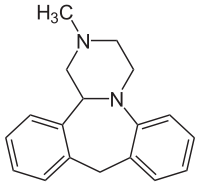 |
| Systematic (IUPAC) name |
| (±)-2-methyl-1,2,3,4,10,14b-hexahydrodibenzo[c,f]pyrazino[1,2-a]azepine |
| Clinical data |
| AHFS/Drugs.com |
International Drug Names |
| Pregnancy cat. |
B (US) |
| Legal status |
? |
| Identifiers |
| CAS number |
24219-97-4  Y Y |
| ATC code |
N06AX03 |
| PubChem |
CID 4184 |
| IUPHAR ligand |
135 |
| DrugBank |
DB06148 |
| ChemSpider |
4040 Y |
| UNII |
250PJI13LM Y |
| KEGG |
D08216 Y |
| ChEBI |
CHEBI:51137  N N |
| ChEMBL |
CHEMBL6437 Y |
| Chemical data |
| Formula |
C18H20N2 |
| Mol. mass |
264.365 |
- c42c(N3C(c1ccccc1C2)CN(C)CC3)cccc4
|
-
InChI=1S/C18H20N2/c1-19-10-11-20-17-9-5-3-7-15(17)12-14-6-2-4-8-16(14)18(20)13-19/h2-9,18H,10-13H2,1H3 Y
Key:UEQUQVLFIPOEMF-UHFFFAOYSA-N Y
|
 N (what is this?) (verify) N (what is this?) (verify)
|
Mianserin (Bolvidon, Depnon, Norval, Tolvon, Lerivon) is a psychoactive drug of the tetracyclic antidepressant (TeCA) therapeutic family. It is classified as a noradrenergic and specific serotonergic antidepressant (NaSSA) and has antidepressant, anxiolytic, hypnotic, antiemetic, orexigenic, and antihistamine effects. It was previously available internationally, however in most markets it has been phased out in favor of its analogue and successor mirtazapine (Remeron).
Therapeutic uses [edit]
Mianserin is used in the treatment of depression, such as that associated with agitation or anxiety, and has similar efficacy to the antidepressant drug moclobemide.[1]
Pharmacology [edit]
Mianserin is an antagonist/inverse agonist of the H1, 5-HT1D, 5-HT2A, 5-HT2B, 5-HT2C, 5-HT3, 5-HT6, 5-HT7, α1-adrenergic, and α2-adrenergic receptors, and also inhibits the reuptake of norepinephrine.[2][3] As a high affinity H1 receptor inverse agonist, mianserin has strong antihistamine effects. Contrarily, it has negligible affinity for the mACh receptors, and thus lacks any anticholinergic properties.
In addition, mianserin also appears to be a potent antagonist of the neuronal octopamine receptor.[4] What implications this may have on mood are currently unknown, however octopamine has been implicated in the regulation of sleep, appetite and insulin production and therefore may theoretically contribute to the overall side effect profile of mianserin.[5][6]
Blockade of the H1 and α1-adrenergic receptors has sedative and anxiolytic effects,[7] and also antagonism of the 5-HT2A and α1-adrenergic receptors inhibits activation of intracellular phospholipase C (PLC), which seems to be common target for several different classes of antidepressants.[8] By antagonizing the somatodendritic and presynaptic α2-adrenergic receptors which function predominantly as inhibitory autoreceptors and heteroreceptors, mianserin disinhibits the release of norepinephrine, dopamine, serotonin, and acetylcholine in various areas of the brain and body.
Side effects [edit]
Common side effects of mianserin may include dizziness, blurred vision, sedation, drowsiness or somnolence, increased appetite or hyperphagia and subsequent weight gain, dry mouth or xerostomia, and constipation, among others. Potentially serious adverse reactions may include allergic reaction, fainting or syncope, seizures or convulsions, and white blood cell reduction or agranulocytosis.
Discontinuation [edit]
Abrupt or rapid discontinuation of mianserin may provoke a withdrawal, the effects of which may include depression, anxiety, panic attacks,[9] decreased appetite or anorexia, insomnia, diarrhea, nausea and vomiting, and flu-like symptoms, such as allergies or pruritus, among others.
Enantioselectivity [edit]
(S)-(+)-Mianserin is approximately 200-300 times more active than its antipode (R)-(–)-mianserin.
References [edit]
- ^ Delini-Stula A, Mikkelsen H, Angst J (October 1995). "Therapeutic efficacy of antidepressants in agitated anxious depression--a meta-analysis of moclobemide studies". J Affect Disord 35 (1-2): 21–30. doi:10.1016/0165-0327(95)00034-K. PMID 8557884.
- ^ Leonard, B; Richelson H (2000). "Synaptic Effects of Antidepressants: Relationship to Their Therapeutic and Adverse Effects.". In Buckley, Peter F.; last=Waddington, John L. Schizophrenia and Mood Disorders: The New Drug Therapies in Clinical Practice. Oxford: Butterworth-Heinemann. ISBN 978-0-7506-4096-1.
- ^ Hugo Kubinyi; Gerhard Müller; Raimund Mannhold; Gerd Folkers (8 May 2006). Chemogenomics in Drug Discovery: A Medicinal Chemistry Perspective. John Wiley & Sons. p. 25. ISBN 978-3-527-60402-9. Retrieved 13 May 2012.
- ^ Roeder, T (November 1990). "High-affinity antagonists of the locust neuronal octopamine receptor". European Journal of Pharmacology (Elsevier) 191 (2): 221–4. doi:10.1016/0014-2999(90)94151-M. PMID 2086239.
- ^ Crocker, A; Sehgal A (September 2008). "Octopamine Regulates Sleep in Drosophila through PKA Dependent Mechanisms". Journal of neuroscience 28 (38): 9377–85. doi:10.1523/JNEUROSCI.3072-08a.2008. PMC 2742176. PMID 18799671.
- ^ Bour, S; Visentin V, Prévot D, Carpéné C. (September 2003). "Moderate weight-lowering effect of octopamine treatment in obese Zucker rats". Journal of physiology and biochemistry 59 (3): 175–82. doi:10.1007/BF03179913. PMID 15000448.
- ^ http://www.medicines.org.au/files/shptolvo.pdf
- ^ Dwivedi, Y; Agrawal AK, Rizavi HS, Pandey GN (December 2002). "Antidepressants Reduce Phosphoinositide-Specific Phospholipase C (PI-PLC) Activity and the mRNA and Protein Expression of Selective PLC β1 Isozyme in Rat Brain". Neuropharmacology (Elsevier) 43 (8): 1269–1279. doi:10.1016/S0028-3908(02)00253-8. PMID 12527476.
- ^ Kuniyoshi, M; Arikawa K, Miura C, Inanaga K (June 1989). "Panic Anxiety after Abrupt Discontinuation of Mianserin". Psychiatry and Clinical Neurosciences (Wiley InterScience) 43 (2): 155–159. doi:10.1111/j.1440-1819.1989.tb02564.x. PMID 2796025.
Further reading [edit]
External links [edit]
|
|
|
|
|
|
|
|
|
|
|
|
|
|
|
|
|
|
|
|
|
|
Serotonin modulators and stimulators (SMSs)
|
|
|
|
Others
|
|
|
|
|
|
|
|
|
|
|
|
Nonselective
|
|
|
|
MAOA-Selective
|
|
|
|
MAOB-Selective
|
|
|
|
|
|
|
|
|
|
|
|
|
|
|
|
|
GABAA
agonists/PAMs |
|
|
GABAB
agonists |
|
|
H1 inverse
agonists |
Antihistamines: Captodiame • Cyproheptadine • Diphenhydramine • Doxylamine • Hydroxyzine • Methapyrilene • Pheniramine • Promethazine • Propiomazine
Antidepressants: Tricyclic antidepressants ( Amitriptyline, Doxepin, Trimipramine, etc.) • Tetracyclic antidepressants ( Mianserin, Mirtazapine, etc.)
Antipsychotics: Typical antipsychotics ( Chlorpromazine, Thioridazine, etc.) • Atypical antipsychotics ( Olanzapine, Quetiapine, Risperidone, etc.)
|
|
α1-Adrenergic
antagonists |
|
|
α2-Adrenergic
agonists |
|
|
5-HT2A
antagonists |
Antidepressants: Serotonin antagonists and reuptake inhibitors ( Trazodone) • Tricyclic antidepressants ( Amitriptyline, Doxepin, Trimipramine, etc.) • Tetracyclic antidepressants ( Mianserin, Mirtazapine, etc.)
Antipsychotics: Typical antipsychotics ( Chlorpromazine, Thioridazine, etc.) • Atypical antipsychotics ( Olanzapine, Quetiapine, Risperidone, etc.)
Others: Eplivanserin • Niaprazine • Pruvanserin • Volinanserin
|
|
Melatonin
agonists |
|
|
Orexin
antagonists |
|
|
| Others |
|
|
|
|
|
|
|
|
|
|
|
|
|
|
|
|
|
|
|
|
|
|
|
|
|
* Note that MAO-B inhibitors also influence norepinephrine/epinephrine levels since they inhibit the breakdown of their precursor dopamine.
|
|
|
|
|
|
|
|
|
|
|
|
|
|
|
|
|
|
| Receptor |
|
|
- Miscellaneous: Tricyclic antidepressants (amitriptyline,
- doxepin,
- trimipramine, etc)
- Tetracyclic antidepressants (mianserin,
- mirtazapine, etc)
- Typical antipsychotics (chlorpromazine,
- thioridazine, etc)
- Atypical antipsychotics (clozapine,
- olanzapine,
- quetiapine, etc)
|
|
|
|
|
|
|
|
|
|
|
|
|
|
|
| Transporter |
|
|
| Enzyme |
|
|
| Others |
|
|
|
|
|
|
|
|
|
|
- Agonists: Azapirones: Alnespirone
- Binospirone
- Buspirone
- Enilospirone
- Eptapirone
- Gepirone
- Ipsapirone
- Perospirone
- Revospirone
- Tandospirone
- Tiospirone
- Umespirone
- Zalospirone; Antidepressants: Etoperidone
- Nefazodone
- Trazodone
- Vortioxetine; Antipsychotics: Aripiprazole
- Asenapine
- Clozapine
- Quetiapine
- Ziprasidone; Ergolines: Dihydroergotamine
- Bromocriptine
- Ergotamine
- Lisuride
- Methysergide
- LSD; Tryptamines: 5-CT
- 5-MeO-DMT
- 5-MT
- Bufotenin
- DMT
- Indorenate
- Psilocin
- Psilocybin; Others: 8-OH-DPAT
- Adatanserin
- Bay R 1531
- Befiradol
- BMY-14802
- Cannabidiol
- Dimemebfe
- Ebalzotan
- Eltoprazine
- F-11,461
- F-12,826
- F-13,714
- F-14,679
- F-15,063
- F-15,599
- Flesinoxan
- Flibanserin
- Lesopitron
- LY-293,284
- LY-301,317
- MKC-242
- Naluzotan
- NBUMP
- Osemozotan
- Oxaflozane
- Pardoprunox
- Piclozotan
- Rauwolscine
- Repinotan
- Roxindole
- RU-24,969
- S 14,506
- S-14,671
- S-15,535
- Sarizotan
- SSR-181,507
- Sunepitron
- U-92,016-A
- Urapidil
- Vilazodone
- Xaliproden
- Yohimbine
Antagonists: Antipsychotics: Iloperidone
- Risperidone
- Sertindole; Beta blockers: Alprenolol
- Cyanopindolol
- Iodocyanopindolol
- Oxprenolol
- Pindobind
- Pindolol
- Propranolol
- Tertatolol; Others: AV965
- BMY-7,378
- CSP-2503
- Dotarizine
- Flopropione
- GR-46611
- Isamoltane
- Lecozotan
- Mefway
- Metitepine/Methiothepin
- MPPF
- NAN-190
- Robalzotan
- S-15535
- SB-649,915
- SDZ 216-525
- Spiperone
- Spiramide
- Spiroxatrine
- UH-301
- WAY-100,135
- WAY-100,635
- Xylamidine
|
|
|
|
|
|
|
|
- Agonists: Lysergamides: Dihydroergotamine
- Methysergide; Triptans: Almotriptan
- Avitriptan
- Eletriptan
- Frovatriptan
- Naratriptan
- Rizatriptan
- Sumatriptan
- Zolmitriptan; Tryptamines: 5-CT
- 5-Ethyl-DMT
- 5-MT
- 5-(Nonyloxy)tryptamine; Others: CP-135,807
- Bromocriptine
- CP-286,601
- GR-46611
- L-694,247
- L-772,405
- PNU-109,291
- PNU-142633
Antagonists: Lysergamides: Metergoline; Others: Alniditan
- BRL-15,572
- Elzasonan
- GR-127,935
- Ketanserin
- LY-310,762
- LY-367,642
- LY-456,219
- LY-456,220
- Metitepine/Methiothepin
- Ritanserin
- Yohimbine
- Ziprasidone
|
|
|
|
|
|
|
|
|
|
|
|
|
|
|
|
|
|
|
|
|
|
|
|
|
- Agonists: Phenethylamines: 2C-B
- 2C-E
- 2C-I
- 2C-T-2
- 2C-T-7
- 2C-T-21
- DOB
- DOC
- DOI
- DOM
- MDA
- MDMA
- Mescaline; Piperazines: Aripiprazole
- mCPP
- TFMPP; Tryptamines: 5-CT
- 5-MeO-α-ET
- 5-MeO-α-MT
- 5-MeO-DET
- 5-MeO-DiPT
- 5-MeO-DMT
- 5-MeO-DPT
- 5-MT
- α-ET
- α-Methyl-5-HT
- α-MT
- Bufotenin
- DET
- DiPT
- DMT
- DPT
- Psilocin
- Psilocybin; Others: A-372,159
- Bromocriptine
- AL-38022A
- CP-809,101
- Dimemebfe
- Lorcaserin
- Medifoxamine
- MK-212
- Org 12,962
- ORG-37,684
- Oxaflozane
- PNU-22394
- Ro60-0175
- Ro60-0213
- Vabicaserin
- WAY-629
- WAY-161,503
- YM-348
Antagonists: Atypical antipsychotics: Clorotepine
- Clozapine
- Iloperidone
- Melperone
- Olanzapine
- Paliperidone
- Pimozide
- Quetiapine
- Risperidone
- Sertindole
- Ziprasidone
- Zotepine; Typical antipsychotics: Chlorpromazine
- Loxapine
- Pipamperone; Antidepressants: Agomelatine
- Amitriptyline
- Amoxapine
- Aptazapine
- Etoperidone
- Fluoxetine
- Mianserin
- Mirtazapine
- Nefazodone
- Nortriptyline
- Tedatioxetine
- Trazodone; Others: Adatanserin
- CEPC
- Cinanserin
- Cyproheptadine
- Deramciclane
- Dotarizine
- Eltoprazine
- Esmirtazapine
- FR-260,010
- Ketanserin
- Ketotifen
- Latrepirdine
- Metitepine/Methiothepin
- Methysergide
- Pizotifen
- Ritanserin
- RS-102,221
- S-14,671
- SB-200,646
- SB-206,553
- SB-221,284
- SB-228,357
- SB-242,084
- SB-243,213
- SDZ SER-082
- Xylamidine
|
|
|
|
|
|
|
|
|
|
|
|
|
|
|
|
|
|
|
|
|
- Agonists: Lysergamides: Dihydroergotamine
- Ergotamine
- Lisuride
- LSD
- Mesulergine
- Metergoline
- Methysergide; Tryptamines: 2-Methyl-5-HT
- 5-BT
- 5-CT
- 5-MT
- Bufotenin
- E-6801
- E-6837
- EMD-386,088
- EMDT
- LY-586,713
- N-Methyl-5-HT
- Tryptamine; Others: WAY-181,187
- WAY-208,466
Antagonists: Antidepressants: Amitriptyline
- Amoxapine
- Clomipramine
- Doxepin
- Mianserin
- Nortriptyline; Atypical antipsychotics: Aripiprazole
- Asenapine
- Clorotepine
- Clozapine
- Fluperlapine
- Iloperidone
- Olanzapine
- Tiospirone; Typical antipsychotics: Chlorpromazine
- Loxapine; Others: BGC20-760
- BVT-5182
- BVT-74316
- Cerlapirdine
- EGIS-12,233
- GW-742,457
- Ketanserin
- Latrepirdine
- Lu AE58054
- Metitepine/Methiothepin
- MS-245
- PRX-07034
- Ritanserin
- Ro04-6790
- Ro 63-0563
- SB-258,585
- SB-271,046
- SB-357,134
- SB-399,885
- SB-742,457
|
|
|
|
- Agonists: Lysergamides: LSD; Tryptamines: 5-CT
- 5-MT
- Bufotenin; Others: 8-OH-DPAT
- AS-19
- Bifeprunox
- E-55888
- LP-12
- LP-44
- RU-24,969
- Sarizotan
Antagonists: Lysergamides: 2-Bromo-LSD
- Bromocriptine
- Dihydroergotamine
- Ergotamine
- Mesulergine
- Metergoline
- Methysergide; Antidepressants: Amitriptyline
- Amoxapine
- Clomipramine
- Imipramine
- Maprotiline
- Mianserin; Atypical antipsychotics: Amisulpride
- Aripiprazole
- Clorotepine
- Clozapine
- Olanzapine
- Risperidone
- Sertindole
- Tiospirone
- Ziprasidone
- Zotepine; Typical antipsychotics: Chlorpromazine
- Loxapine; Others: Butaclamol
- EGIS-12,233
- Ketanserin
- LY-215,840
- Metitepine/Methiothepin
- Pimozide
- Ritanserin
- SB-258,719
- SB-258,741
- SB-269,970
- SB-656,104
- SB-656,104-A
- SB-691,673
- SLV-313
- SLV-314
- Spiperone
- SSR-181,507
- Vortioxetine
|
|
|
|
|
|
|
|
|
|
|
|
|
|
|
|


