 June
18th 1999 was an international day of protest, action and carnival, timed
to coincide with the meeting of the G8 (Group of Eight, most industrialised
nations) Summit in Köln, Germany. Organised under the slogan “Our
Resistance is as Transnational as Capital”, there was a massive
build up to the day, starting with a call to action “aimed at the
heart of the global economy: the financial centres and banking districts”. June
18th 1999 was an international day of protest, action and carnival, timed
to coincide with the meeting of the G8 (Group of Eight, most industrialised
nations) Summit in Köln, Germany. Organised under the slogan “Our
Resistance is as Transnational as Capital”, there was a massive
build up to the day, starting with a call to action “aimed at the
heart of the global economy: the financial centres and banking districts”.
On the day there were protests in over 40 countries. Over 10,000 people
took to the streets of Port Harcourt, Nigeria, at the same time as over
10,000 people occupied the City of London in the UK.
The heart of the beast
was transformed into a carnival and a riot, which caused millions of pounds
worth of physical damage (though apparently financial trading did not
miss a beat). It was a fantastic day…I was involved in mobilising
for June 18th from October 1998 onwards and these are my recollections
of that process. It’s just one person’s perspective. There
are many others to read, and thousands unwritten. The pamphlet Reflections
on June 18th is a good place to start. It was written soon after the event
and contains some interesting comment and analysis.
The
Idea
The idea began in the UK, ten months before the event, with the Global
Street Party (Birmingham G8 Summit in 1998, coinciding also with the World
Trade Organisation Meeting in Geneva). There were street parties and actions
in more than 70 cities across the globe.
The main objective behind the J18 mobilisation was to bring together many
diverse groups and movements around the world, to recognise that their
issues and campaigns are global: whether you are campaigning for workers
rights, wilderness defence, the environment, or animal rights; or against
the arms trade, sweatshops, third world debt, or whatever; your fight
is against global capitalism and neo-liberalism.
This objective was reflected in the name “June 18th 1999”
which was chosen to be as neutral as possible: not restricting the mobilisation
to any one political position or geographical location. The G8 wasn’t
really the issue. Though it was timed to coincide with the Summit, I don’t
remember really thinking about them much. Our battle was with global finance.
The excitement created by the J18 idea reflected a real change in people’s
political approach in the UK. To put it very, very crudely, it was part
of a switch from ‘anti-roads’ to ‘anti-capitalism and
anti-globalisation’, inspired by the People’s Global Action
Network, the Zapatistas, and the experiences of the anti-MAI (Multilateral
Agreement on Investment) campaign and the Global Street Party.
The
Structures
The main organising for June 18th was done in open monthly meetings that
happened in London, and in the weekly London Reclaim the Streets (RTS)
meetings. There were usually between 30 and 100 people at these meetings.
The work was done in ‘working groups’. A list of working groups
produced for feedback to a RTS meeting in April 1999 included:
l International Networking
l National Networking
l Accommodation
l Legal
l Media
l Website
l Radio
l Publicity/Agit-Prop
l Handbook
l Critical Mass
l Post-Action Party
l Follow on
It is interesting that ‘Finance’ is not on
this list. There must have been a lot of money behind June 18th just to
cover all that printing! Some funds (though not nearly enough) came from
benefit gigs and fundraising, but there were also substantial, anonymous
donations and the whole financial process was shrouded in secrecy. This
was partly necessary, to protect the groups that gave us money, especially
as we did not know what repression might follow the event. But I think
it was a problem because there was a lack of transparency, which created
a de facto ‘inner circle’.
I would also add ‘Logistics’ to this list. The logistics group
was the only central J18 working group that was closed. I wasn’t
in it, so I can’t say very much about it, but it was the group that
dealt with the big carnival: where to hold it, and how to move the crowd
to get there. This group was closed for security reasons. The state and
the police always try to stop RTS actions from happening, and we knew
they were very sensitive about the ‘Square Mile’ (the nickname
given to London’s financial district), so it was accepted that the
logistics of how the action would happen had to remain a well kept secret.
Believing Our Own Hype…
June 18th wouldn’t have happened if we hadn’t believed our
own hype. There was so much creativity; such ambition. I remember someone
suggested that the signal to move so many thousands of people should be
projected onto the clouds - it was rejected because “it’s
never cloudy on a Reclaim the Streets”. There were even plans to
do a fly-by leaflet drop on the City, to damage their morale and link
the financial centre to the Kosova war. We almost had the pilot and the
plane sorted, but we heard that airspace over the city is restricted (because
it’s so near the City airport) so we couldn’t do it. We were
insane really!
The very idea of an international day of action in financial centres was
extremely ambitious. To pull it off in London we needed to mobilise thousands
of people on a weekday. Even at 11am on June 18th we still thought that
the police would close the ‘ring of steel’ (the name given
to the security check points that encircle the City of London) and no
one would get anywhere near the Square Mile. But we just went for it anyway.
The theory was, if we hyped it enough, it would work, and we made it into
an historical event before it had even happened. There was even a movie
trailer, with Hollywood special effects cut together with activist video
footage: “June 18th 1999 - you’ll wish you were there…”
Publicity and Education Work
Over a quarter of a million flyers, stickers and posters were produced
by the central organising group in London alone in the run up to the event.
Local groups and single issue campaigns produced their own publicity too:
“Animal Abuse is as Transnational As Capital” and “Smash
the Arms Trade!! June 18th 1999, City of London”.
There was also a lot of time and effort put into education work, making
the links between global finance and the world’s wrongs. Corporate
Watch and RTS worked together to produce Squaring Up to the Square Mile,
a small booklet explaining global finance in simple terms: why it should
be targeted and where those targets might be found, with a colourful map
insert of the City of London. There was also a list of institutions providing
finance to corporations that might already be the target of campaigns.
Talks and video showings were held around the country.
30,000 copies of Evading Standards were also made for the day. Based on
a newspaper produced for an RTS action in 1997, this was a spoof of the
Evening Standard, designed to catch people out, thinking it was the real
newspaper. On the inside it was freeform agit-prop.
The Internet
At the time there was a lot of mainstream media crap about the new ‘internet
activists’. It was even alleged that the whole J18 process was organised
via the net by people in Köln, while people in London organised the
Köln demonstrations. Of course, this is quite ridiculous. The vast
bulk of the work done to prepare for J18 was good old-fashioned legwork.
There were hundreds of thousands of leaflets to distribute and hours of
face-to-face meetings. The international and national networking groups
spent hours stuffing envelopes and posting snail mail letters to groups
around the country and around the world, to get them involved.
That said, we did make considerable use of the internet and it was - and
is - vital to international networking as we know it. (There’s been
a lot written about this, so I’ll spare you). The central organising
group met only once a month, so e-mail was used extensively to communicate
between meetings. Texts for publications such as Squaring Up to the Square
Mile and Evading Standards were all co-edited by groups of people, passing
the texts back and forward via e-mail, with changes and suggestions.
There was also an international e-mail discussion list, which was a total
nightmare! It was dominated by individuals from the global North who seemed
to have nothing better to do than sit at their PCs flooding our inboxes
with utter garbage political debate. Frankly we should have been much
clearer about what the list was for and then just kicked anyone off who
didn’t stick to that. I think we were uncomfortable about being
authoritarian and out of order, but the reality is that some positive
discrimination in favour of groups with less internet access (for example
those in the global South) would have made the list far more egalitarian
and constructive.
Perhaps the most exciting use of the internet was the media working group’s
Indymedia project.
Media
‘The Media Debate’ is a perennial thorn in the side of activist
movements, at least in the UK. There is a fierce contradiction between
the desire to get our message out and a total hatred of working with the
scum capitalist press, who twist our words, ignore the issues and publish
names and photos that could get people sent to jail.
A group of people wanted to work on media stuff: others wanted to have
nothing to do with the media. I remember the debates got quite tedious
and entrenched very quickly. In the end it was sort of accepted that some
people were going to do media (and other people were going to disapprove)
so there wasn’t much point arguing about it: a media working group
was formed. This isn’t a very satisfactory resolution of the issue,
but it was a quick fix that wasn’t too much of a disaster.
The main thing the media group did was a web-based video streaming project.
There was a media centre in London, working together with groups in Australia.
For the first time, reports of global events were transmitted over the
internet. Street reporters on bikes and motorbikes roved the City, taking
footage and couriering it back to be put straight out on the net, using
innovative software that later became the backbone of the Indymedia network.
We also made considerable use of the borderline alternative/mainstream
magazine The Big Issue in the run up to the event. It was sort of a trade
off: we gave interviews and information, and they published a feature
edition on the protests. It included a lot of total crap, but it got the
important information (meet-up times and places, basic issues and website
address for more information) out to their estimated four million readership.
After the event, the media impact was phenomenal. The story just didn’t
drop out of the press for months afterwards. right wing headlines screamed:
“Hate Filled Anarchists Destroy City of London”. The liberal
press lamented, somewhat less accurately, that a few misguided anarchists
had hijacked a really rather nice drop the debt demonstration (they never
did get it!). After the initial shockwaves had died down, the term ‘anti-capitalist’
was wrenched from the realms of the old left and became this exciting
new phenomenon discussed in all the broadsheet comment and analysis pages.
Then began a trial by media; the naming and ‘shaming’ of the
‘leaders’ of the movement. Some people (foolishly, I believe)
agreed to do interviews about their role; these were (unsurprisingly)
twisted and used against them and others. Other people were hounded by
the press, doorstepped and scrutinised.
It came back again when the press had their own protest, when the police
demanded that they hand over their footage of the protests for evidence
purposes and they refused. (But remember, they can’t be relied on
to do this!!!)
Personally I think J18 was pretty painfully misrepresented in the media.
They ignored, or misunderstood the “Our Resistance is as Transnational
as Capital” bit, and there was little or no mention of the international
nature of the event. At the end of November when anti-capitalism was back
in the headlines, they failed to make the connection between J18 and the
scenes coming out of Seattle.
I think it would be useful for any group working on press for a future
mobilisation in the UK to take a close look at the press coverage of J18,
and the actual presswork done by the media group. I think that any press
release material was ignored. I also believe that the whole event would
have received little or no coverage if it hadn’t been for the ‘violent’
scenes on the day. I believe it was actions and events which kept the
issue alive in the media for a very long time, not a ‘press effort’
in the traditional, activist sense of a press office, press releases etc.
Autonomous Day of Actions
The UK part of J18 was focused on the City of London - calling for people
to travel from around the country and do decentralised, autonomous actions
on the same day, in the same Square Mile. However, it was felt that there
had to be some centralised action for people to take part in if they had
come without an affinity group, without knowledge of the area or without
experience of action. So, the idea for a mass Carnival Against Capitalism
was born. The aim was to have autonomous actions in the morning and then
come together at noon for the main event.
One criticism of the day was that the Carnival was such a massive, spectacular
project that it took the steam out of the autonomous, decentralised part
of the day. This worked in two ways. Firstly, many people did not want
to risk arrest in the morning, because they didn’t want to miss
the afternoon’s event. Secondly, an action on that scale required
the participation of pretty much all the networked direct action affinity
groups in the country to pull it off. Most people with experience of action
and keyed into the process ended up taking on roles; facilitating the
crowd to the destination, providing sound systems etc.
Nonetheless, there was an impressive list of autonomous actions that took
place in the morning, with a co-ordinated attempt to shut the City by
closing tube lines and bridges at 7:30am to coincide with a Critical Mass
bike ride, as well as pickets and occupations of individual financial
institutions, street theatre, graffiti and paint bomb actions.
The Carnival Against Capital
This was a massive logistical project. The plan was to split the crowd
into four groups, to confuse the police. Eight thousand carnival masks
were produced in advance, 2,000 each in Red, Green, Black and Gold. On
the back of the mask was a poetic text about the importance of carnival,
rebellion, and masking up. There were also instructions to follow the
coloured streamers that matched your mask.
There were several affinity groups with different roles to ‘facilitate’
the event. I think there were four groups of ten people to guide the crowd,
each equipped with coloured streamers, maps and mobile phones, with instructions
to find people they knew and trusted in the crowd, brief them and give
them streamers. Then there were groups driving sound systems and materials
in vehicles.
The night before, at least 50, probably closer to 100 people knew the
plan and final destination for the Carnival, yet the police evidently
did not. This suggests that, at the time at least, their power to infiltrate
our networks was limited.
Of course, on the day the planned military precision of synchronised watches
and funky signals was a bit of a flop. The gold masks went out too early.
The plan to have half the crowd inside and half outside the station concourse
was nearly a total disaster because of people’s natural tendency
to want to hang out in the sun. Half the red group just wandered off,
seized by that crowd momentum that sometimes takes over, and roamed without
any destination until they were quite brutally attacked by the police.
The Mission Impossible theme tune that was our signal to move was inaudible
above the crowd noise, so we had to resort to old-fashioned blast horns.
The two groups that were supposed to make the first leg of their journey
by underground were foiled by the police shutting down the tube, and had
to navigating a haphazard route to the scene with A-Z maps. As a result
the first group arrived at the scene too early and had to keep protesters
off the road and traffic flowing so that the materials vans could get
in!
Nonetheless, the action was a pretty spectacular success. This probably
had a lot to do with the complete collapse of police communications. They
had a communications structure going through one central point. This hub
could not handle the traffic created when the crowd split into what was
actually five groups (counting the split away red group) and police all
over the Square Mile radioed in “They’re here!”
It is difficult to know how much of this was down to internal police politics
(inter-force rivalry between the Met and the City police meaning that
actually it probably suited the Met quite nicely if the policing was a
disaster). But it does show that it is impossible to underestimate the
power of the unexpected. Innovative and imaginative plots to foil police
attempts to stop your action happening are absolutely priceless, and really
good fun too!
It is fairly typical of Reclaim the Streets events that there was an intricate
and complex plan to get people to the Futures Exchange, and that was it.
After that everyone (and no-one) was in control. There was no central
committee directing people, despite attempts by press, police and courts
to suggest there was. Some things may have been planned by people involved
in organising the event: the opening of the fire hydrants, the bricking
up of the Futures Exchange doors (not the bricking in - before the place
was smashed up there was actually a wall built over the door!).
Squaring Up to the Square Mile was later accused, by press and police,
of directing people to destroy things. In fact, it was simply an educational
tool, explaining what different institutions did and where they had their
offices. But people brought their own creativity and anger.
In fact, the attack on the LIFFE building, which saw protesters getting
to within just feet of the actual trading floor came as a (fantastic)
surprise. One anonymous writer summed it up:
“We’d failed in our under-ambition. Unprepared, we never imagined
we could get so close to occupying a trading floor in one of the City’s
major exchanges. We’d planned the wall, and built it. We’d
planned to free the Walbrook, and done it. But we’d stopped short
of planning a full-scale occupation.” (We Are Everywhere, Verso,
2003)
The myth that spectacular events like the Carnival Against Capital just
happen entirely spontaneously is, in the case of J18, just that: a myth.
There was a phenomenal amount of planning that went into it. However,
there was also a lot of spontaneity and for me it’s that combination
that made it really special. In a lot of ways I don’t think any
of us believed how successful it actually was, how many places and different
groups took part around the world and how big a deal it became in the
media and in helping to change people’s thinking.

Repression
We were very scared about what the fallout from J18 could be for the people
involved in the organising. There was a lot of hype about finding the
‘organisers’ of the riot, who were portrayed as men (sic)
in suits with mobile phones who instructed the crowd what to smash up.
But that’s just garbage: it’s not what the logistics group
or anyone else involved in organising actually did. The police and media
did manage to target and harass a few individuals, but the overall repression
of people involved in organising was relatively light.
More serious was the hunting down of people who took part in the rioting.
Only 16 people were arrested on the day. Another 50 had been arrested
by the end of the year. There are more CCTV cameras per square metre in
the City of London than anywhere else in the world, and 60 officers were
employed full-time to go through 5,000 hours of video footage. The police
set up a website, with 138 pictures, appealing for people to come forward
and identify the rioters. Regular checks of the site saw people’s
faces disappearing and the label “Now Identified” replacing
the image. One man was tracked down from DNA left in blood on a riot van.
Several people did serious time for charges linked to J18 in London and
the legal and prisoner support for these people was not given the attention
it deserved. Our resistance is only as strong as our prisoner support,
and the state can really fuck us if we don’t stand together, so
I hope that any future mobilisations will learn this lesson - the same
lesson as must be drawn from the far more serious repression that followed
Genoa, Thessaloniki and other subsequent anti-capitalist events.
Follow on: International vs. National
Networking
On the list of working groups I quoted from above there was a note at
the bottom that the ‘National Networking’ and ‘Follow
On’ groups were desperately in need of more people. This is very
significant. Both of these groups struggled and were kept going by people
who were not so close to the de facto inner circle I described earlier.
The sexy, exciting part of the J18 mobilisation was the international
element, and the organisation of the Carnival in London. Nowhere near
as much energy or funding went into the establishing of meaningful networks
at a more local level in the UK. People from outside of London were marginalised
by the process, especially if they were not prepared to travel regularly
to the capital.
I remember there was only one person in London working on the ‘what
next?’ aspect of the event - what would happen to the hundreds of
people who would hopefully be inspired by their experiences of June 18th
and want to go on to do more and ‘get involved’? As a result,
the main problem with June 18th 1999 was that it was just a day.
There were follow-through projects that grew out of J18. A number of broad-based
activist forums for sharing information about local radical activity flourished
- The London Underground, Brighton’s Rebel Alliance, NASA in Nottingham,
Manchester’s Riotous Assembly and several others. Some of these
forums are still running but most have had a chequered history, and in
general I think that the years following J18 were not a period of strength
for radical social movements in the UK.
Conclusions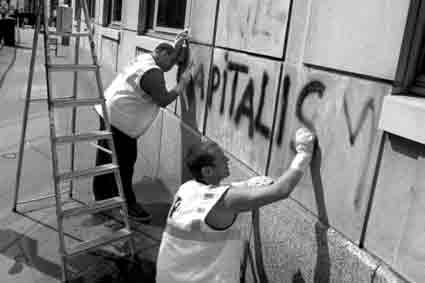
There is only so much that can be learned from how J18 was organised.
J18 and the many other successful and inspiring anti-capitalist events
in recent history were produced by a free flowing convergence of events
and political currents combined with sheer luck. The political culture
of the time and place were key. To just reproduce these structures and
processes, in a different context, won’t produce the same results.
As we got ready on the morning of June 18th, a friend turned to me and
said “I’m scared. We’re intensifying struggle and we’re
just not ready for this…” and in a lot of ways they were right
- we weren’t.
It was great and inspiring to do something so momentous and crazy, but,
as far as networks in the UK are concerned, it feels to me like it all
sort of fizzled and burnt out in the months and years that followed. In
some ways this probably wasn’t our fault: in the same way that we
can’t just reproduce the J18 structures and have the same effect
today, I’m sure there are many factors that can cause a downturn
in radical activity, most beyond our control. However, I think that if
the psychology of J18 had been more focused on building networks of resistance
that went beyond June 18th 1999, the long-term impact of the event in
the UK could have been much greater.
On the other hand, at a global level, J18 was a massive success. The sheer
audacity of it was vital to the future of anti-capitalist mobilisation,
giving confidence to activists preparing the anti-WTO (World Trade Organisation)
demonstrations in Seattle and the anti-IMF (International Monetary Fund)
protests in Prague. I think that J18 is also unique in the recent history
of anti-summit mobilisations. It was not focused on a single geographical
location, attacking a summit: instead it targeted global finance, with
decentralised actions. Any group could take part, wherever they were.
The most significant lesson I would take from J18 is the importance of
pushing boundaries. It may seem obvious to say it, but one of the main
strengths of the anti-capitalist movement has always been its diversity,
creativity and originality. When we mobilised for J18, ‘anti-capitalism’
was a relatively new concept. We pulled it off because it was almost completely
unexpected.
Since 1999 there have been many major anti-summit events; but, if the
anti-capitalist ‘movement’ is going anywhere, it has got to
keep moving. We have around nine months to mobilise against the G8 Summit
in the UK in 2005 and I think we should be looking at where we are politically:
how can we interact with the unprecedented international movement against
the Iraq war? How can we work with the particular political and geographical
situation we have here, in the UK? Where do we want to be a year after
the G8 have gone? We have the opportunity to push the boundaries and make
the 2005 G8 mobilisations a positive, pivotal event in the development
of the global anti-capitalist movement.
Repression
Five years on, at least two
people remain in prison for their actions on J18. Rob Thaxton was sentenced
to 88 months in a US jail after throwing a single rock at a cop whilst
trying to avoid arrest. James Borek pled guilty in January 2004 to Section
20 Unlawful Wounding (GBH) and two violent disorder charges, plus an additional
charge of skipping bail in 2000. He received a four and a half year sentence.
Both would appreciate and deserve our solidarity.
MCCF, Rob Thaxton, #12112716,
4005 Aumsville Hwy, Salem, OR 97301, USA
Donations to and information from:
AAA, PO Box 50634, Eugene, OR 97405, USA
James Borek, LL6803, HMP Blundeston, D-108, Lowestoft, Suffolk NR32 5BG,
UK
 Resources
and Further Reading Resources
and Further Reading
*The Squaring up to the Square
Mile booklet containing information about how the City works, produced
by Corporate Watch during the run up to J18 is available at: www.corporatewatch.org.uk/publications/squaringup/intro.html
*Reflections on June 18th was a pamphlet produced post-J18 with some very
interesting reflection on the politics behind the day of action. It can
be found online at: www.infoshop.org/octo/j18_reflections.html
*An excellent collection of articles about June 18th, the process behind
it, what took place on the day - in the UK and around the world - can
be found in Do or Die Issue 8, p.1-34. See: www.eco-action.org/dod/
BACK
TO TOP
|


