

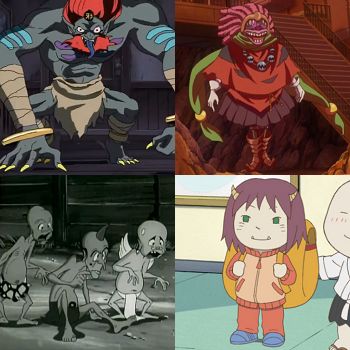
"What've you got?"note
Amanojaku (天邪鬼) is a type of Oni characterized by their physical might, vileness, and manipulative nature. Its appearances in Japanese folklore vary, but it consistently acts in opposition to morality, order, and self-interest. At times, it acts as a corrupting force. It employs a variety of tactics, such as mind-reading, possession, and impersonation (dressing up in stolen clothes, disguising itself on a murdered human's skin, and magically mimicking others' voices).
Modern depictions of the Amanojaku show it to be obsessed with contrariness to the point of predictability, making it easy to beat them via Reverse Psychology. For example, if accosted by one, telling the oni how happy one is with its company will cause it to vanish. In youkai-centric works, amanojaku are usually prey to self-contradiction, preventing them from acting consistently or in accordance with social expectations.
Amanojaku has roots in Shinto. Its most commonly accepted origin (found in the Kojiki and the Nihon Shoki) links it to the vassal kami Amenosagume, who misinterpreted the gods' pheasant messenger to be a bad omen, therefore causing Earth's ruler Amewakahiko’s death when he angered the gods by shooting it. Other legends connect the amanojaku with Amanozako, an obnoxious goddess regarded as the ancestress of wicked youkai, including the Tengu. Fittingly, "zako" (ざこ) translates as "opposing all".
In Japanese Buddhism iconography, amanojaku symbolize wickedness and appear as defeated, monstrous creatures beneath sculptures of Bishamonten and the Four Heavenly Kings. Alternatively, the amanojaku appear as faces on their armor. It's assumed this role is due to syncretism with the early Buddhist interpretation of the yaksha.
As a result ot the above, this youkai's etymology is fairly complicated. "Amanojaku" translates as "heavenly evil oni" and can be decomposed into "ama no" (which references Amenosagume, Amanozako, and contrariness) and "jaki" (linked with evil and power). Related to the latter is "akki", a wicked oni. All three terms broadly denote oni trampled by the Four Heavenly Kings, further muddying distinctions between classic amanojaku and other oni (e.g., the lantern-carrying Tentōki and Ryūtōki niō; Niranba and Biranba of the Ten Rakshasis).
In Japanese folklore, the Amanojaku is a key character in the legends that explain why some plants have red roots (seen in Urikohime and the Amanojaku) or the reason behind the peculiar shapes of rock formations (seen in Atmanojaku no Kasaneiwa).
Sub-Trope of Always Chaotic Evil. It might be a Consummate Liar, and think Bad Is Good and Good Is Bad. See also The Corrupter and Commander Contrarian. Some interpretations do away with the oni's physical strength and portray it as The Imp.
Examples:
- Dororo: In the 1969 anime-original episode 14, Dororo is tricked into freeing three amanojaku who are stuck as temple statues by overturning the warrior gods stepping on them. The amanojaku are human-like with a notable aberration each: one has a horn, another a tail, and the third wings. They cause chaos through mischief, but help out when they accidentally free a carnivorous and truly evil youkai. Nonetheless, Hyakkimaru cuts off their horn, tail, and wings to return them to their places at the bases of statues.
- Dororo (2019): In episode 19, an amanojaku is freed from the war god temple statue that served as his prison. He is about half the size of a human, has red skin, and has a tall head from which several stumps protrude. He makes the entire village act and speak opposite of what they intend, which almost gets Hyakkimaru to abandon his quest and kill Dororo when the amanojaku gets a hold of him too. Munetsuna timely sneaks up on the youkai and knocks him out. Afterwards, he's sealed back on the statue's base.
- GeGeGe no Kitarō: Amanojaku and jaki are treated as separate youkai starting with the 2007 anime iteration.
- Amanojaku is a recurring enemy of Kitaro in all adaptations. He is usually defeated by having a boulder dropped on him or a statue placed on top of him. In the 1996 anime, a reference is made to Urikohime and the Amanojaku when Amanojaku abducts a girl named Yurika to eat her.
- Jaki are slug-like youkai in Episode 69 of the fifth series. They are under control of Anagura-Nyūdō and stick to people to feed on their motivation. They cannot be removed, but they'll let go voluntarily if someone with more motivation is nearby to feast on them.
- Ghost Stories: Amanojaku is the main youkai of the series. He encounters the protagonists in the old school building at a time when he's harmless. He gains power from human fear, though, and with five specimens running around, it's easy to get the emotional energy to become a giant monster quite capable of killing them. The protagonists attempt a ritual to seal Amanojaku inside the old camphor tree behind the school, but because it's been chopped down, the ritual instead traps the youkai inside Kaya, the protagonists' pet cat. With no immediate solution from either party, Amanojaku stays with the children as a familiar and comes to care for them. During the final battle against Ohma, he manages to free himself from the feline body and chooses to fight his fellow youkai to buy the children time to gather the spiritual energy needed to seal Ohma. It's implied that due to the ritual, Amanojaku gets sealed in another camphor tree, but he's okay with that.
- Hanada Shounen Shi: In episodes 13 & 14, Ichiro is forced by an amanojaku to travel 13 years into the past to prevent a mistake. Back then, the amanojaku made a man drunk on the day he was supposed to conceive his child. The delay affected the child's gender from girl to boy, and for this grave intrusion on the child's destiny, the amanojaku became locked inside him. With trial & error, the winning tactic is to convince the past-amanojaku that he should keep the man from going home, which prompts him to send the man home, and then banish the amanojaku with a big hug because his kind doesn't like love. Ichiro is pulled back to the present when he succeeds, but instead of thanking him, the amanojaku insists Ichiro owes him for taking so long.
- Hell Teacher Nube: Nube's class receives a transfer student named Yuka in Chapter 88. Yuka is androgynous, and her behavior leaves much to be desired. Whenever someone asks for something, she pulls an Exact Words. Nube suspects she carries an amanojaku with her and corners Yuka to pull the youkai out. Yuka insists that he's just holding a doll and that she's always been like this, after which she doubles down on her behavior. It all comes to a head when she witnesses Nube banish a jibakurei and has to acknowledge obake exists. From then on, she does her best to get along with her classmates. Nube reflects on this good ending because that amanojaku he pulled from her really just was a doll, and Yuka's social problems were purely psychological.
- Hozuki's Coolheadedness: After the incident with the pheasant, the goddess Amenosagume became the very same Amanojaku that went on to kill Urikohime. As a goddess, she can't be punished in Hell, but she can be banished there. Hozuki assigned her to Amanojaku's Den, the area for people who were contrary or incited others to be so, as the worst overseer the sinners can encounter. In modern day, Amanojaku has perfected her obnoxious nature by means of social media and especially likes flaming. By her own request, Urikohime is also an employee in Amanojaku's Den so she may punish the people who behave like her killer. She invites Rurio over because she feels a kinship between them: not only is Rurio a companion of her peer Momotarō, he's also a divine pheasant like the one killed through Amenosagume's machinations. Rurio goes along with it and, to Urikohime's delight, violently headbutts Amanojaku for irritating him.
- Naruto: One of the Wood Release attacks is the Wood Human Technique. This generates a huge wooden oni with a dragon wrapped around him in resemblance of Ryūtōki. Wood Human Technique is in some capacity a stronger form of Wood Dragon Technique, which only summons the wooden dragon. The oni is capable of normal combat, but can also spawn more dragons to sic at the opponent.
- Noramimi: In Chapter 24 and Episode 4, an old acquaintance of Noramimi drops by named Cinnamon. She's a fellow oni, but unlike him, she's an amanojaku. She looks like a human with horn and whiskers, and she's very tiresome because she can't ever make up her mind or do what she proclaims she'll be doing. She's also a bit of a trickster and aims to make it big as a stand-up comedian.
- Nura: Rise of the Yokai Clan: One of the inhabitants of Tōno Village is an amanojaku named Awashima. He has a male form by day and a female one by night, which he's not too fond of because he considers himself male at all times.
- Sailor Moon: In episode 11 of the Black Moon Arc, Ail summons a Cardian named Amanju. Despite Cardians being unable to disobey him, this one always does something other than what he orders her to do, like draining ducks when he tells her to drain humans. After causing some uncoordinated ruckus, she's defeated by the Sailor Senshi, and Ail just never figures out why she supposedly didn't obey him.
- Saint Seiya: Jaki is a very oni-looking giant of a man who, on orders of the Pope, attacks Eagle Marin. When he fails to squash her by throwing a boulder, they grapple. Just as Jaki is about to crush her to death, Eagle Marin causes both of them to tumble off a cliff. She shows up later, while Jaki seems to have died from the fall.
- Takeo-chan Bukkairoku: An amanojaku by the name Wakahiko inhabits a shrine fronted by a statue of Bishamonten trampling an amanojaku. There's some implication that the youkai and the statue are the same being because Wakahiko is dressed as a guardian himself and hates Bishamon. Years ago, he overheard a group of people talking about the dead cherry tree next to the statue and, as a prank, made it bloom in winter. Among the group was a little girl named Uriko, who was so delighted that Wakahiko repeated his prank every winter. However, because youkai can only exist through grudges and the prank evolved into a gift, Wakahiko had to stop to save himself. Three years later, Uriko intends to marry at the shrine and is confident the tree will bloom for her as it's always done in the past. Takeo, unaware of Wakahiko's self-preservation, tricks the amanojaku by ordering it to do nothing at the wedding. She's told the truth the next day and begs Wakahiko to leave the tree alone, forgetting for a moment that an amanojaku will always do the opposite. Content, Wakahiko accepts that this is his end and gifts Uriko a blooming cherry tree for her wedding day.
- Tokimeki Mononoke Jogakkou: Akina is a formerly human amanojaku enrolled at a high-school for Yōkai. Compelled to be a Consummate Liar, she can force herself to tell the truth—doing so to warn the somewhat airheaded Arare not to let their classmates know she's a human.
- Yokai Doctor: An amanojaku child travels to Earth by lightning bolt to be treated by Gokukuji in Chapter 2. Kotoko offers to nurse the cute little thing to health, but despite all her efforts like foregoing sleep to play sugoroku and bearing the amanojaku's pranks, the amanojaku only ever tells her she sucks and that everyone hates her. Kotoko snaps, assures them the feeling is mutual, and orders them to buzz off. The amanojaku does, but returns with Gokukuji, who belatedly explains to Kotoko that amanojaku speak in reverse truth. Realizing the child's affection for her, Kotoko happily exclaims that she "hates" them.
- YuYu Hakusho: In Chapter 18 (Episode 5), Jyaki is a small blu eoni that enters Sakamoto's mouth and possesses him, which is spiritually visible from the horns the young man grows on his head. Jyaki worsens Sakamoto's behavior as a gang leader until Yusuke banishes and apprehends them. As a wanted criminal, the creature is handed over to Botan and Koenma.
- Legend Of The Millennium Dragon: Among the oni taking up arms against Genun's army is Amanojaku, whose unmasked form is a little boy.
- Destiny The Tale Of Kamakura: The Big Bad Tentōki is modeled after the folkloric one, but is different in several ways. Firstly, he's a bad guy. Secondly, the "tō" in his name doesn't use the kanji for "lantern" but for "boss". And thirdly, he can change into a quadrupedal dragon-like creature. He wishes to marry Akiko and has been going after several of her incarnations, but she always ends up with Masakazu. This time, he arranges for her soul to be whisked away to the Afterlife while Masakazu is distracted by another spirit inhabiting Akiko's body. When Masakazu inevitably figures everything out and comes to save Akiko, they escape the overconfident oni by jumping out of the window and making a run for it. Tentōki takes on his dragon-like form and catches up with them shortly after they've boarded the train home. He takes Masakazu hostage to force Akiko into marriage, but the two humans are saved by Binbōgami, whom the couple had shown hospitality to earlier. Tentōki is left having to wait for the next incarnation.
- Joji And The Amanojaku: While on vacation, Joji comes across a female scarecrow in distress. There's an amanojaku named Nojak around who plants thornbushes in the rice fields to sabotage the harvest. Joji disguises himself as the other scarecrow and instructs the crows that he'll trick Nojak into planting all the thornbushes he has tonight, and they are to pull them out immediately. The plan succeeds.
- Kakuriyo: Bed and Breakfast for Spirits: Ōdanna is a jaki, which is a type of youkai known to dwell in temples and has such a bad reputation that no other youkai want to associate with them. As such, Ōdanna keeps his identity a secret. Ōgondōji found him as a child on the spot where Tenjin-ya would later be built and took him under her guidance, which made him the upstanding man he is today. In Volume 4, he even fights and kills a jaki that attacks Aoi at the Dragon Palace, ignoring the villainous jaki's recognition and subsequent argument that as kin they should be on the same side.
- Shadow of the Fox: Amanjaku are tiny demons fighting against the protagonists.
- The Zashiki Warashi of Intellectual Village: Shinobu is at the center of a CIA project to control reality by means of an amanojaku. Unbeknownst to Shinobu, the amanojaku has been installed at his right temple, courtesy of the oni's ability to wear another's skin. It operates through Shinobu's perception of reality and makes him change it by writing the Singer Song Liar story. After the CIA's plan is uncovered, Shinobu deduces where the amanojaku is located and takes a knife to his own head to cut it out. After the first cut, the amanojaku expands from the wound to stand as an oni of less than a meter tall. It has disheveled hair, two horns, and Shinobu can't make out whether it even has a sex. Despite the amanojaku's creepy demeanor, Shinobu reasons that it was forced to do what it did by the CIA and lets it go. The amanojaku declares it isn't grateful, which Shinobu figures means it probably is grateful.
- Akumaizer 3: In Episode 20 of Choujin Bibyun, a group of young youkai fans perform a ritual to summon one from the Youkai Daihyakka. What they get is Amanojaki, a bunch of floating skulls. Amanojaki proceeds to attach skulls to the heads of the children to turn them into minions, but the children inherit Amanojaki's contrariness and do not obey properly. Once Bibyun shows up, Amanojaki generates a humanoid purple body covered in swirls to do battle. It is defeated when it throws its weapon at Bibyun, and Bibyun swings his sky sword to flip Amanojaki's weapon right back at it.
- Guru Guru Medaman: Amanojaku is one of the six heroic obake protagonists. His body is totem-like and easily falls apart, but the separate pieces still function and can even fly. Amanojaku strongly believes that obake should act like obake and not adopt human customs, and overall he's confrontational and uncooperative unless there is an emergency. In times of crisis, he's a valuable and reliable teammate.
- Ninja Sentai Kakuranger: In episode 33, Sasuke's cousin Kosuke is tricked into removing the iron pole that kept an amanojaku trapped inside a temple. He abducts (but claims to have killed) and disguises himself as the head priest in order to distribute mind-altering mushrooms to make everyone in the village act contrary and in some cases even hostile. In a further nod to Urikohime and the Amanojaku, inedible persimmons are handed out at the police station. Because the amanojaku kept the mushrooms away from Kosuke as a thank-you, Kosuke is able to inform the Kakurangers of what's going on. The amanojaku is defeated in battle, and the head priest is freed soon after. He appears in Mighty Morphin' Power Rangers as "Marvo the Meanie".
- VOCALOID: The song series "The Fox's Story", also known as the "Onibi Series", features an Amanojaku named Shikyou, whose name translates to either "death" or "misfortune" and who is played by Kagamine Rin. She serves as the series' main antagonist and cuts off poor Mai's head and sends it to Akari in a basket as punishment for Mai and her mother, Ryou, not believing in gods or supernatural beings.
- Japanese mythology and folklore:
- Amanojaku no Kasaneiwa: There's an area on Mount Futakami in Okayama that is littered with boulders. This area is called Amanojaku no Kasaneiwa or The Amanojaku's Pile of Rocks. The legend goes that an amanojaku wanted to reach the heavens, either to be there or to take the stars for themself. They gathered many rocks and arranged them into a tower, but the tower toppled, and the rocks were left as they are today.
- Hashiguiiwa: There's a series of rocks going out into the sea in Wakayama called Hashiguiiwa or The Bridge Pillar Rocks, named so because they look like the abandoned pillars of a bridge that was never finished. There's a legend attached to it that explains that the Buddhist monk Kobo Daishi made a bet with an amanojaku that he could build a bridge from Kushimoto to Oshima in one night. A tall order, but it did seem to the amanojaku that Kobo Daishi was going to win. To stop him, the amanojaku imitated a rooster's call. Kobo Daishi believed that the morning had come and therefore gave up, leaving the bridge forever unfinished.
- Otohime: The chaotic daughter of Emperor Tenji, Otohime, gets cast into the sea at Shibushi in Kagoshima for her mischief. So, she raises Biro Island overnight and goes to live there. After a while, she wants to either return to shore or visit the deity living on Gongen Island just off the coast, so she makes a deal with another deity that she'll be allowed her path if she can finish building one before morning. An amanojaku makes a rooster crow early, tricking Otohime into giving up and living in loneliness on Biro Island. At low tide, the remains of the path are still visible.
- Urikohime and the Amanojaku: Urikohime's parents leave her alone at home and warn her not to open the door for anyone in their absence. Their warning is no match for the amanojaku's treachery, and once inside, it forces Urikohime out of her clothes. Depending on the version, it might also kill her, don her skin and clothes, and hide the body by eating it. If not, then the Amanojaku ties her up outside in a persimmon tree and makes do with the clothes as disguise. The amanojaku convinces Urikohime's parents at first that they're their beloved child, but a bird or Urikohime herself warns them of the deceit. The amanojaku is slain, and its spilled blood is why the roots of the millet are red.
- Buddhism:
- Tentōki and Ryūtōki are a pair of jaki (evil spirits) who share quite a lot of similarities with the amanojaku. They were also defeated by the Four Heavenly Kings and appear in religious sculptures, the most notorious case being a set of 13th-century wooden statues by Kōben. After their defeat, the two oni converted to Buddhism, this being the reason why they are portrayed as niōnote holding lanterns that symbolize the Buddha and his teachings. Tentōki is the more lively posed of the two, carrying the lantern in his left hand. He's red, has two horns and three eyes, and represents the agyō. Ryūtōki is a stately figure but for the dragon coiling around his neck. He holds its tail with the right hand while the left one holds the other wrist. He has spiky eyebrows, his color is green, and he represents the ungyō.
- Another duo of ambiguously jaki can be found at the base of statues of Tobatsu Bishamonten in which he's held up by the goddess Jiten while she is flanked by two members of the Ten Rakshasis: Niranba and Biranba. Unlike other jaki, they aren't being trampled and appear as a retinue.
- Future Card Buddyfight: Lesser Fiend, Amanojaku is a The Dark Lord's Rebirth monster card and looks like a blue-skinned elvish thief with a horn on his forehead. He belongs to the Katana World and has the Oni Assassin attribute.
- Malifaux: Officially, Asami Tanaka is one of the Masters of the Ten Thunders. In truth, it's Amanjaku who's calling the shots. He is a short, blue-skinned creature with large horns, and the one that turned Asami into a futakuchi-onna to serve as a builder of bodies for the oni to take up residence in. Asami wants to be rid of him, but so far he always convinces her they make a good team. Included among their best warriors is Ama No Zuko, named after the goddess and possibly an amanjaku too.
- Princess: The Hopeful: "Amanojaku" is the name carried by Dreamlanders who hijack human bodies for their own use. They're considered the lowest of Dreamland'69s citizens, and before their workings were discovered, they were thought to be parasitic entities. Their modus operandi is to enter a human's dream, and if in the dream they manage to catch their target's self-image, they throw it into the Dreamlands while they take control of the body. This leaves the human stuck as an inhabitant of the Dreamlands while the amanojaku has to painstakingly learn to live as a normal human.
- Yu-Gi-Oh!: There are two amanojaku-based cards. The first is Reverse Trap (Amanojaku no Noroi in Japanese), which is a trap card depicting a shaman-like ghost. It reverses all effects that add or subtract to the attack and defense values. The second is Amanokujaki, a light-attributed monster card based on a portmanteau of amanojaku and kujaku (peacock), ending in "jaki" because that is the pronunciation of the kanji when it doesn't directly follow on "amano-". It's a humanoid monster with horns and peacock tail feather bat wings.
- Cross Road: Niccolò Paganini playfully calls himself this when the religious angry mob comes after him for his Deal with the Devil, calling his music evil. "You know, I'm sort of an Amanojaku, so when you tell me not to play, that just makes me want to play. So how about it, want to try getting cursed?" But when he starts to play for them, his devil, Amduscias stops him — a violinist can't risk injuring their hands, as Niccolò told his student Asha right before the angry mob showed up.
- Akanesasu Sekai de Kimi to Utau: Amanojaku is one of the youkai inhabiting Naraku. He plays the blue oni to pretty much all of his peers, putting brains before brawn.
- Ayakashi: Ghost Guild: Amanojaku is a female oni that loves nothing more than doing the exact opposite of what she's ordered to do.
- Crush Pinball: Following on aliens and devils, Jaki Crush is themed around jaki. They're the main obstacles, but other evil creatures show up too.
- Darkstalkers: The Night Warriors: The combatant Bishamon is designed around the amanojaku-faced armor the Buddhist deity Bishamon wears. The combatant Bishamon's armor, Hannya, is alive because it's infused with a Makai beast and even has a separate skeleton. Paired with the sword Kien, Hannya tries to take control of Bishamon, but Bishamon is still fighting back. The Palette Swap Oboro Bishamon is Bishamon when he is in full control of Hannya and Kien.
- Dragon Quest VII: The cheeky devil (Amanojaku in Japanese) is a monkey-like golden devil who's part of the Demon Family. It has three lines: one about food, an attempt to convince the protagonist to give up, and a piece of advice not to listen to a thing it says.
- Fate/Grand Order: Amanojaku is an event villain who is said to be an evil god. It jumps between people to bring out the negative emotions they harbor in the darkest corners of their hearts. It was sealed away in an Izumo providence shrine.
- Final Fantasy XIII-2: Amanojaku are rare enemies that look exactly like and appear alongside the notsugo. They're encountered in the Bresha Ruins. Neither look nor act like their folkloric namesakes.
- Icchibanketsu -ONLINE-: Amanojaku is a mischief-making man who falls under the ayakashi race and whose type is samurai. He is armed with four katanas. In combat, he benefits from strong resistance against physical attacks.
- Ken Ga Toki: Tentōki and Ryūtōki belong to the marebito grouping and are brothers. Tentōki claims to be the eldest, and Ryūtōki doesn't object. In any case, Tentōki is the dominant one, but the quiet Ryūtōki can be surprisingly sharp-tongued. Tentōki lacks his third eye, and Ryūtōki's eyebrows are switched out for a single horn. He has both a dragon curled around his neck and a dragon tattoo from his legs to his shoulders.
- Momotaro Densetsu:
- Amanojaku is a recurring enemy and party member in the series. He's a thin cephalothorax with messy hair and a single horn modeled after Kazuhiko Torishima. He does stuff like stealing at random, changing the train destination at random, and temporarily changing the name of other players. In games in which he's playable, such as Momotaro Densetsu Gaiden, Amanojaku is hard to control because any instruction can lead to multiple outcomes, one of which is picked at random. There's also a stronger Palette Swap named Amanojaku Z. He wears a crown over his horn and is never a party member.
- Ryūtōki is a villain who abducts three children and is fought in a boss battle inside a cave. He combines traits of both the folkloric Ryūtōki and Tentōki. He looks like and poses as Tentōki, but his colors are Ryūtōki's, and instead of a lantern, he holds a dragon up in his left hand.
- Ōkami: Hostile imps (Amanojaku in Japanese) come in five classes: green, red, yellow, blue, and black. They wear masks with the first katakana of the Iroha sequence, are monkey-like in movement, and most carry an instrument with them. The green one has a flute, the red one a shamisen, the yellow one a kendama, the blue one a kite, and the black one a small drum. Neutral imps also wear masks, although the merchant's version doesn't contain katakana but the kanji for "merchandise".
- Ōkamiden: Hostile imps (Amanojaku in Japanese) come in five classes: green, red, yellow, blue, and black. They wear plain masks and paper hat, are monkey-like in movement, and most carry a toy with them. The green one has a paddle (and explosive ammo), the red one a spinning top and a nail-augmented paddle, the yellow one a large drum, the blue one claws, and the black one small mallets. Neutral imps are encountered in both the past and the present. Of note are Aji and Umami, the cooks of Orochi.
- Onigiri (2014): Both an amanojaku and references to Tentōki and Ryūtōki are present.
- Amanojaku is a Vanguard Swap partner recruited during the "Oni in Onigashima" quest. He's stolen beans from Izuna and needs to be tracked down in the Onigashima shrine, where, after a good trouncing, it's revealed he's an old friend of Izuna and, unlike what he'd let everyone think up until that point, a boy. Although he is an amanojaku, he's kind-hearted and, to his own annoyance, a terrible liar.
- Tentōki and Ryūtōki are represented by the Tōdaiki class of youkai. The name "tōdaiki" derives from a youkai that's an enchanted human with a candle on their hand. This youkai is commonly posed in a way very similar to Ryūtōki. In the game, Tōdaiki resemble Tentōki minus his lantern. They are said to have carried around a lantern in the past, and that if they'd reacquire them, they'd be even stronger. Variants are the blue Frost Tōdaiki and the green armored Tadakatsu. A boss version named Tentōki also shows up. They've got four horns, are blue, carry a club, and still have their lantern. Despite the bestiary stating it's accepted Buddha's teachings, it is hostile.
- Onmyōji (2016): The imps with horns and cards in front of their faces are amanojaku. Ranked from weak to strong, they come in the colors green, blue, yellow, and red. The green one attacks with a paddle. The blue one is female, scratches her opponents, and flies a kite to boost her allies' speed. The yellow one rides a drum and either throws his drumsticks or beats a tune to up the chance for his allies to land a critical hit. The red one is pure brawn. He throws his entire body into an attack or spanks his own butt to direct fire his way and force the enemy into using normal attacks.
- Onmyoji~Heian Yokitan~: Amanojaku and Komanojaku are sisters who look like humans with sideway horns. "Koma" is written with the kanji for "small room", contrasting the expanse of "ama"/"heaven". They're miko. Amanojaku always goes against what others say and do, and with her onusa, she can force others to go against themselves. Komanojaku looks up to her big sister and tries to be like her, but for now, she's just too honest.
- Oreca Battle: Amanojaku is card B07-051 and depicts three blob-like creatures: an angry red one, a happy green one, and a sad blue one. They're brothers, and each is stuck with a singular emotion. This alone would be annoying enough to others, but they also always say the opposite of what they mean. They're of the earth element and belong to the Kaminari Mei no Gekirin set.
- Pokémon: Malamar is a sadistic Dark/Psychic Pokémon resembling an upside-down squid, which has the power to control minds. Its signature abilitynote "Amanojaku" (localised as "Contrary") causes any changes to its stats to be inverted — e.g. seeing an enemy with Intimidate will raise its Attack instead of lowering it.
- Shikihime Garden: Amanojyaku and jaki are treated as separate youkai. There's also a hime known as Amanosagume who is closely related to amanojyaku.
- Amanojyaku is a red-haired hime with two horns. She has a white snake for a pet that she usually has wrapped over her shoulders, and she drags a huge club with axe blades with her. Her description states she can never be honest, and she furthermore is of the axe-attribute, has access to Reverse as her special skill, which makes one stronger if the ATK is low, and can be obtained either through a summon or by matching Enma with a Killing Stone Avatar. By putting her through an Eight Gods Awakening, Kei Amanojyaku is unlocked. She's available in the variants Setsubun, Christmas, and Chibi.
- Amanosagume is a pink-haired hime with two horns. She's mechanical and herself the founder of all demon clans, but she refuses to divulge who made her. Her weapon of choice is a giant meat cleaver. Like Amanojyaku, she is of the axe-attribute and has access to Reverse as her special skill, which makes one stronger if the ATK is low. She can be obtained either through a summon or by putting Amanojyaku through a Five Element Awakening. Using another Five Element Awakening turns Amanosagume into Cho Amanosagume. She's available in the variant Chibi.
- Jaki is a purple-haired hime with two horns. She's a demon of curses and carries around an axe. She is of the axe-attribute and has no special skills. She can be obtained from a summon, a Pattern Quest, or by upgrading Akki or Momijigozen. She's available in the variants Christmas and Chibi.
- Akki is a blue-haired hime with two horns who spreads disease and misfortune. She has no special skills and is armed with an axe and therefore is of the axe-attribute. She can be obtained from a summon or a Pattern Quest, and she's available in the variant Cosmos and Chibi. By putting her through an Eight Gods Awakening, Kei Akki is unlocked.
- Shin Megami Tensei: Amanojaku are recurring monsters in the series. Depending on the game, they belong to either the Jaki race or the Ogre race.
- Shin Megami Tensei I: Amanojaku make their debut in the form of a boss battle. Said boss, true to Urikohime and the Amanojaku, disguises themself as a police officer, probably by killing a human and wearing their skin. With some manipulation, they are allowed in by the protagonist's mother, whereupon they eat her and disguise themself as her to trick the protagonist into letting his guard down. The disguise is of little value because the protagonist and his friends see right through it, and the amanojaku doesn't survive the subsequent battle.
- Devil Children: Fire Book & Ice Book: Amanojaku is encountered while wailing on Mecchii for his reluctance to enter battle against the Devil Children. He turns his ire on them as they approach, but is defeated and killed.
- Devil Children Messiah Riser: Amanojaku flees when the Imperium opens attack and returns when they're defeated.
- Touhou Project:
- Touhou Kishinjou ~ Double Dealing Character: Seija Kijin is a creature of contradiction, so such an extent that even her name literally means "Rightwrong Onihuman." In the game itself, she wants to stage a revolution, overthrow the social hierarchy, and put the weak at the top. Not because she cares about those at the bottom, but rather just as an expression of her contrarian desire to see the world flipped on its head. Her special ability is also The Power To Turn Over Anything, with which she can invert the player's controls and flip the screen. After her defeat, her story continues in Danmaku Amanojaku ~ Impossible Spell Card, where she is the Villain Protagonist. She no longer uses her switching-around powers — because doing that wouldn't be very contrarian of her — and the game's story ends with her losing all of her friends and allies, but she's fine with that because that's just how it is for an amanojaku. Unlike typical amanojaku, ZUN has explicitly stated that Seija isn't an oni however. Rather, she is the opposite of a typical Touhou oni who are renowned for their Super-Strength and Honesty while Seija is notorious for being a Consummate Liar who gets by on dirty tricks to compensate for her weakness.
- Touhou Kanjuden ~ Legacy of Lunatic Kingdom: Sagume Kishin is a Lunarian Goddess. She is named after the deity Ame-no-Sagume and is, according to Word of God, part celestial god, part terrestrial god, and part amanojaku. In complete contrast to Seija, who is a liar who acts in opposition to the world, Sagume is a Cosmic Plaything who finds the world itself acting in opposition to anything she says in a bid to turn everything she says into lies, and therefore she doesn't speak very much.
- Yo-kai Watch: Contrarioni (Amanojaku in Japanese) is a Yo-kai that belongs to the Shady Tribe. He has yellow skin, two stacked eyes, and a horn. He makes people argue with each other no matter what the subject is or what the person truly thinks, and operates on Bizarro Universe rules, such as only crossing at traffic lights when they're red and waiting when they're green.
- Star vs. the Forces of Evil: The Japanese title for the "Naysaya" episode, in which Marco blurts embarrassing things due to a curse by Tom, is "Amanojakku". Additionally, the title entity is a demon who will only release Marco if he reveals his darkest secrets.