

Rorschach (Walter Kovacs)

Click here to see him without his mask.
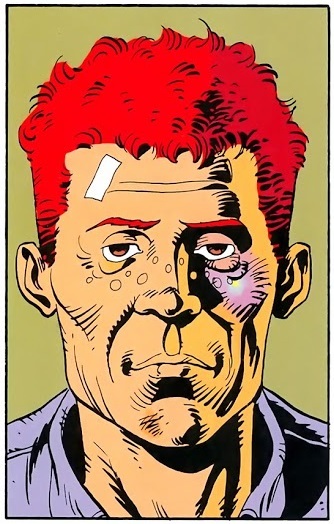
"This city is dying of rabies. Is the best I can do to wipe random flecks of foam from its lips?"
Voiced by: Titus Welliver
"The accumulated filth of all their sex and murder will foam up about their waists and all the whores and politicians will look up and shout 'save us'... and I'll look down and whisper 'no'."
The only non-government superhero still active as of the beginning of the book, Rorschach is a ruthless, disturbed vigilante who believes the world to be falling apart around him. He speaks in fragments and lives like a bum, having devoted his life almost entirely to fighting crime — and it's his devotion that allows him to pick up the trail of a man's mysterious death...
Back to the main Watchmen character page.
- Abusive Parents: His mother was certainly a horrible parent who beat and emotionally abused poor Walter on a daily basis. How bad was she? When informed of her death, Walter only had one thing to say: "Good."
- Allegorical Character: Like Ozymandias with the Sea Captain, one of the characters in the Show Within a Show Tales of the Black Freighter is symbolical of Rorschach. In his case the black and white-spotted shark quote: “How shall I describe it? It was massive, like no shark I'd ever heard tell de, with skin neither black nor wholly white, but a pale and mottled yellow”. The shark like Rorschach is pure undisciplined savagery that tries its best to prevent the efforts of the misguided hero (who seems to recognise it), but is ultimately used by its cunning opponent to reach their goal, albeit with horrific results that both the Sea Captain and Ozymandias come to regret. The connection also comes in the form of the Mondegreen Gag with the police offer mishearing his name on the phone as “Raw Shark”.
- All of the Other Reindeer: Some bullies show this to Rorschach and he goes berserk on them.
- Anti-Hero: Rorschach is one of the best and most famous examples in comic books.
- The Anti-Nihilist: Rorschach believes that rules and principles are the most important in life because the world has no more meaning than the one we impose on it. Alternatively or overlaps with Übermensch.
- Anti-Role Model: You would think from the Watchmen fanbase that he's an intelligent badass to aspire toward, but many new readers were taken by surprise at how the story goes out of its way to subvert how how Rorschach sees himself — far from being a master detective, he's made as repulsive, disturbing and ineffective of a protagonist as possible without making him outright unsympathetic as a way of spelling out how unglamorous, dangerous and insane a real life Vigilante Man would be. He's a mental basketcase, a ruthless and violent sociopath with a rigid and arbitrary moral code, has strong reactionary views and is homophobic and sexist, is plain looking at best if not ugly and takes poor care of his physical health, and is clearly not a people person in any sense of the word. On top of that, he's not even all that smart, acting mostly on hunches and assumptions instead of seeking out actual evidence or questioning his own theories.
- Audience Surrogate: Moore intended Rorschach to explore the adolescent mindset of the traditional comic book story, and Rorschach largely shares that attitude and tries to enact it in a more realistic setting. This makes him immediately relatable and identifiable to superhero comic fans in the early part of the book. However, from the fifth issue, the focus shifts away from him to Dan Dreiberg and Laurie, who become The Everyman figures from the middle to the end of the book.
- Artistic License – Biology: Rorschach is nearly destitute, lives in squalour, and has an appalling diet. Yet he still somehow possesses a fairly muscular physique, and is physically fit and strong enough to fight both hardened criminals and the police, including a SWAT team when Veidt sets up a trap for him at Moloch's house.
- Asshole Victim: Downplayed as he was killed because he was unwilling to go along with Veidt’s ruse and to let him get away with murdering three million people. However, he was still a misogynistic and psychotic bigot.
- Ax-Crazy: He is borderline insane at times and is extremely ruthless with his brutality against criminals, with his extreme methods of killing. Such as when he angrily murdered the child abductor and his dogs. Even as a child, he was moderately unhinged, but fully embraced his homicidal sociopathic side when he became an adult.
- Badass Boast: Rorschach's boast is the trope image."None of you seem to understand. I'm not locked in here with you. You're locked in here with me."
- Badass Bookworm: Rorschach has a very prose-like way of monologing in his narration and was a bright student in his youth and is quite talented in gymnastics and amateur boxing, leading him into becoming a capable crimefighter, despite his flaws.
- Badass Longcoat: More evocative of pulp heroes.
- Badass Normal: He is, among other things, more badass than the Antarctic itself, enduring the bitter cold and what had to be some severe wind chill on one of Nite Owl's hoverbikes with no superpowers and no more protective equipment than the same overcoat and hat that he wore around New York. Without even a shiver. And then, after the big reveal but before his death, he starts to walk out into the same Antarctic weather, in the same clothes and with no easy route home, with his intention to reveal Veidt's crime even if he has to walk home to do it. Never compromise, indeed.
- Bash Brothers: With Nite Owl.
- Bat Deduction: Deconstructed quite conclusively. While we are initially led to believe that Rorschach may be some kind of master pulp detective with a great gut instinct, it quickly becomes clear that he bases his prevalent "mask-killer" theory entirely on assumption rather than evidence. Every person he tries to warn points towards more obvious and compelling answers, only for them to be ignored. While his gut instinct that Blake's murder was the start of a larger conspiracy proves correct in a sense, he fails to consider the sheer scale of it until it's far too late.
- Be Careful What You Wish For:
- His quote above. He feels the complete opposite when New York is destroyed.
- He is also mentioned as being on the giving end of this trope with Captain Carnage, a masochistic supervillain who picked fights with superheroes so that he could get off on being beaten up by them. When Carnage tried his act on Rorschach, the latter obliged him by throwing him down an elevator shaft.
- Becoming the Mask: Initially played straight. ("NO! MY FACE! GIVE ME BACK MY FACE!") Later averted; see Dying as Yourself.
- Beneath Notice: Aside from his allies, no one would've thought that a crazed masked vigilante would be a homeless vagrant carrying around a sign that warns people about the end of times.
- Berserk Button: He has a few of them.
- Never ever steal his face. See above.
- He also really doesn't like being called "Walter".
- Never make fun of him when he's "investigating", unless you wish to be the next subject of his Jack Bauer Interrogation Technique.
- In fact, just don't threaten or disrespect him at all.
- Don't ever call or even slander him a pervert, as his former landlady would have been in serious trouble if it weren't for Rorschach backing off due to her children.
- Berserker Tears: The final panel of Kovacs before his death depicts him sobbing in a crude mixture of rage and despair.
- Black-and-White Insanity: Rorschach's devotion to his ethos is so strong that he can't accept any form of compromise. The fault in his philosophy is shown early on, as his patriotism and admiration for the Comedian's persona and combat record make him accept the attempted rape of Sally Jupiter, who Rorschach considers to be a whore, as a moral lapse of an otherwise upstanding citizen, even though he is later shown to consider rape a perfectly good reason to kill someone. He also applauds President Truman's dropping the Atomic Bomb on Japan as it ended a world war, but decries Ozymandias' doing the same to New York for the same reasons, and is determined to make Veidt answer for this "evil". That last moment of inflexibility leads directly to Rorschach's death.
- Black-and-White Morality: Symbolically displayed through his mask, which is described as how he sees the world: through an extreme filter of black and white. Other characters find it more like Black-and-Gray Morality.
- The Blank: The whole idea behind his mask.
- Blood Knight: Rorschach is hinted to be this. Upon seeing a woman about to be mugged and raped, Rorschach had this to say about the assailant:Rorschach: The man turned...and there was something rewarding in his eyes. Sometimes the night is generous to me.
- Bold Inflation: Aside from the ill-fated Crimebusters meeting (which took place long before the 1975 kidnapping case, which completely redefined him), the only instances where he spoke like this are when he was unmasked by the police and when he goads Dr. Manhattan into killing him.
- Boxing Battler: He has extensive training in boxing and can easily send thugs sprawling with a single punch. It's understated, however, as he is savvy enough to favor tactics, psychological warfare and the odd Improvised Weapon over Good Old Fisticuffs.
- Breakout Character: He is easily the most popular and influential character in the comics, with some people viewing him as the protagonist. This is especially true for Jackie Earle Haley's interpretation, which remains one of the most acclaimed things about the 2009 film. Before Doctor Manhattan's role in Rebirth, Rorschach was the most consistently used character of Watchmen in DC comics, appearing through cameos in Kingdom Come and The Question trying to imitate him in one of his issues (and calling him a loser for his ineffective methods). He is also the protagonist of the licensed Watchmen game.
- Brutal Honesty: Rorschach makes no secret of what he really thinks of his former teammates and how he sees them as soft and uncommitted, and openly insults the older generation and how they ended up. It's one of the many reasons no one can stand being around him.
- Bunny-Ears Lawyer: Weird though he is, he's feared by the criminal underworld for good reason. Nite Owl described him as "tactically brilliant", and this is not an Informed Ability, as we see for ourselves that Rorschach is able to make excellent use of his environment against both the police and the other prisoners, managing to hold his ground and inflict rather outsized damage despite lacking any actual weapons. He's also introduced by showing up at a crime scene and locating evidence within minutes that the police couldn't find after hours. That said, his obsessive behavior and eccentricity do work against him pretty regularly.
- Butter Face: A Rare Male Example. Has a very muscular and athletic body, but from the neck up, he's rather unattractive. Plain-looking at best. Dr. Long even notes that he is in excellent shape for his age and lifestyle while describing him as "fascinatingly ugly".
- Byronic Hero: As flawed as he is, Rorschach is a very relatable character. An outcast and loner even among his superhero "peers", intelligent but embittered due to his experiences, introspectively brooding, strong in his personal beliefs, and a total refusal to compromise on anything, Rorschach is the exemplar of a Byronic hero in comic books.
- Bystander Syndrome: Inverted. He beats up thugs who have harmed people he's never met and idealizes people he doesn't know (Kitty Genovese, Harry Truman, etc.) but loathes virtually everyone he does know. Familiarity breeds contempt, indeed.
- The Cassandra: Downplayed. Rorschach is right that there is a larger conspiracy behind the murder of the Comedian, but completely wrong about what it is. He believes this to be a plot to eliminate superheroes, both retired and active, and goes around warning his fellow masks as a result. Due to his anti-social disposition, nobody takes him seriously until efforts are made to take Dr Manhattan and Ozymandias out of the equation. Perhaps they should have, at least about there being a vast conspiracy of some sort afoot, as despite his evident personality defects Rorschach is a resourceful amateur detective who has spent years on the street investigating crime and putting away wrongdoers in his own brutal way. As a matter of fact, the actual mastermind behind the conspiracy - Ozymandias - finds Rorschach to be enough of a threat to engineer the murder of Moloch and frame him for it to get him out of the way. The ending of the comic also gives Rorschach a posthumous chance to either be this, or the hero who exposed Veidt's homicidal scheme, as a journalist from the far-right tabloid New Frontiersman reaches for his diary in search of something to publish from the crank file...
- Celibate Hero: He's freaked out beyond all recognition about anything to do with sex, due to child abuse. He has a massive madonna-whore complex and mentions once that he was "offered Swedish love and French love but not American love [by prostitutes]," however you want to interpret that.
- Child Prodigy: After being put in foster care and away from his abusive mother, he accelerated as a student in academics, particularly literature and religious studies, and was impressive in gymnastics and amateur boxing.
- Civvie Spandex: Being an Expy of The Question and Mr. A.
- Clueless Detective: Not as blatantly obvious as most examples, but the Scientific Method is clearly an alien concept to Walter. Owing to his uncompromising, paranoid personality, his method of deduction involves coming to absurd conclusions and trying to find sufficient evidence later. He flatly dismisses his former teammates' much more plausible theories as to how the Comedian died. As a result, he spends most of the plot on a wild goose chase after an imaginary superhero killer.
- Coat, Hat, Mask: He sports the basic outfit, but with a head-covering mask (as opposed to the standard domino) with a shifting black-and-white pattern that initially inspired his moniker.
- Combat Pragmatist: Rorschach goes into every fight with one aim: to neutralize his opponents as quickly and comprehensively as possible, and he is ingenious at using whatever is around him to achieve this aim. When trapped in Moloch's house with a SWAT team hammering on the door, he improvises well enough on the fly with household items and his grappling gun to hold them off and make his escape through a window, though he then gets overwhelmed by sheer numbers and arrested. In prison, he incapacitates a would-be attacker with hot oil while unarmed in the chow line, and easily deals with Big Figure's two goons using nothing more than cloth, an electrical cable, and the toilet in his cell.
- Conspiracy Theorist: He started as an Expy of The Question, who in the DC Animated Universe was a saner Expy of Rorschach.
- Cool Mask: Made from a failed prototype for a designer dress. Contains black and white fluids, sandwiched between thin layers of latex, which move in response to heat and pressure but never mix into grey.
- Cop Hater: Rorschach doesn't think highly of the police, seeing them as weak on criminals, just like other heroes, and having little issue assaulting them to make his escape, and made numerous anti-police remarks during the passage of the Keene Act, which has led to cops hating him back, brutally beating him during his capture.
- Corrupted Character Copy: Of The Question and Mr. A, whom Rorschach was specifically based on. Moore also puts in elements of Batman, noting that "he would be considered a nutjob in real life" and in another interview he clarified Rorschach as "Batman without the excuses". There's more than a little of Travis Bickle in his journal entries, too. (Also confirmed by Moore.) When Steve Ditko was asked about Rorschach's similarity to his own heroes, he confirmed it as well, saying, he was "Like Mr. A, except insane."
- The Cowl: As the main Terror Hero who works as a vigilante operating outside the law to bring down criminals when the police are inept.
- Creepy Good: Rorschach is firmly on the side of justice and despises criminals, but suffers from a horribly severe case of Black-and-White Insanity, to the point he literally cannot properly function in normal, modern society.
- Creepy Monotone: Represented in the comic by all of his dialogue being in italics and without the bolded words that other characters' lines have to indicate emphasis. Laurie lists his monotone as one of the things she just finds creepy about him.
- Cynicism Catalyst: The kidnapping and death of Blair Roche (see Despair Event Horizon).
- Dark Is Not Evil: His childhood is akin to any Serial Killer’s backstory, he has horrible and shallow views on women, and he creeps the hell out of everyone he knows. Nonetheless, his actions throughout the comic are for the sake of righteousness, and by the end, he comes off as the moral one compared to Veidt, who can be considered Light Is Not Good.
- Deadpan Snarker: On the rare occasion that he expresses any form of humor, it's this. Particularly with Big Figure ("Small world"). Also, when a therapist attempts to evaluate him with a Rorschach test.
- Deathly Unmasking: In the finale, Rorschach is the only member of the team unwilling to cooperate with Adrian Veidt's plan for utopia - only for his attempted exit to be brought up short by Doctor Manhattan. Unable to fight his way out but refusing to compromise "even in the face of Armageddon", Rorschach doffs his hat and distinctive shifting inkblot mask - opting to be without his "face" in his final moments - and tearfully demands that Manhattan get it over with. Manhattan obliges.
- Death Before Dishonor: Rorschach, by far the most morally unyielding of the team, cannot let all the villainy that's occurred for Veidt's plan to work go unpunished - though he knows that blowing the whistle will result in a possibly apocalyptic reignition of hostilities, and since Veidt has Doctor Manhattan on his side, there's no chance of stopping the supervillain anyway. In the end, Rorschach unmasks and all but orders Manhattan to kill him.
- Death Seeker: Alan Moore says he is. He finds it.
- Deconstructed Character Archetype: Rorschach is one for Steve Ditko's characters like Mr. A and The Question, and to a lesser extent, Batman. While Mr. A and the Question were treated by their narratives as truly uncompromising good guys, Rorschach pretends to be uncompromising despite compromising his stated values all the time, and he's a terrible human being for it. He despises rapists and kills them without remorse, but his patriotism and admiration for the Comedian's persona causes him to overlook the rape of Silk Spectre I, Sally Jupiter, who Rorschach considers to be a whore, leading him to dismiss the crime as a "temporary moral lapse" of an otherwise upstanding American citizen. He decries Ozymandias' plan to wipe out New York City, while he previously praised President Truman dropping nuclear bombs on Japan, as it ended a world war. He admires Blake's acts as a government employee and doesn't think terrorism, murder of dissidents, and political assassinations fall under his own category of bad behavior. Rorschach's unshaking belief in his own worth over society's norms leaves him living as a hobo, impossible to employ, sleeping in the street, eating trash, and breaking into his friends' houses to eat cold beans stolen from the fridge. His most advanced gadget is a Batman-like zipline pistol originally made by his partner, Nite Owl II.
- Deconstructive Parody: Moore intended him to parody many of Steve Ditko's characters, especially his objectivist characters Mr. A and The Question. Similar to Mr. A, Rorschach subscribes implicitly to an objectivist viewpoint, i.e., Black-and-White Morality, atheism, and that anyone with such a viewpoint can act as judge, jury, and executioner. As Moore points out, such characters are in fact shaped and defined by entirely subjective experiences, and the only way they can maintain their viewpoint is via Psychological Projection, paranoia, and living in certain denial. His rational belief in his own worth over society's norms leads him to live the life of a hobo, since he is unemployable, poor, and unbalanced, and believes that anyone with some level of comfort and achievement is a Sell-Out and "prostitute" (his term for "looter").
- Despair Event Horizon: He crosses it when his investigation into the little girl's kidnapping reveals the kidnapper had butchered her and fed her to the dogs. He kills the dogs and then traps the kidnapper in the building, which he sets on fire. It was Kovacs who went into that place; it was Rorschach that came out
- Determinator: Even after he jumps out a window, which is at least five stories up, he lies on the ground telling himself to get up while the police kick him unconscious. And then some. Even more impressive in the movie version as he does get up and proceeds to beat down several more cops before he's finally overwhelmed. Later on, he repeatedly keeps on attacking Ozymandias, despite having just received a brutal Curb-Stomp Battle from Veidt alongside Nite Owl.
- Disappeared Dad: Rorschach's father walked out on his mother before he was born and never made any attempt to contact his son, even after he was removed from his mother's custody. Despite this, Rorschach idolizes him and considers him to be a good man—seemingly out of spite towards his mother, who often disparaged her ex.
- Does Not Know How to Say "Thanks": Nor how to apologize, as he tries to do so with a handshake.
- Does Not Like Guns: Nite Owl says that Rorschach didn't shoot Moloch because that way of killing someone is too ordinary. Presumably, this is why Rorschach chose to improvise when he was cornered by the police instead of picking up the gun. The gun was also empty, and Rorschach only kills criminals; crazy as he is, he doesn't bear ill will against police officers, and only fights them at all in order to escape.
- Does Not Like Women: From his poor experiences with his mother.
- The Dog Was the Mastermind: A rare Anti-Hero version. Rorschach's identity was mostly a secret until it was revealed that he was the guy who carried a "THE END IS NIGH" sign.
- Do Not Call Me "Paul": "You keep calling me Walter. I don't like you." His therapist eventually starts writing "Rorschach" in his notes, a sign that his patient is getting to him.
- Doomed Moral Victor: Played With. Rorschach is so horrified by Veidt's actions that he feels compelled to reveal the truth, even when Doctor Manhattan threatens him with death, and even when revealing the truth could doom the world to a nuclear apocalypse. Rorschach demands that Manhattan kill him, suffering a mental breakdown all the while — as even at this point, he refuses to compromise.
- Dramatic Irony:
- Rorschach’s throwaway Secret Identity of the New York Beggar with a Signboard proclaiming “The End Is Nigh” is horribly ironic, given the comic ends with the deaths of three million people in New York and an uncertain and likely destructive future for mankind. The end was nigh indeed.
- In his edgy opening monologue (see above), Rorschach claims the “vermin” of New York, from the whores to the politicians, will eventually drown in their collective filth, and when they ask him to save them, he’ll “look down and whisper no”. When the said population of New York is killed by Veidt, Rorschach is horrified and full of tearful grief for the millions that he failed to save, and refuses to lie and let their killer get away with his atrocities, even if that means dying himself.
- Rorschach idolises the Comedian as a “true patriot” who, according to Rorschach, never let anyone retire him, never cashed in his reputation, and never buckled in his beliefs. In actual fact, the Comedian was as pathetic and despicable as any other rapist Rorschach deals with every night, had a Freak Out and retired upon discovering Veidt’s master plan, and was too cowardly to reveal what he had uncovered to the government. The Comedian was the opposite of everything Rorschach held him up as.
- Relatedly, Rorschach defending the Comedian from Laurie’s justified hatred over his attempted rape of her mother, Sally, in the past, is very ironic in hindsight, considering the Comedian is actually her father.
- The Dreaded: Everyone is absolutely terrified of Rorschach, even his teammates. This is seen in the very first issue of the comic maxiseries when Rorschach enters the bar, and the bartender begs him not to kill anyone. And in one scene, he is feared even more than Dr. Manhattan. Where the rioters argue with Manhattan, Rorschach disperses crowds with his mere presence. And this is throughout the entire Lower East Side.
- Dying Alone: We don't even know how Dreiberg reacted or if he even cared about his ex-partner. Averted in the film, as Dreiberg follows Rorschach in an attempt to dissuade him from exposing the truth, only to witness in horror as Manhattan kills him. He then proceeds to pummel Ozymandias (who started all this crap) in the face, who, to his credit, does not resist.
- Dying as Yourself: Rorschach takes his mask off just before Dr. Manhattan kills him. Confirmed by Alan Moore who believed that it "is not the mask talking, it's not Rorschach, it's the actual human being [Walter Kovacs] that is somewhere under there."
- Entertainingly Wrong: His investigation of The Comedian's murder is doomed from the start because of his very wrong assumption of a masked killer - an old villain trying to kill superheroes and a conspiracy that will endanger his old gang. Veidt enables this assumption to throw him off his trail and send Rorschach to jail. It's only after he teams up with Dan Dreiberg, who questions his assumptions, that they make real headway.
- Everyone Has Standards:
- Despite Rorschach's fanaticism and brutality, he isn't without some restraint. He doesn't bust Moloch for using illegal cancer medication, and he later spares the landlady who lied about him to the press, recognizing that she is simply a desperate woman who wanted to help her kids. As brutal and unsympathetic to criminals as he is, it's implied that he mainly focuses on serious crime and saves his wrath for murderers, rapists, muggers, and the like, although most petty criminals would probably rather steer clear of him entirely than test that assumption out.
- Also, Rorschach is the one who stops Nite Owl from beating the innocent Knottop to death.
- For all his elaborate conspiracy theories, he does find his brief consideration of the mask killer being an elaborate Thanatos Gambit to be absurdly outlandish.
- Rorschach spends much of his narration making misanthropic observations about the world at large. He even states that when the "accumulated filth of all their sex and murder" reaches its apex, he won't stick around to act as anyone's savior. But when he witnesses Veidt's plans come to fruition, he is horrified beyond words and immediately goes off to avenge the very same people he spent most of the story denigrating.
- Expecting Someone Taller: A variant. Upon being captured by the police, they are surprised (and a little disgusted) to find that he wears platform shoes to appear taller than he really is.
- Exposed to the Elements: Upon making landfall in the Antarctic, Rorschach refuses to change into anything more insulating and doesn't seem overly bothered by the sub-zero temperatures.
- Expressive Mask: And how. Though the mask is just abstract patterns, the artwork does show there are consistent "expressions" to it. For example, it has the same pattern in moments of shock and surprise. The mask does more than cover his face; to Rorschach, it is his face. His actual face, in contrast, is like a mask; his expression rarely changes. The black and white splotches in his mask never mix, representing his morality. For him, there is only black and white, never gray.
- Extreme Melee Revenge: Anything he does. A vengeful prisoner gets his face burned, and a masochistic "villain" is thrown down an elevator shaft. Rorschach does not half-ass his responses.
- Face Death with Dignity: How he goes out. He does not beg for mercy and refuses to compromise. Also overlaps with Face Death with Despair; the final shot of Kovacs doesn't depict him as a stoic hero staying true to his beliefs in the face of death, but rather as a fundamentally broken man sobbing in pure rage and despair.
- Failure Hero: His biases and flawed reasoning repeatedly prevent him from uncovering the nature of The Conspiracy. Rorschach is tragically too late to stop Veidt's schemes, and is so horrified by it that he instigates his own death through Doctor Manhattan. That being said, Rorschach‘s journal that he sent to New Frontiersman may result in Veidt’s crimes being exposed.
- Fatal Flaw: His absolute refusal to compromise his principles or accept shades of grey ends up leading to his death:Rorschach: No. Not even in the face of Armageddon. Never compromise.
- The Fettered: Kovacs' demonstrates a dark fulfillment of this archetype while exploring some of its weaknesses. Kovacs' principles are all that matter to him; the good must be protected, and the evil must be punished, no compromise or nuance allowed. His moral code prescribes protecting the innocent while ruthlessly punishing the guilty, and to him, the line between the two is crystal clear, symbolized by his black-and-white mask. But problems and cognitive dissonance arise when he proves willing to dismiss wrongdoing committed by those he respects and rationalize crimes against those he does not. When he's finally confronted with his own failure to completely live up to his standards and faced with a dilemma he can't solve just by appealing to his code, he breaks down.
- Fiery Redhead: He has red hair and is an extremely brutal and volatile vigilante. Unlike most examples of this trope, though, he's more of a Tranquil Fury type of guy.
- Fingore: His favorite method of inflicting pain and getting information is to break people's fingers until they start talking. It usually works.
- Foil: To Ozymandias. Both Kovacs and Veidt are ultimately unstable Übermensch who are unflinching in doing what they think is right, no matter what the cost. They just play it in very different ways.
- The Friend Nobody Likes: Before crimefighting was outlawed, he seemed to get along relatively well with his costumed peers, albeit with some criticism of his methods. After going rogue and a healthy dose of Sanity Slippage, however, his former colleagues grow largely disgusted and disappointed in his brutality, rotten attitude, and reckless vigilantism. Even Nite Owl, formerly his closest ally, is unsettled by his old friend's worsening mental state, and Rorschach's sociopathic tendencies and abrasive attitude begin to put a strain on their partnership when they reunite to investigate the Comedian's death.
- Friend to All Children: One thing he won't stand for is someone else hurting a child, even if he isn't necessarily all that engaging with them himself (although that's mostly just because he's, well, Rorschach). The murder of Blair Roche pushed him over the edge, driving him to commit his first killing. Later on, he doesn't punish his landlady for (falsely) telling the news that he made lewd advances at her, because her kids are with her. Also, perhaps, because he saw himself in her son. And unlike his mother, she was holding her kids as she loved them and only did it for their sake.
- Freudian Excuse: A good part of his personality, his isolation, his self-righteousness, his dismissive view of adult society, his attitude to women (which can be summed up as a Madonna-Whore Complex) derives from his very abusive childhood as the son of a prostitute, which results in his fixation and obsession with purity, moral and sexual. This leads to his refusal to compromise, an attitude that manifests itself when he calls those he considers Sell-Out (such as Adrian Veidt) "prostitutes" in the metaphorical sense, and his Slut-Shaming of Sally Jupiter, Laurie, and his landlady (though he regrets that last part), and his tendency to view everything in extremes.
- From Nobody to Nightmare: He went from being the impoverished and abused son of a prostitute and a dressmaker to one of the most feared vigilantes in the city.
- Full-Name Basis: With Dan, whom he almost always refers to as "Daniel". It's unknown if this is intended as a show of respect or contempt or, knowing Rorschach, some bizarre mix of the two.
- Genius Bruiser: Holds his own in a fight, is very strong, and has decent, albeit not exceptional, detective skills. Dan Dreiberg is the overall better detective and is the one who actually figures out that Adrian Veidt is behind The Conspiracy... but Kovacs, to his credit, was the first to figure out there was a conspiracy.
- Good Is Not Nice/Good Is Not Soft: He might be dedicated to fighting crime, but Rorschach is not gentle about it. He's a stone-cold Vigilante Man prone to dealing with his problems with extreme violence and brutality with an uncompromising sense of Black-and-White Morality. And even then, he's an extremely hard person to get along with.
- Grappling-Hook Pistol: One of Rorschach's signature tools, until the police take it away after his arrest. It gets turned into an Improvised Weapon at one point. It was originally designed for him by Dan, back when they were partners.
- Hates Their Parent: He couldn't give less of a shit when he's told his mother died. Given how awful she was to him, it's not hard to see why.
- He Who Fights Monsters: Rorschach's chapter even closes with that quote. He wasn't even always the violent, unlikeable vigilante he is during the story. It seems that he and Dreiberg were legitimate friends at one point, and though always odd, he was less...off. Then the kidnapping case happened and changed him forever.
- He-Man Woman Hater: Rorschach has some serious issues with women, largely due to his troubled childhood. Even before he became Rorschach, it was noted that he struggled to talk to girls, and he was extremely uncomfortable handling women's garments while working in textiles. When he finally switches over, this attitude eventually morphs into full-blown misogyny, viewing Sally Jupiter as a "whore" and dismissing her rape as a minor mistake on Comedian's part and barely concealing his contempt for Laurie. That said, he appears to let go of some of his issues towards Laurie, at least, after she and Dan break him out of prison, commenting that it's a pity she didn't come with them to investigate his "mask killer" theory after Doctor Manhattan whisks her off to Mars.
- Hero with an F in Good: Not only is he's The Cynic, but his methods are violent to the point of shocking even other heroes.
- Hero-Worshipper: Rorschach admires The Comedian and sees him as a patriot and dismisses his brutal assault of Sally as just a slip-up at most, despite having personally and happily murdered other rapists.
- Hidden Heart of Gold: Is a painfully flawed person, with a host of mental issues and regressive political views. However, he is sincere in his desire to protect the innocent and punish the guilty, and is perhaps the only character from the main cast who rejects Veidt's false utopia—even as his mind unravels all the while.
- Hobo Gloves: Since he's a bum who happens to work as a superhero, it should come as no surprise that his gloves are dirty and fingerless. Given he's both a Tragic Hero and a Sociopathic Hero, his gloves have both the "sympathetic" and "rough" connotations.
- Holier than Thou: Rorschach is extremely self-righteous and makes no secret of his contempt for pretty much everyone around him, including civilians and other heroes whom he regards as weak and uncommitted, and sees himself as the only person left who still has real integrity and believes in good principles.
- Homeless Hero: Downplayed. He lives in squalor, has poor personal hygiene, and often resorts to stealing food, either from his friends or trash cans. Since he is entirely devoted to his work as a superhero and doesn't have ties to civilian life in terms of friends and family, he doesn't care about being poor. However, he still has an apartment, and his landlady, Dolores Shairp, still complains about him not paying rent. Where he gets the money from to pay rent is never clarified.
- Horrible Judge of Character: He views The Comedian, a brutal rapist and assassin, as a great American patriot whose death deserves to be avenged and whose worst crime, his aforementioned rape of Sally Jupiter, was just a "moral lapse" on his part.
- Humble Hero: Deconstructed. Rorschach sees himself as a humble hero compared to every other costumed adventurer who's either gone soft and retired or is a Sell-Out, and still fighting the good fight. But in practice, he's a Holier than Thou nutjob with reactionary views who's not that competent as a vigilante and lives a double life as a jobless vagrant who carries around a "THE END IS NIGH" sign.
- Hypocrite:
- Rorschach claims to be an uncompromising believer in Black-and-White Morality, but it's clear Alan Moore intended him to be this instead. Rorschach condemns Veidt's attack on New York City, regardless of the peace it brings, but once defended the bombings of Hiroshima and Nagasaki with the same reasoning (though maybe his issue with Veidt's attack was because it was a gigantic falsehood vs. America's ownership of the responsibility of the A-Bomb). He also murders rapists but tolerates the Comedian nearly raping Sally Jupiter because he was a veteran who suffered a "moral lapse."
- Though Rorschach adheres to an essentially Objectivist moral code (complete with an outspoken contempt for moochers), his lifestyle would make Ayn Rand weep. He's rarely, if ever, worked an honest job in his life, and he's never produced anything of value; even his trusty grappling gun was a gift from Dan, who also allows Rorschach to crash at his apartment and eat out of his fridge. Combine that with his sanctimonious diatribes against the police, "the system" and "sell-outs," and Rorschach has more in common with a college campus protester than John Galt.
- Hypocrite Has a Point: While it is a complete reversal of his stance regarding the Hiroshima and Nagasaki bombings, Rorschach still is the only one in the room willing to argue that the simultaneous deaths of millions are just that, regardless of any good intentions or consequences involved.
- Hypocritical Humor: We have this bit of humor from him.Rorschach: Why are so few of us left active, healthy, and without personality disorders?
- Then again, he might not necessarily include himself in that category...
- I Let Gwen Stacy Die: Went over the edge after failing to save little Blair.
- I Regret Nothing: In his final journal entry, as he and Dan are prepared to head to Antarctica to deal with Veidt, he writes that he has no regrets, having lived his life free of compromise and is prepared to "step into the shadow now without complaint."
- Improbable Weapon User: Frequently, as a Combat Pragmatist with a penchant for improvisation. Exemplified by his trusty grappling gun, which he can employ as a weapon with devastating results.
- Improvised Weapon: Can turn just about anything deadly, whether it's hairspray into a flamethrower or throwing cooking fat into an attacker's face. Notably, Rorschach rarely ever throws a punch in the story.
- Informed Attribute: Played with. Rorschach is referenced as being a brilliant detective, but his "mask killer" take on the Comedian's death is completely wrong. However, this was because he was against Veidt, who's ridiculously intelligent and actively working to manipulate him. By himself, he appears to have been pretty successful at least at legwork, evidence gathering, crime scene analysis and uh, "interviews". He is also stated to have been a lot more skilled before the Blair Roche case utterly broke him.
- Innocently Insensitive: After learning of Hollis Mason's death, Rorschach notes to Dan that this adds further evidence towards his Mask Killer theory. Dan, trying to cope with learning of the death of a dear friend, snaps at him and a, by his standards, sheepish Rorschach says he was trying to comfort Dan by pointing out that he could avenge Hollis by finding the villain they are after. Though not entirely mollified, Dan does appreciate that Rorschach at least meant well.
- Irony:
- Rorschach heavily follows the tenets of Objectivism and is akin to other objectivist heroes such as Mr. A and The Question. However Rorschach in the end disregards the core principle of objectivism: self preservation, given he tearfully asks Doctor Manhattan to kill him when the latter won’t let him leave Karnak. Rorschach is also in a lot of ways the least self-serving character in the entire comic.
- Outspoken reactionary and heavily implied homophobe Rorschach's motivation to become a vigilante was the murder of Kitty Genovese. The real Kitty Genovese was gay.
- Ironic Nickname: Similar to how Ozymandias, the guy who wanted to create permanent peace, named himself after a poem about how nothing lasts forever, Rorschach, a staunch objectivist who believes that everything is clearly defined as right or wrong, named himself after a test whose signature trait is being almost entirely subjective and having no wrong answers.
- Jack Bauer Interrogation Technique: He's a master of and firm believer in this trope, making it his to go method of getting information. He doesn't even care if the person he's doing it to is the one he's after, reasoning that doing it enough will get someone to talk.
- Jerk with a Heart of Gold: A possibly insane, borderline sociopathic, ruthless vigilante with reactionary leanings who nevertheless has good intentions, saves civilians, cares for children, tries to be a hero, and genuinely appreciates his friendship with Daniel (enough to not even take it hard when Daniel finally snaps and tells Kovacs what a load he can be).
- Knight in Sour Armour: He’s a disgusting, callous, misogynistic and insane Vigilante Man. However he still spends every night protecting women and children from sexual predators and in the end is the only one of the heroes that refuses to let the man who killed millions in the name of peace walk free.
- Knight Templar: A rare Anti-Hero example.
- Little "No": What Rorschach fantasizes about doing when the world eventually destroys itself, as seen in the page quote. He eventually changes his mind.
- Logic Bomb: As a child, Walter expressed in a paper that dropping the atomic bomb on Hiroshima and Nagasaki was indeed justified, as it helped to end World War II and prevent greater loss of life in the future. He followed this mindset through when he became Rorschach, and doubled down on his Black-and-White Insanity after his Start of Darkness. Ozymandias' destruction of New York was done as a massive Genghis Gambit, meant to pressure the world into giving up international conflict and prevent greater loss of life in the future. Despite Veidt's motives, his actions to save the world are beyond anything Rorschach can stomach. He suffers a mental breakdown so immense that Doctor Manhattan has to Mercy Kill him.
- Loners Are Freaks: Rorschach has no close friends or anyone he even particularly likes being around or who likes him in return, except maybe Dan, and even Dan has his limits for how much of Rorschach's shit he is willing to put up with. Dr. Long even states that he's never met anyone so isolated.
- Loving a Shadow: A non-romantic example. Early on, Rorschach praises his father as an honest, hard-working man. It is later revealed that he never even knew his father, who ditched Rorschach's mom before he was born and was possibly just one of his prostitute mother's many customers. Despite this, he still idolizes the man well into middle age.
- Loser Protagonist: A mentally ill vigilante who lives in a dingy apartment, with his journal as his only confidant. Rorschach has No Social Skills, a Paralyzing Fear of Sexuality, is repeatedly called out for never showering, and is The Friend Nobody Likes among his fellow superheroes.
- Madonna-Whore Complex: As a result of his bad upbringing and personality formation, Rorschach tends to see women as either helpless victims or succubi, i.e., entirely in extremes. In his mind, Blaire Roche and the historical Kitty Genovese, the horrible victim of rape and brutal murder, are pure angels whom he failed to rescue, whereas women who don't fit that standard, whether it's actual prostitutes (such as his mother or his landlady), or independent women who complain about sexual assault (such as Sally Jupiter), are liars and betrayers. This allows him to hate rapists and submit them to retribution, while simultaneously dismissing allegations against the Comedian as false or a simple mistake if he even acknowledges them.
- Meaningful Name:
- Rorschach, as in the ink blots, is a fitting name for a man with a capacity to externally project his internal beliefs, who sees plots and meaning in vague outlines (i.e., the "Mask Killer" conspiracy idea of his) that are either non-existent, or woefully short of the real thing. The reality of the Rorschach inkblot test, as noted by Dr. Malcolm Long, is that they are truly meaningless and only reflect people's capacity to interpret the world, which is also fitting for Rorschach's existential belief in his convictions, that the world doesn't make sense unless you want it to.
- The mondegreen "Raw Shark" which the police officers initially mishear when getting the Anonymous tip (by Veidt as it turns out) is perhaps a more apt description of his attitude and approach to crime-fighting and vigilantism than Rorschach.
- Mercy Kill: One way of interpreting his request is that Dr. Manhattan kill him near the end.
- Misanthrope Supreme: He has an extremely dim view of humanity as a whole, viewing just about everyone as either scum to be put down or weak, immoral hedonists who lack the conviction and determination he believes he possesses in abundance. Unsurprisingly, even his former friends can't stand being around him as a result.
- A Mistake Is Born: One of the abusive things his mother did to him was remark that she should've had an abortion while he was in earshot.
- Morality Chain: His former superhero comrades were this to him. Rorschach is described as having always been more extreme and disturbed than the other Crimebusters, but we see in a flashback that he was much better adjusted when he worked alongside them, especially Dan. Even his speech bubbles were more solidified. After the Blair Roche incident and the outlawing of costumed heroes, Rorschach went completely off the deep end.
- Motor Mouth: He gets uncharacteristically talkative when investigating Veidt's offices alongside his old partner Nite Owl, making a long, long string of observations on Veidt's fixation with Egyptian culture and speculating on his plans, all while Dan tries to crack Veidt's computer password. Overall, he and Dan are not so different in how they approach crimefighting like excitable kids playing Sherlock.
- "Mystery Man" Superhero: By virtue of being an Expy of The Question and Mr. A, Rorschach is one of these. He makes a point of keeping his identity a secret, he is clearly based on pulp detective, and he's a Badass Normal superhero.
- Never Hurt an Innocent: One of Rorschach‘s few virtues is that he doesn’t ever once harm any innocent civilians in the comic (cops attacking him is another story), even if he personally looks down upon most people. Indeed, the horrific murder of an innocent girl is what made Rorschach Jump Off The Slippery Slope. This contrasts to the Comedian, who causally gunned down a Vietnamese woman pregnant with his child and Ozymandias who killed over three million people in New York, many of whom such as Bernard, Bernie, Joey, Malcom and his wife were innocent.
- '90s Anti-Hero: Debuting in The '80s, he and The Comedian are considered the prototypes, or Ur-Examples, for these types of anti-heroes, despite not strictly embodying this trope themselves.
- No Celebrities Were Harmed: Rorschach is based on the characters of Steve Ditko, but he also incorporates some aspects of the real-life Ditko. Like Rorschach, Ditko was a very talented figure and something of a legend, but one who ended up living in squalor and obscurity due to his uncompromising principles, causing him to refuse anything greater. Moore's stated opinions on Ditko also more or less match what Ozymandias says of Rorschach: disagreeing with the particulars of what he believes, but nonetheless respecting his genuine conviction in believing it.Moore: Steve Ditko is completely at the other end of the political spectrum from me. I wouldn't say that I was far left in terms of Communism, but I am an anarchist, which is 180° away from Steve Ditko's position. But I have a great deal of respect for the man, and certainly respect for his artwork, and the fact that there's something about his uncompromising attitude that I have a great deal of sympathy with. It's just that the things I wouldn't compromise about or that he wouldn't compromise about are probably very different.
- No-Sell: His Combat Pragmatist street-fighting approach is no match for Adrian Veidt, who outclasses him while continuing his Expo Speak to him and Dreiberg without missing a breath.
- No Sense of Privacy: Rorschach regularly violates the privacy of his buddy Dan Dreiberg, the former Nite-Owl, with the excuse that if it really bothered Dan, he would invest in better locks.
- No Social Skills: He never bathes, he thinks it's socially acceptable to break into people's houses and steal their stuff, and has the nerve to tell Laurie that her mother almost getting raped by the Comedian could have been a "moral lapse". Even Dan has problems dealing with him to the point where he finally lashes out at Rorschach. This leads to a handshake that Rorschach finds very awkward. The only time Rorschach feels at ease with anyone is when he's breaking people's fingers. He at least has the decency to try to avoid doing that in front of children (probably because of his own past experiences with Abusive Parents). It's made clear to the reader that while Rorschach genuinely wants to help others, his total lack of proper social skills and his abundance of disorders will probably end up destroying him, and they very much do so.
- Noble Bigot with a Badge: Is, among other things, a misogynist and homophobe. But unlike many examples, instead of whitewashing his behavior, it only serves to further showcase how unpleasant a person he is, and why you shouldn't entirely identify with him uncritically.
- Not Me This Time: He's set up for Moloch's murder and fervently claims his innocence, although he makes no effort to deny the other killings he actually was responsible for.
- Obfuscating Insanity: Granted, he is pretty crazy as it is, but he typically adopts the identity of a loopy prophet of doom as a civilian disguise.
- Odd Friendship: With Nite Owl, who used to be his partner in crime-fighting. It's telling that when he suspects a Mask Killer, Dan is the first one he warns.
- Ominous Walk: Uses this to great effect.
- Only Sane Man: He paints himself as one in a Crapsack World. However, he is also batshit insane, asocial, and generally incapable of self-reflection and irony. Ultimately, it's left ambiguous. It's clear that his approach to crimefighting is flawed, that he doesn't quite latch on to Veidt's conspiracy, and is not as competent a fighter as he thinks he is, getting effortlessly manhandled by Veidt and failing to land even a single blow. But he's also the only one who refuses to become complicit in Adrian's twisted lie on which he plans to base his future utopia. Whether this makes him insane or the only one who's not is a major point in the story at large. Crazy though he may be, he's a man of uncompromising conviction and the only main superhero in the story who never truly betrays what he believes to be right, no matter how limited his actual agency to act on his beliefs really is or how questionable said beliefs might be.
- OOC Is Serious Business: He is the one who has to restrain Dan from assaulting the gang member who told him about Hollis Mason's death.
- Paralyzing Fear of Sexuality: Rorschach is extremely uncomfortable around anything even remotely related to sex or the female form, making numerous disparaging comments about sex workers and "fornicators", and was deeply uncomfortable even handling women's garments when he worked in textiles. He bluntly states to Laurie that he isn’t a fan of her revealing Silk Spectre outfit, but claims it isn’t personal. This is in no small part due to his past with his prostitute mother.
- Patriotic Fervor: Rorschach has very nationalist views and ideas. Part of his admiration for The Comedian is tied to his service for the government as a black ops operative which he sees as admirable despite it involving assassination and war crimes, mostly because it was done to non-Americans, and as a young man and an adult he cites Harry Truman as a hero, albeit not for his actual politics (i.e. New Deal Democrat progressive) as for his decision to drop atomic bombs on Japan. He also subscribes to The New Frontiersman and considers them the only paper that tells "the truth" and nominates them as the custodians of his diary in the event of his expected, and eventual, death. It should also be noted that it's implied that his admiration of Truman is the result of his father's supposed support for him, this being the only thing his mother told him about the man, in turn suggesting that Rorschach's personal politics are based around what he thinks his father's would be.
- Pay Evil unto Evil: His modus operandi. Rorschach's entire worldview is built around punishing evil, with protecting the innocent being secondary at best.
- Pet the Dog: Rorschach is definitely not the nicest guy, but he does have his moments of kindness:
- Despite being a rampant moral absolutist, Rorschach begrudgingly decides to let Moloch off the hook after Moloch reveals he has terminal cancer. This is after discovering some "illegal" drugs (i.e., phony pharmaceuticals that Moloch likely couldn't have known were outlawed) in his possession, making it an even more striking act of leniency.
- Rorschach may be batshit insane, Ax-Crazy, and treat even his teammates with suspicion and abuse, but he does make it very clear that he does value his friendship with Nite Owl and apologizes when Nite Owl calls him out on his behaviour, admitting that even he knows he isn't easy to get along with.
- Despite his awful attitude towards women and his dismissal of the attempted sexual assault of Laurie’s mother, Sally Jupiter, Rorschach is genuinely polite towards Laurie after she and Dan break him out of prison, and he respectfully calls her “Miss Juspeczyk”. Later on, Rorschach amazingly says to Dan it is a pity Laurie couldn’t come with them to investigate his "mask killer" theory since Doctor Manhattan had teleported her to Mars, which is the only wholesome thing Rorschach has ever said regarding a woman in the entire comic.
- When Dan is upset to the point of tears over Hollis Mason's death, Rorschach actually attempts to comfort him. It doesn't come out in the traditional way, being Rorschach, but Dan appreciates the effort.
- When Daniel and Rorschach go to retrieve Rorschach's spare mask, and he calls his landlady a whore to her face, but doesn't press further after seeing her kids.
- The Pig-Pen: Rorschach's personal hygiene leaves a lot to be desired. It's been noted that he rarely showers due to seeing it as a distraction, and that's on top of wearing old clothes that he doesn't wash, living in squalor, and regularly sweating from physical activity. As a result, he smells terrible.
- Pinball Protagonist: Rorschach doesn't actually do a lot to affect the overarching plot, and is often Entertainingly Wrong about The Conspiracy he's trying to uncover. Even when he confronts the Big Bad Veidt, he's easily defeated in personal combat, and is too late to stop his plans from coming to fruition. The one time Rorschach's actions have any potential effect on the plot at large is in the very final panel, as his journal could be released to the world and possibly uncover Adrian's schemes.
- Pint-Sized Powerhouse: The guy's 5'6" and an incredibly strong and brutal fighter who can snap bones like they're breadsticks. He wore elevated heels as a part of his outfit to make up for his lack of height.
- Politically Incorrect Hero: His black and white morality and extreme views of justice result in this. He has no patience for proof or rights when pursuing criminals and applies torture liberally. He sees addicts and prostitutes as scum beyond redemption, no matter how victimized or desperate they are or how similar their circumstances are to his own. He's explicitly misogynistic and darkly puritanical about sex and women as well as implicitly homophobic. For instance, has a less than sympathetic reaction to one character's survival of a sexual assault. The fact that he deeply admires and stubbornly defends the Comedian, easily the most politically incorrect character in the story and responsible for numerous CIA missions that toppled left-wing governments, is a pretty good indication in itself. Not to mention his subscription and alignment with The New Frontiersman, which has even more extreme views. It should be noted, however, that a lot of his views are the result of severely traumatic experiences he'd had as both a child and throughout his superhero career. For instance, he greatly admires Harry S Truman, who was a Democrat and expressed the exact kind of social views Rorschach would find contemptible, and it's heavily implied that his admiration for Truman was driven by spite towards his mother since she hated him.
- The Power of Friendship: The Power of Friendship is apparently the only thing that can counter his Knight Templar attitude about everything. The only time we see him display a more-or-less human reaction (outside of flashbacks) is when Daniel bursts out and spells it out for him just how difficult exactly "being his friend" is.
- Pragmatic Hero: Initially, Rorschach was this during the early days of his career. He was in better health mentally, being a vigilante was still legal, and he would leave criminals to be arrested by the police, instead of murdering them. But the Keene Act and mentally snapping after the brutal murder of a girl caused him to lose it.
- Principles Zealot: Most people easily see him as this. There is, however, one time where he could be viewed as straying from his principles. A former criminal, Edgar Jacobi, previously known as Moloch the Mystic, had cancer, and in his desperation to save his life, he took illegal drugs that probably wouldn't save him anyway. Rorschach let this offense slide, for Edgar. He did, however, take the name of the company that sold the drug down, so in this case, he might be viewing Edgar as a scam victim instead of a criminal.
- Properly Paranoid: After an attempt is made on Ozymandias's life, it seems he was right to suspect that the Comedian's murder was the beginning of a plot to kill off superheroes. Or not. Ozymandias himself had killed the Comedian, then faked his own assassination attempt, so Rorschach would believe his own theory and thus miss the real plot.
- The Protagonist: Often regarded as the closest thing Watchmen has to one. A Failure Hero through and through, with an insane code of ethics and warped, regressive views—Rorschach is nonetheless the first to investigate the circumstances behind the Comedian's death. Though his investigative process is as flawed as he is, his actions ultimately help uncover the Jigsaw Puzzle Plot that is Veidt's scheme to "save the world."
- Psychological Projection:
- Rorschach has a talent for this, projecting those characteristics onto others that he unknowingly possesses himself.Rorschach: Why are so few of us left active, healthy, and without personality disorders?
- There's also his frequent insinuations about how All Women Are Lustful, and how Ozymandias as a Sell-Out is similar to a prostitute, solely out of his bitterness about his mother being a prostitute.
- Rorschach also mocks other heroes for not being able to be as tough as he is, either because they are too comfortable (Veidt), too pampered (Sally), or that they have retired (Dan Dreiberg), when in most cases Rorschach merely fights low-level thugs whom he intimidates by breaking their fingers and other bullying acts, in addition to interrogating an old man suffering from cancer (Moloch). Likewise, he's the only hero who ends up being captured by the police and having his identity exposed (something that doesn't happen to Dan, Laurie, or Adrian), and he pretty much suffers a Curb-Stomp Battle against the only antagonist who is a match for him (Ozymandias), simply because he's not as good a combatant as he thinks he is. Even so, he does acknowledge beforehand that Ozymandias very well may be a better fighter than himself.
- Likewise, his hilarious comment near the end, about how he must not let the Egyptian décor at Veidt's office overpower his logic, unaware that his own logic is colored by his mask-killer theory, simply because the murder victim was Eddie Blake, the Comedian (his idol).
- Rorschach has a talent for this, projecting those characteristics onto others that he unknowingly possesses himself.
- Psychopathic Manchild: As tough and intimidating as he is, Rorschach is also incredibly immature, and his worldview, belief in absolute good and evil, inability to tolerate shades of grey or anything that threatens his beliefs, his views on women, and his poor hygiene and absent social skills are a sign of a child who never grew up. Read some of the essays he wrote as a kid and his narration now, and the two aren't all that different in their ideology. He even expresses the same adolescent admiration for his father, despite never having even met him, simply assuming that he must have been a good man because he was told as much. Alan Moore intended him as a deconstruction of the black-and-white morality of heroes like Mr. A, showing how someone who insists on seeing the world in such rigid terms, with absolutely no room for nuance or lenience, would come across less as a brave exemplar of moral integrity and more as someone completely unable to function in the world in any real capacity.
- Purple Is Powerful: Although they're hard to spot considering how grimy they usually are, Rorschach wears a pair of rather gaudy purple pinstripe trousers, reflecting that beneath his otherwise plain, gritty Civvie Spandex he's really not so different from the other "costumed heroes". They don't lessen his intimidation factor in the slightest.
- Purple Prose: Indulges in this occasionally in his journal, which makes for a stark contrast against his usual Terse Talker tendencies. Some of it is clearly intended to be somewhat sophomoric, reflecting his juvenile view of the world.
- "Reason You Suck" Speech: In the film, he gives a very short (but still powerful) one to Dr. Manhattan.Rorschach: Out of my way, people need to be told!
Dr. Manhattan: You know I can't let you do that.
Rorschach: Suddenly you discover humanity? Convenient. [removes mask] If you had cared from the start, none of this would have happened. - Real Men Wear Pink: He studied gymnastics as a teenager, making him exceptionally agile and skilled at climbing and running across buildings. He also used to work as a dressmaker, which is how he came to create his iconic mask.
- Red-Headed Stepchild: Right from childhood, though his mother has as much influence in the mockery as the hair color.
- Red Oni: He is the intense and impulsive Red Oni to the calm and rational Blue Oni of Nite Owl.
- Right for the Wrong Reasons: He's correct that the Comedian was murdered as part of a larger conspiracy. He's wrong, however, that it's part of a plot to kill masked heroes - it was instead part of Adrian Veidt's Genghis Gambit to prevent nuclear war between the U.S. and Soviet Union by killing half the population of New York City.
- Rule of Symbolism: In the pirate comics, the protagonist is threatened by a shark, which he calls a soulless, emotionless machine that does nothing but kill and eat. He kills it and eats it to survive, but is ultimately doomed to damnation. When an informant (possibly Ozymandias) calls the police to deliver a hint as to the vigilante's future whereabouts, the detective can't hear him correctly over the room noise (asking what the caller means by "Raw shark?" before the realization finally sets in. Rorschach is ultimately killed because he's impossibly driven and unwilling to compromise, leaving Veidt alone in his damnation.
- Running Gag: He keeps breaking into Dan's house throughout the novel, forcing Dan to call the locksmith. Even more ironic when you notice the locksmith is the "Gordian Knot Lock Company". Sick of this, Dan finally buys the toughest lock they sell, only to wind up teaming up with Rorschach shortly after. The stronger lock winds up buying them time to escape when the police try kicking down the door.
- Sanity Has Advantages: Before the cheese slipped completely off his cracker, Rorschach was apparently a much more competent detective and an even better fighter—the Mayfair RPG books mention that he tracked down all four of Kitty Genovese's killers, subdued them and tied them up for the cops, for example, and one of them mentions an extortion kidnapping he solved. Now, the unpredictable thinking and methods that were once assets have given way to nihilistic fixations and obsessions that actively hamper his deductive thinking.
- Sanity Slippage: Before the Blair Roche case, it's hinted that he was somewhat stable and didn't have his creepy monotone voice, as evidenced by the word balloons in the flashback to the first Crimebusters meeting. He was also more willing to display emotion and idealism, and expressed his friendship with Dan more openly with things like handshakes, and while brutal towards criminals, he at least didn't use lethal force, or at least not as often. After Blair Roche's murder and the burning down of her murderer's house, he slowly spiraled into insanity and became more obsessed with his Black-and-White Morality principles.
- Scarf of Asskicking: Wears a white scarf as part of his costume.
- Sensitive Guy and Manly Man: Manly Man to Nite Owl's Sensitive Guy.
- Serial-Killer Killer: It could be argued that he fits in this trope, though he is more commonly placed as He Who Fights Monsters.
- Shallow Fan: Rorschach idolizes the Comedian as one of the last true heroes because of his supposed patriotism and morals. His investigation into his death reveals the Comedian was easily one of the most cynical and unprincipled characters in the series.
- Smiting Evil Feels Good: Deconstructed. Rorschach clearly takes pleasure in making people he views as evil suffer before he kills them, but this results in him becoming yet another monster who's becomes just as cruel and disturbed as the people he goes after.
- Snow Means Death: Dies alone in Antarctica, ending up as nothing but a bloody smear on the ground.
- Sociopathic Hero: He is one of the better-known examples of this, being more than willing to torture and kill if he believes good will come of it. He also shows a Lack of Empathy towards the criminals he kills, even hinting that he enjoys killing them.
- Son of a Whore: He developed several sexual hangups thanks to growing up around his mother's work. Well, that and being beaten and verbally abused by his mother, and bullied by other kids for being a Son of a Whore.
- Soul-Sucking Retail Job: After finishing his formal education, Walter took up a full-time job as an unskilled manual laborer in the garment industry, and he found it "bearable but unpleasant", since he was handling women's clothing. After his Cynicism Catalyst, Rorschach left his job entirely and commited being a masked vigilante full-time.
- Start of Darkness: He failed to save a little girl in time when a murderer kidnapped her and fed her body to his dogs. Rorschach killed the dogs, chained the murderer to a stove, set the place on fire, and left him with a hacksaw and a choice: cut his hand off and escape, or stay there and die. Rorschach watched the building burn, but didn't see anyone emerge. After that, he never left criminals alive.
- Stealth Expert: He can be extremely quiet and good at sneak attacks when he wants to be. He manages to sneak up on Moloch in his apartment and breaks into a military base without being noticed.
- The Stoic: Without his mask, Rorschach is extremely reserved and unemotional, rarely changing his blank facial expression, to the point that Dr. Long finds it unnerving.
- Super Zeroes: For all his toughness and intimidation, he's probably the closest thing to a straight example of this among the main cast as he is shown to be a raging lunatic with backwards social views who lives in squalor, has terrible hygiene and who was not only wrong about the nature of the Ozymandias' conspiracy but ends up being utterly useless in stopping the actual plot. As cool as he might seem, it's made painfully clear that Rorschach is someone no sane person would ever want to be like.
- Symbol Face: Rorschach famously wears a white mask with shape-changing black and white ink that never mixes. The ink changes and takes form into multiple shapes and patterns. This is supposed to show how he only sees the world through Black and White, Good and Evil. There is no gray; the inks do not mix to become gray.
- Teleportation Sickness: Subverted: it says something about Rorschach that he's only mildly annoyed that Dr. Manhattan warped him out of his laboratory even though Laurie and others consistently complain about being nauseous whenever they get teleported.
- Terror Hero: Rorschach's well-earned reputation for brutality means even civilians are terrified to be around him.
- Terse Talker: He's always like this when talking, but his journal and internal monologue switch between this and outbreaks of fluency. Still skips articles and pronouns in the journal."Stood in firelight sweltering. Blood spreading on chest like map of violent new continent."
- That Man Is Dead: After failing to save Blair Roche, he no longer responds to the name "Walter Kovacs". In his mind, Walter Kovacs entered that house. It was Rorschach that left it. Moore, however, believes that in his final moment, when he removes his mask and asks Dr. Manhattan to Get It Over With, he in fact died as Kovacs, or rather chose to die as a man rather than an icon.
- Took a Level in Kindness: Though hard to spot, Rorschach is genuinely nicer as a person upon Dan and Laurie rescuing him from prison, being respectful towards the latter despite his previous misogyny, and he even apologizes to Dan after angering him. Sadly, this positive character growth is cut short as Rorschach is killed not too long after by Doctor Manhattan to keep Ozymandias’ atrocities secret.
- Trademark Favorite Food: The guy sure loves his sugar cubes.
- Tragic Bromance: With Nite Owl, who is his sole connection to ordinary people and society. While his tough-guy persona prevents him from admitting it at first, Rorschach does care deeply for their friendship.
- Tragic Hero: A man who grew up in a hellish childhood and tried so hard to uphold some sort of moral standard, albeit guided by a twisted perception of integrity, and driven by a growing list of tragedies and failures... before ultimately being destroyed by it.
- Tranquil Fury: Unlike the other characters, who express fury through violent outbursts (The Comedian, particularly), Rorschach is almost always calm and quiet in his violence. Even when pushed to his very limit in 1975, he didn't yell or lash out; he retained his quiet demeanor. He is emotionally withdrawn, and during his adulthood, he only makes a facial expression twice in the book (Panel 8 of Page 7 of Chapter 6, when he remembers a childhood incident, and when he orders Manhattan to kill him). For the rest of the story, his face is either covered by his mask or a blank stare. This is changed in the movie, however. His blank stare is replaced by a Clint Squint, and he is prone to fits of eye-twitchery. In 1975, when pushed to his limitations, instead of breaking down into a calm psycho, he breaks down into an aggressive animal.
- Trauma Conga Line: Between his utterly wretched childhood, his declining mental health, seeing the world and his city decline and end up on the brink of annihilation, and the horror of the Blair Roche case, Rorschach was pushed further and further past his breaking point until he ended up what he is now.
- Übermensch: In addition to creating his own meaning and morality, Rorschach's view of life is largely misanthropic. That said, he does follow his own rules to try to make the world a better place. In the end, it is he alone who refuses to buy into Veidt's "stronger, more loving world," and ultimately has to be silenced.
- Unbuilt Trope: Despite his status as a mascot and an iconic Badass Normal, fans coming to Watchmen will be surprised that he's frequently shown to be incompetent and ineffective. He utterly fails to decipher Ozymandias' scheme, merely coming across a few important clues which he filters with a very wrong assumption that Nite Owl shoots down with basic detective work. Rather than being a persistent thorn on the side of the Big Bad, Rorschach is easily played by Veidt and effectively neutralized as a threat a little under halfway through the story, being framed for murder, arrested, and sent to prison where he more or less is confined without any possibility of escape until Nite Owl and Silk Spectre spring him. While Rorschach is indicated as being a skilled and experienced fighter, he prefers to leverage his reputation as The Dreaded to terrorize and bully criminals into submission, and the few actual fights he gets in during the story tend to end poorly for him: When Rorschach faces off against a SWAT team he's quickly overpowered and beaten unconscious (A stark contrast a similar confrontation Batman faces during Batman: Year One), and when going against Veidt, a man whom Rorschach had earlier dismissed as an effete liberal who hasn't been in a real fight in years, Rorschach gets his ass handed to him to the extent that Veidt is able to easily fend off Rorschach one-handed while basically ignoring him.
- The Unblinking: He goes extended periods just staring, with Dr. Long noting "he never seems to blink", a trait which makes him even more unsettling to be around.
- Uncleanliness Is Next to Ungodliness: Or in Rorschach's case, uncleanliness is next to a severely warped mind. Ironically, it's heavily implied that he doesn't bathe, as it distracts him from crimefighting. Many who encounter him recount the fact that he smells terrible, and he liberally douses himself with cologne to counter his smell.
- The Unfettered: To Rorschach, his moral code is the only thing that matters at all in the chaotic world that has no meaning other than what people impose on it, no exceptions and no compromise even if it means armageddon. It doesn't end well for him.
- Ungrateful Bastard: Due to being, well, Rorschach, he struggles to show gratitude and is unappreciative of those he depends on, especially Dan. Even though Dan and Laurie breaking him out of prison doesn't get much respect, to the point that Dan finally has enough and calls him out on it, which Rorschach acknowledges and apologizes for.
- Unreliable Narrator: Rorschach narrates most of the plot through journal entries, which flesh out his thoroughly warped view of the world. When in jail, he also claims to have met Kitty Genovese before her murder, but despite his certainty, his own recollections seem shaky, casting doubt on his entire backstory.
- Unscrupulous Hero: What he currently is and what he is well-known for. Rorschach is far from an ideal hero. He is ruthless towards criminals, killing them when he could easily beat them and leave them for the police. That said, most of the criminals Rorschach encounters are either killers or rapists, so killing them might seem a proper punishment. However, he does have genuinely good intentions and sincerely wants to make the world a safer place. To this end, he still saves civilians and actually cares a lot for kids.
- Unwanted Assistance: Alluded to in the story's opening moments, when the police are investigating the Comedian's murder site and openly hope Rorschach doesn't get involved, as they'll be up to their asses in corpses if he does.
- Used to Be a Sweet Kid: He was once a fairly innocent kid whose abuse by his mother and bullying, along with other traumas, warped him into the violent fanatic he is now.
- Verbal Tic: 'Hurm' and 'Ennk'.
- Vigilante Man: A deconstruction of this trope, as well as the Anti-Hero in general. He is not presented as a good person, and the police disdain him — in fact, they hate him almost as much as the criminals do.
- Walking Disaster Area: He tends to create a lot of messes. It ranges from the relatively mild, such as easily breaking Dreiberg's locks and busting into his house to eat his cans of beans, to the extreme brutality of burning down a house, terrifying a load of bargoers just by showing up to break a criminal's fingers, and wrecking his cell and a prison restroom to kill his victims.
- We Used to Be Friends: Rorschach and Nite Owl once had a close partnership, but the Keene Act and Rorschach's own issues drove a wedge. By the beginning of the story, Dan hasn't seen Rorschach in years and is clearly disturbed by what he's become. Rorschach, meanwhile, casually insults Dan and views him as squeamish for leaving heroics behind. That said, Rorschach warns Dan of a potential mask-killer for the sake of their old partnership. When they do team up again, Dan takes great pains to work with Rorschach, flaws and all.
- Well-Intentioned Extremist: His violent and murderous behavior towards criminals is fueled by his own twisted desires to protect the world and defend the good. However, due to mental trauma, he tends to view almost everything and everyone as bad and needing punishment, making him come off as a Sociopathic Hero.
- What You Are in the Dark: Only Nite Owl and the other heroes know he can be somewhat caring.
- Writers Cannot Do Math: Rorschach was born in 1940. His police folder includes a school report he wrote when he was 13, but it's dated 1963, when Rorschach would have been 23.
- Wrong Genre Savvy: His fundamental issue. His views on morality would be better suited to the kind of stories Watchmen sets out to deconstruct: In-Universe, they come across as unrealistic at best, and outright insane at worst, which is often. Likewise, while he is proven right in there being a conspiracy involving Blake's murder, he completely misses the true reason for his death, and more pertinently, the true nature of the conspiracy.
"No. Not even in the face of Armageddon. Never compromise."