

Iron Kingdoms characters (index)
Factions: Cygnar | Cygnar Warcasters | Cygnar Characters | Cygnar Warjacks | Khador | Khador Warcasters And Warlocks | Khador Characters | Khador Warjacks | Protectorate of Menoth | Protectorate Warcasters And Solos | Protectorate Warjacks | Cryx | Banes and Thralls | Iron Liches | Cryx Warcasters | Cryx Characters | Cryx Warjacks | Retribution of Scyrah | Retribution Warcasters and Solos | Convergence of Cyriss | Convergence Warcasters And Solos | Convergence Vectors | Crucible Guard | Crucible Guard Warcasters And Solos | Trollbloods | Trollbloods Warlocks | Trollbloods Characters | Iron Kingdoms Trolls | Circle Orboros | Circle Orboros Warlocks And Solos | Circle Warbeasts | Skorne Empire | Skorne Warlocks And Solos | Skorne Warbeasts | Legion Of Everblight | Legion Warlocks And Solos | Dragonspawn | Grymkin | Grymkin Warlocks And Solos | Infernals | Cephalyx | Rhul | Llael And Ord | Talion Charter | Soldiers of Fortune | Mercenaries | Blindwater Congregation | Swamp Warbeasts | Thornfall Alliance | Dusk | Khymaera | Dragonspawn | Orgoth |

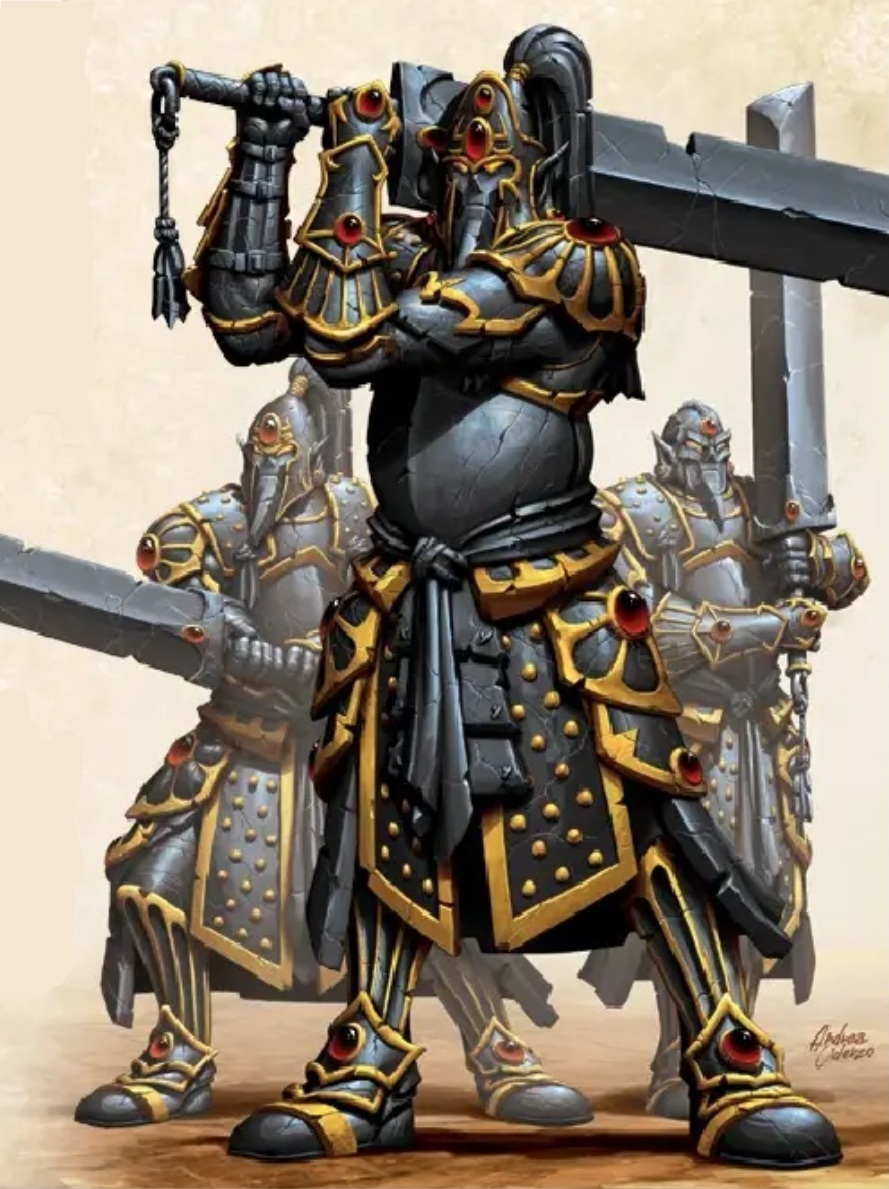
Rear Left to Right: an Aradus Sentinel, Tiberion
The Skorne Empire is a recently unified society and race living in Eastern Immoren near the Bloodstone Marches. Once a nomadic people, the skorne settled the city of Halaak after discovering the awful truth of their existence: Lacking any gods to worship, upon death skorne souls were cast into the void, driven mad through endless torment. This informed skorne society for the next four centuries, as their mightiest scientists sought a means to preserve Skorne souls upon death.
The skorne are a house and caste-based people, with every person within society knowing their place in the scheme of things, although it is possible to transcend one's caste by merit of being particularly skilled at what one does. They are also firm believers in the fact that "might makes right", with much of their society being ruled over by warlords with varying degrees of control over their peers. For centuries, skorne warbands and tribes survived in the desert by warring amongst themselves, and raiding the elves to their north and the Iron Kingdoms to their west.
After being deposed from his throne of Cygnar, Vinter Raelthorne IV fled to Eastern Immoren, where his incredible martial prowess allowed him to unite the scattered and warring houses of the skorne in the First Unification War.
Now, the skorne are a fully militarized society, and the full might of their forces have been sent west to invade Immoren. Though Vinter IV failed to reclaim his throne of Cygnar and was eventually deposed by Archdomina Makeda, the Skorne Empire continues its conquests in Western Immoren, most recently having conquered parts of Ios, the home of their ancient elven foes.
- And I Must Scream: All skorne that do not get exalted or chosen by an exalted to be its revered companions (that is, the majority of them, including all non-warriors with very few exceptions) will, upon death, be flung into the yawning Void to experience endless pain and agony and inevitably go mad.
- Ancient Grome: Skorne draws heavily from real world stereotypes about Sparta and Rome, particularly in their martial culture and their imperialism.
- Appropriated Appellation: When the elves still ruled much of central Immoren, before the Abyss was created, they called the primitive skorne godless. The skorne took it as a compliment, in the belief that the elven gods pampered the elves, making them weak and dependent on the gods.
- Balance, Power, Skill, Gimmick: Skorne through second edition were an infamous Skill faction due to how their own units inherently contradicted one another. 3rd edition ironed most of these contradictions out, turning the faction into a Power faction with Skill elements.
- Barrier Warrior: The basilisk krea is a support beast with the primary function of protecting your army from ranged attacks with its Force Aura.
- Fantastic Caste System: All skorne have a caste which largely defines one's role in skorne society. The skorne castes are, in descending order: warrior, worker, slave and outcast. Typically one's caste is determined early in life, but some skorne belong to castes other than the one they were born into.
- Fantastic Racism: Skorne tribes used to raid the elven empire of Lyoss long before the events of the game, and the elves, in turn, denigrated the skorne as godless peoples, in contrast to their own substantial pantheon of benefactors. Discovering the truth of this insult is what has shaped much of modern skorne culture, and the enmity continues to this day. For this reason, Makeda chose Ios as the target for her invasion.
-
 Fan Nickname: Fans coined the term "Skornergy" to refer to how badly the Skorne models struggled against their own rules and their own inter-faction rules. In effect, "Skornergy" is the opposite of Synergy, where a unit is designed to do thing X and yet its rules actively work to undermine its ability to do thing X. Some brief examples of Skornergy:
- Ancestral Guardians are designed to use Soul Tokens gathered from allied models to support Immortals. Immortals are "Soulless" and thus do not produce Soul Tokens.
- Hexeris1 could use his Feat to take control of any enemy models he destroyed during that turn, but his offensive spell removed them from play before they could be destroyed. His Vampirism allowed him to take FURY from Warbeasts that were destroyed, but his spell and his Feat both prevent this.
- Makeda1 had a spell that increased movement, but prevented the unit from charging into melee or making ranged attacks in a faction that wants Speed Shoes to allow it to close into melee with the enemy faster.
- Hordes from the East: The skorne originate in Eastern Immoren, and come to the western half of the continent for one purpose: conquest.
- Living Statue: Skorne ancestral guardians and immortals are statues animated by the souls of the exalted and their revered companions.
- Mage Species: Unlike the other races, all skorne have the potential to use magic in the form of mortitheurgy. As a result, in the RPG, in contrast to characters of other races can only have an ARC stat or take magic careers if they have the Gifted archetype, skorne non-Gifted characters start with an ARC stat of 1 and can take magic careers as long as they meet the prerequisites (the only exception being the Extoller career). A skorne character with the Gifted archetype is either a particularly powerful individual or one who committed early to the study of magic.
- Nay-Theist: The skorne know that gods exist. They just don't have any of their own, and view worshipping gods as a weakness, and in fact, held the Lyossans' dependence on their gods against them.
- The Nothing After Death: Because the Skorne peoples never worshipped any gods, they never have had the protection of gods in Urcaen. Instead, when they die their souls are cast into the endless void to eventually go mad. It is because of this discovery that now Skorne Immortals and Ancestral Guardians exist. Discovering this trope was in play for their people, the Skorne developed the exaltation stones to magically bind the souls of those who wore them upon death, and prevent them from being condemned to the void.
- Pain and Gain: Skorne Warlocks generally revolve around inflicting this trope on their allies or even themselves, causing self-harm to gain huge Status Buffs.
- Proud Warrior Race Guy: The Skorne are a species-wide example. Even when they were nomadic peoples, they were fully militarized, they simply warred against one another as often as they did against outsiders. With the First Unification War under Vinter Raelthorne IV, the Skorne are now a united front against the rest of the world.
- Scary Impractical Armor: Skorne armor tends to very closely resemble the page image for this trope, to help sell the faction as a bunch of pain-obsessed lunatics.
- Scrappy Mechanic: Skorne were built with several rules on their models that were designed to create an army that had lots of units it had to sacrifice to fuel other units, mirroring the lore of Skorne as a faction that inflicts torture and pain on itself to become stronger as a whole. The trouble was, the way this was implemented resulted in Skorne players having to effectively pay a "tax", taking two units to accomplish what other factions could do with a single unit or model, leaving them at a significant disadvantage. This "Skornergy" was eventually abandoned entirely with 3rd edition, turning the faction from one that inflicts pain on itself to hit harder into one that tanks the enemy's initial hit then gives it back harder.
- We ARE Struggling Together: Despite being forcibly unified and having the leaders of all houses who refused to bend the knee executed, the "united" Skorne Empire is still largely composed of numerous houses all vying for position over petty rivalries.
- Wutai: The other primary influence that defines the faction. The honosuke code in particular is like a Spartan-Japanese crossbreed of Bushido, and the National Weapon of skorne forces are all katanas and naginatas.
Skorne Castes
Warriors

Not all skorne can aspire to become a Cataphract, as the position requires exceptional height, bulk, strength, and unflagging endurance. Similarly, not every house boasts Cataphracts among their numbers; only a few possess the esteem and wealth required to field even a few of these heavily armored combatants. Those deemed fit by the chirurgeons and mortitheurges of their house are the greatest warriors of their generation. Cataphract philosophy is founded on proud self-reliance within a supremely capable fighting unit. Among the Skorne, combat is more than a means to an end, it has its own intrinsic meaning. The grueling discipline and training required to become a Cataphract is welcomed not as an obstacle to be overcome but as a transformation to be relished.
Cataphract units include:
Cataphract Solos Include:
- Tyrant Vorkesh (see: here)
Cataphracts are the Heavy Infantry core of the "Masters of War" theme force
- Alpha Strike:
- Arcuarii have the ability to perform a "Combined Ranged Attack," trading quantity of attacks for damage by concentrating all their attacks on a single target.
- Incindiarii also have this ability, accentuated by the Area of Effect nature of their Pocket Rocket Launchers.
- Area of Effect: The major difference between the ranged attacks of the Arcuarii and the Incindiarii is that the latter fire explosives with this trope.
- Armored Collar of Durability: Part of the sign that the Cataphracts are extremely durable compared to their peers is that they have a large collar that comes up and covers their necks, mating with their helmets if they choose to wear them.
- Balance Buff: After 3rd edition eliminated morale systems, Cataphract units all lost the "Fearless" special rule. In exchange, they gained "Tough."
- Bayonet Ya:
- Incindiarii mount bayonets to the front of their rocket launchers as their melee weapons
- Arcuarii technically have ballistae that fire harpoons, meaning their melee weapon is the same blade as their projectile attack, just locked and loaded into its firing implement.
- Call That a Formation?: Inverted, while under the effects of the "Shield Wall" order, Cataphract Cetrati are as tough as Khador Warjacks, despite shield walls falling out of favor in real life because of the use of explosives and artillery. Artillery like everything used by the Venator Warrior branch, and yet somehow despite constant inter-house warfare, Cataphract Cetrati still insist on using Shield Walls.
- Dog Pile of Doom: Cetrati can perform a "Combined Melee Attack," all dogpiling onto the same target with their spears to improve damage at the cost of quantity of attacks.
- Fire-Breathing Weapon: The Incindiarii are so named because their rocket launchers shoot firebomb rockets that deal both "Damage Type: Fire" and "Continuous: Fire" on impact.
- Harpoon Gun: A variant, the harpoons that Arcuarii use are actually closer to a compact ballista that fires the harpoon as an enormous bolt with a chain on the end. This also ensures they never run out of ammo, as they reel in the harpoon via its chain after each shot, dragging any unlucky bastard they hit along with it.
- Hypocrite: The Venators are considered among the lowest of the low, almost to the level of slaves, despite being members of the vaulted Warrior caste, because of their use of ranged weapons. The refusal to charge into the enemy's guns and start hacking away with swords is seen as antithetical to the hoksune code, and thus a dishonorable form of combat. Meanwhile:
- The Cataphract Incindiarii run around with rocket launchers but are seen as just as valuable and worthy of respect as the other Cataphracts.
- The Arcuarii use harpoon guns and yet the Skorne culturally refuse to acknowledge their use of projectile weapons at all.
- Luckily, My Shield Will Protect Me: Played with. Cetrati do gain more armor than their cousin units by using shields, however these shields only give half the usual armor bonus, comparable to "Buckler" bonuses rather than "Shield" bonuses.
- Man on Fire: Victims of the Incindiarii's rocket launchers suffer from this trope due to their "Continuous: Fire" effect.
- Master Swordsman: Cataphracts stand apart from their Skorne peers by their utter mastery of their melee weapons. Cetrati and Arcuarii both have the "Weapon Master" special rule on their melee attacks, giving them free boosted damage in melee.
- No One Could Survive That!: After their Balance Buff, the Cataphracts all received the "Tough" special rule, giving them a 33% chance to ignore lethal damage.
- Shoulders of Doom: The other major sign of just how much more durable Cataphract armor is compared to other Skorne armors is their enormous shoulder pads that fully encase the wearer's head from the sides.
- A Thicket of Spears: While in a Shield Wall, Cetrati naturally perform this trope, with a solid wall of steel perforated by their deadly war spears.
- Yank Into Melee: Enemies hit by Arcuarii at range get dragged up to 8" into melee range with the Arcuarii.

Nihilators are fanatical and savage skorne that are obsessed with gaining a glorious death to achieve exaltation and seek out the most violent deaths against the most impossible odds in order to gain the attention of the extollers. The nihilator cult originates from Xaavaax the Flayed, who was the foremost disciple of the great ancestor Morkaash, the revered philosopher who founded the paingiver caste. After Morkaash’s death, Xaavaax and a small group of dedicated adherents ventured deep into the Shroudfall Mountains to test the limits of self-inflicted pain. Several of his followers died over the weeks that followed, but those who survived returned with a frightening new zeal. Thereafter the cult grew steadily on the fringes of skorne civilization.
This cult enacts rituals that radically reinterpret Morkaash’s teachings about enlightenment through suffering and incorporate the codes of honor in battle as passed down by Voskune. Nihilators start down their all-consuming path with an initiation rite requiring the ritual scarring of their flesh. They use these self-inflicted agonies to achieve a waking meditative state that allows them to ignore even the most crippling injuries in battle. Akin to the berserkers of the west, they can enter a blood frenzy that makes them exceptionally terrifying. Nihilators grow so blinded by their desire for glorious death that they soon lose the ability to distinguish friend from foe and many of them die on the blades of their comrades as they hurl themselves wildly into the fray.
Nihilators have only a single unit:
Nihilators have only a single solo:
- Warlock Naaresh (see: here)
Nihilators are exclusive to the "Disciples of Agony" theme force.
- The Berserker: Nihilators hurl themselves wildly into the fray, seeking the most violent deaths in the quest for exaltation. They have the "Berserk" penalty on the tabletop, meaning every time they score a kill in melee they must make another attack, even if that attack is against an ally.
- Body Horror: Nihilators don't have horns. Those are piercings. In fact, their bodies are laden down with large, sharp points of metal that are slipped through their flesh.
- Crippling Overspecialization: Nihilators do one thing: they kill light infantry hordes in melee. Anything that doesn't fit that trope, they're fairly weak against, and their low armor and defense coupled with a small unit size means even with the benefits of "Tough" they're still going to struggle to accomplish anything before getting shot to pieces.
- Cult: Nihilators were borne out of a cult that developed from the early research into Mortitheurgy. In contrast to Mortitheurges, who harness magical powers from pain and death, Nihilators seek to use pain to achieve enlightenment. Their success is reflected in their incredible durability and powers on the tabletop.
- Feel No Pain: Skorne nihilators use self-inflicted agonies to achieve a waking meditative state that allows them to ignore even the most crippling injuries.
- Fragile Speedster: speed 6 means they can casually run 12" per turn if necessary, but their defense 13 and armor 13 mean hits are pretty likely to land and anything that does will kill them.
- Glass Cannon: Nihilators have the durability of wet tissue paper but their power 12 great swords and "Berserk" special rule along with speed 6 and base-melee accuracy 7 allow them to cleave through entire enemy squads with just five men.
- Impossibly Cool Weapon: To really help sell their Pain and Gain design, not only are nihilators covered in piercings, their swords have piercings!
- Nerf: After 3rd edition removed any morale mechanics, Nihilators lost their "Fearless" special rule and gained nothing in return.
- No One Could Survive That!: Their Feel No Pain abilities are reflected in the "Tough" special rule, which allows Nihilators to ignore 33% of lethal attacks.
- One-Handed Zweihänder: Their trance-like state has gifted them the strength to wield their greatswords with just a single hand to cut through enemies.
- Pain and Gain: Nihilators have achieved an enlightened state through their ritual infliction of pain upon themselves.
- Serrated Blade of Pain: In contrast to the more realistic Japanese-style weapons of the Cataphracts or the Praetorians, nihilators wield sinister greatswords made from many jagged points jutting out at odd angles.
- Walking Shirtless Scene: Nihilators wear only pants and whatever jagged bits of metal they've pierced through their own flesh into battle. They don't even wear helmets!

Praetorians are one of the oldest subsets of the Warrior caste among Skorne society. In this harsh society that requires all able-bodied adults learn to fight, Praetorians form the backbone of all house armies as well as the Army of the Western Reaches. When Vinter Raelthorne moved to his Abyssal Fortress, he ordered the dominars to send him their best warriors. To those who passed muster, Supreme Archdomina Makeda now offers welcome into the fortress and inclusion in the great conquest to come. All others were ejected to return to their houses in shame. Thus, even the least of Makeda’s Praetorians are the greatest of their houses and are rightfully proud of their abilities and standing. Accustomed to linking their honor with their houses, these soldiers have transferred that pride to their cohorts, and the various cohorts compete enthusiastically for both spoils and glory.
Iron mines are a highly valued resource among the skorne, relatively few and scattered. While the process of smelting steel is well known to the Skorne that valued metal is generally reserved for weapon blades. Blades are crafted using folded sheets of very thin steel, a process mastered by the best artisans, some of whom are technically slaves yet valued as the finest living treasures of their house. The armor worn by Praetorians is most often constructed of strengthened bronze, using an ancient technique which produces a light metal only marginally weaker than steel. With many overlapping plates, this armor provides excellent protection without inhibiting mobility. Every Praetorian learns to endure fighting in the punishing heat of the sun and to push their endurance past normal limits. Each armor suit is set with fire-hardened tusks and horns, providing additional protection and serving as impromptu weapons if a Swordsmen is disarmed or outnumbered and grappled. Large tusks are commonly added to shoulder armor and helmets so Praetorians can slam into an adversary as a last resort. These also help deflect blows intended for the neck. Many Praetorians prefer to fight bare headed, reserving helmets for the most dangerous engagements, such as when assaulting walls during a siege; their fighting style emphasizes all-around awareness, and helmets constrict both field of vision and hearing.
Praetorian units include:
- Praetorian Feroxes
- Praetorian Karaxes
- Praetorian Keltarii
- Praetorian Swordsmen
- Tyrant Officer & Standard
Praetorian Solos include:
- Tyrant Rhadeim (see: here)
- Warlock Makeda (see: here)
- Warlock Xerxis (see: here)
- Warlock Zaadesh (see: here)
Praetorians are the core of the "Masters of War" theme force.
- Alpha Strike:
- Karaxes can perform a "Combined Melee Attack," sacrificing quantity of attacks for improved damage and accuracy by all concentrating on the same target.
- Keltarii can also perform a "Combined Melee Attack," helping to offset some of their Crippling Overspecialization.
- Swordsmen can perform an individual version of this trop with their "Combo: Strike" ability. In lieu of each swordsman making two attacks, they can make a single attack with greater power.
- Armor-Piercing Attack: Swordsmen have the "Penetrating Strike" special rule, allowing the whole unit to do 1 damage even if they can't penetrate the armor of a Warjack or Warbeast.
- Battlefield Flagbearer:
- In keeping with their Samurai designs, Swordsmen are led by a model that carries a large flag on his back. This allows his unit to more easily see him across the battlefield and follow.
- Karaxes and Swordsmen can both be accompanied by a standard bearer who improves the unit's cohesion
- Tyrant Commanders form a complete unit with their standard bearer, who provides the Tyrant with an improved Area of Effect to their Status Buffs.
- Blade Spam: Keltarii can make two attacks per turn with their double-ended glaives thanks to their "Rapid Strike" special rule, giving the unit up to a staggering twenty melee attacks per turn.
- Call That a Formation?: Inverted, Karaxes can form a Shield Wall to improve their armor up to Heavy Warjack levels despite operating on a battlefield with artillery.
- Double Weapon: Keltarii use double-ended glaives.
- Early-Installment Weirdness: Originally, Tyrant Commander & Standard units were an attachment for any and all Skorne Warrior units, a sort of "universal command attachment." 3rd edition changed them completely so that they were an independent unit who wandered around on their own, providing Status Buffs to nearby Skorne warriors.
- Fragile Speedster: Keltarii and Swordsmen emphasize mobility and agility over durability, possessing below-average armor and above-average speed.
- Horse of a Different Color: Praetorian feroxes are so named for the large felines they ride, the ferox.
- Impossibly Cool Weapon: Keltarii fight with double ended glaives whose blades are closer to sickles, but with numerous added protrusions and shanks that would make them prone to catching on enemies they try to slash.
- In a Single Bound: Praetorian feroxes have the "Jump" special rule, allowing them to launch themselves to any point within 5" after they complete their move for the turn.
- Luckily, My Shield Will Protect Me: Karaxes and Feroxes both have enormous shields that offer them marginally improved durability compared to Swordsmen and Keltarii.
- Meaningful Name:
- "Karax" is Ancient Greek for "pointed stake" and Karaxes are A Thicket of Spears while in formation.
- "Ferox" means "ferocious", which the giant felines they ride certainly are. It's also part of the scientific name of Lithodes ferox, a species of king crab known for its hard shell that is covered in spikes, allowing it to be both armored and offensive at the same time. Praetorian Feroxes are similarly heavily armored compared to other Praetorians, while also packing quite powerful melee abilities thanks to their spears and mounts.
- Non-Indicative Name:
- The "spears" used by Karaxes are actually naginatas or glaives, as they are a large, single-edged blade mounted to the end of a pole rather than a pointed tip. Even after the 3rd edition change to "Pikes," they're still incorrectly labelled.
- "Keltarii" is an As Long as It Sounds Foreign Latin rendition of the term for the Celtic people, who most definitely did not fight using double-ended glaive-sickles and no shields or heavy armor.
- No-Sell:
- Karaxes have "Girded," rendering them immune to blast damage
- They also have "Set Defense," inflicting penalties on any enemies who try to charge, slam, or impact attack them.
- Karax Officers have a Minifeat which renders the whole unit immune to stationary or knockdown.
- Karax Officers also have "Tactics: Practiced Maneuvers," which prevents Karaxes from being body-blocked from moving by their own units.
- Parrying Bullets: Keltarii have the "Blade Shield," special rule, giving them +2 defense against ranged attacks as they engage in this trope to deflect and block bullets.
- Savage Spiked Weapons: While their blades are far more practical than most other Skorne models, both Karaxes and Feroxes wield glaives that have numerous small spikes all over the lugs that secure them to their poles. This is done to better help them fit into the Scary Impractical Armor design of the rest of the Skorne forces.
- Speed Shoes:
- Keltarii have "Reposition: 3," allowing them to potentially move 13" per turn and still charge into melee to kill enemies.
- Swordsmen Officers grant their unit the "Side Step" special rule, allowing them to make a free 2" move every time they hit an enemy.
- They also have "Granted: Relentless Charge," giving the whole unit the ability to ignore difficult terrain while charging into melee.
- Tyrant Commanders have a series of "Battle Plan" abilities, with their "March" Battle Plan granting the unit the "Pathfinder" special rule so they move twice as fast through rough terrin
- Tyrants' "Push to the Limit" Battle Plan grants a nearby unit +2 speed for a turn
- Spikes of Villainy: Praetorian standard bearers all carry standards that are covered in spikes, to emphasize that Skorne is Always Chaotic Evil.
- Status Buff:
- In 2nd and 3rd edition, Swordsmen Officers had a Minifeat which gave the whole unit free bonus damage for a turn
- In 4th edition, Swordsmen Standard Bearers grant the whole unit +1 accuracy in melee
- Tyrant Commanders can remove the "knocked down" Status Effect on nearby allies with their "Reveille" Battle Plan.
- If Praetorian feroxes made a "Jump" special move that turn, their mount gets free bonus damage thanks to its "Pounce" special rule
- Feroxes also have "Brutal Charge" on their spears, giving them +2 damage on charge attacks.
- Stone Wall: Karaxes fill this role among the Praetorian variants, using their enormous shields and the "Shield Wall" special order to have durability on par with Heavy Warjacks.
- A Thicket of Spears: Karaxes and Keltarii both excel in getting into this formation, using their long spears to threaten enemies at range.
- Uniqueness Value: Despite being the same format as basically every other "Command Attachment" in the game, the Tyrant Commander & Standard unit is actually a two-man unit that runs around on its own, not needing to be attached to any one squad.

Skorne military tactics once focused exclusively on closing quickly and butchering the enemy in melee and the earliest skorne ranged weapons were large and clumsy, designed to bring down the walls of rival houses and slay oversized beasts. However over the last century the tyrants have learned the power of a combined-arms approach. Vinter Raelthorne was well versed in these lessons and encouraged the recruitment and training of large numbers of Venators to operate the reivers of his invading army.
Despite being in the respected warrior caste, the Venators are looked down as inferior to some warriors due to their reliance on ranged weaponry. However, due to the wars against the technologically advanced Iron Kingdoms, tyrants and dominars have become increasingly willing to put Venators in the field. With no hope of exaltation, these ruthless warriors fight more for survival and victory, taking pride in the accomplishments of their houses. They do not embrace the hoksune as readily as some, and so they would prefer to avoid death if possible. They have learned to cling to life tenaciously, the best of them seeking to master their martial arts and to fight in additional battles beyond the present.
Venator units include:
Venator solos include:
- Venator Dakars
- Warlock Jalaam (see: here)
Venators are the core of the "Winds of Death" theme force.
- Acid Attack: Slingers fire specialized capsules containing acid, giving their attacks Damage Type: Corrosion by default.
- Alpha Strike:
- Slingers can perform a "Combined Ranged Attack," sacrificing quantity of attacks for improved accuracy and damage by concentrating all their fire on a single enemy.
- Reivers can also perform a "Combined Ranged Attack," offsetting the loss of Hollywood Acid on their guns with More Dakka.
- Anti-Armor: Slingers gain bonus damage against constructs like Heavy Warjacks with their "Attack Type: Erosion."
- Arbitrary Weapon Range:
- In 2nd edition, Venator Catapults had a minimum range requirement, prohibiting them from firing upon enemies within 8"
- Reiver Officers have the "Extended Fire" Minifeat, which gives all Reivers in their unit +4 range for a turn.
- Area of Effect: Slingers can use their "Attack Type: Acid Bath" to turn their attacks into this. In the lore this is a result of switching the specific type of projectile they use for an explosive-cored bullet.
- Balance Buff:
- By the time of 4th edition, Venator Catapults lost "Inaccurate," gained a net +2 ranged accuracy, lost their minimum range requirement, and got cheaper.
- Flayer Cannons lost "Strafe" and "Range Finder" but gained improved ranged accuracy and nearly quintupled their maximum rate of fire.
- Combat Pragmatist: Venators are part of the prestigious Warrior caste, but their use of ranged weapons has seen them ridiculed and regarded as low as the slave caste by other warriors. Given that they are seen as dishonorable no matter what they do, Venators typically have no qualms with engaging in whatever tactics and strategies are necessary to win, leaving petty concerns like "Honor" to the Praetorians and Cataphracts.
- David Versus Goliath: Reivers and Dakars have the "Burst Fire" special rule, giving them bonus accuracy and damage against larger foes, up to +2 accuracy and damage against large and huge-based enemies.
- Death from Above:
- Slingers have "Arcing Fire," allowing them to rain bullets from their slings onto enemies behind cover.
- Venator Catapults also have this special rule, allowing them to rain considerably larger explosive shells onto enemies who think themselves safe behind their fortifications.
- Flechette Storm: Reiver guns and Flayer cannons fire a storm of razor sharp needles at foes, using a combination of their inherent sharpness and their quantity to overwhelm enemies and defeat armor.
- Force and Finesse: Venators are the Finesse to the other Warrior caste members' Force. While even Swordsmen focus more on melee and cutting enemies down in a bloody brawl, Venators focus on precision elimination of enemies at range, before they can ever pose a threat to themselves or their fellow warriors.
- The Gunslinger: Venator Dakars have "Weapon Master" on their Reiver guns, giving them free boosted damage due to their Improbable Aiming Skills. In 4th edition, they also gain the "Dual Attack" ability, allowing them to shoot and fight in melee at the same time.
- Herd-Hitting Attack: In 2nd edition, Flayer Cannons had the "Strafe" special rule, allowing them to perform a kind of "improvised Area of Effect attack" that would strike a theoretically infinite number of enemies as long as they were within 2" of the original target.
- Imperial Stormtrooper Marksmanship Academy: In 2nd edition, Venator Catapults had the "Inaccurate" penalty, giving them de facto a default accuracy of 1 (average accuracy is 6).
- Luck Manipulation Mechanic:
- In 4th edition, Reiver Officers grant their unit free rerolls on all Combined Ranged Attack accuracy rolls.
- Venator Dakars can use their "Battle Plan: Combat Coordination" to allow a single allied Venator to reroll an attack or damage roll.
- More Dakka:
- Flayer cannons, Catapults, and Reiver guns have the "Burst Fire" special rule, reflecting that they pose greater threat to more durable foes simply by firing more shots at once against them.
- Flayer cannons also have the "Fast Reload" special rule, allowing them to potentially fire up to five shots per turn if enough Grunts are nearby.
- The Musketeer: Reivers wield their eponymous firearms, but can quickly switch to their swords if enemies close into melee.
- No-Respect Guy: Venators are the only reason that the Skorne Empire can remain competitive and threatening to the Iron Kingdoms, yet their use of ranged weapons in contravention to the hoksune code sees them regarded as dishonorable and almost as low as the slave caste.
- Siege Engines: Venators are the sole source of artillery among the infantry members of the Warrior caste.
- Venator Catapults are designed to hurl enormous explosive balls at enemy fortifications, offsetting their minimum range requirements by being far from any threat of enemy retaliation
- Venator Flayer Cannons meanwhile are gigantic Reiver Guns that fire an absolute storm of needles, shredding medium and light infantry in droves.
- Speed Shoes:
- In 2nd edition, Reiver officers granted their unit "Reform," allowing them to move 3" for free at the end of their turn.
- Venator Dakars can use "Battle Plan: Desperate Pace" to allow Catapults or Flayer Cannon crews to gain +2 speed for a turn.
- Status Buff:
- Slingers can give themselves a free bonus damage die against constructs with their "Attack Type: Erosion."
- Reivers, Flayer Cannons, and Catapults all have "Burst Fire," giving them +1 accuracy and damage against medium-based models, and +2 accuracy and damage against large and huge-based models.
- Venator Dakars grant all Venators within 10" of themselves +1 accuracy with their "Veteran Leader" ability.
- In 4th edition, Reiver Standard Bearers grant all members of the unit +1 accuracy in melee and at range.
- Status Effects: Slingers can use their "Attack Type: Flare" to strip enemies of the Stealth special rule and inflict -2 defense on them to boot.
- Sword and Gun: Dakars have become such masters of their Reiver guns that they can wield them with deadly skill at the same time they stab foes in melee with their "Dual Attack" special rule.
- Target Spotter:
- In 2nd edition, Venator Catapults had a "Range Finder" special rule, which helped offset their "Inaccurate" penalty by giving them bonus accuracy the more grunts were nearby to help aim.
- Flayer Cannons also had this special rule in 2nd edition, giving them considerable lethality with their "Strafe" special attack.
- Then Let Me Be Evil: Since they are regarded as dishonorable losers anyways, Venators have no restrictions on doing anything underhanded or dishonorable to win. They'll use guns, flares, Acid Attack and other Status Effects, or any other implement they can think of to absolutely obliterate their foes.
Workers

Following the discovery of the ultimate fates of Skorne souls upon death, centuries of research and development were put into trying to devise a means of avoiding the inevitable fate of the Skorne peoples. With the discoveries of Ishoul and Kaleed, a solution was found, and a new caste of Skorne were created. Extollers are responsible for preserving the souls of worthy Skorne warriors who fall in battle, guiding them to Sacral Stones and Ancestral Guardians so that they might escape the Void. Due to the significance of their duties which also play a major role in the ancestor worship among Skorne society. Even members of the Warrior caste treat Extollers with deference and respect, knowing that one day their fate will be in the hands of an Extoller. The rites by which an initiate cleanses his or her soul for this sacred office carry deadly risk. A Skorne must pluck out an eye and replace it with a crystal oculus that reacts to spiritual energy, during which many initiates die from the shock and agony. Those who survive gain special insight and learn to communicate with the Exalted. Speaking to the ancients itself neither easy nor simple as their advice is cryptic, and the touch of their minds can lead to madness. Further exacting procedures must be observed when awakening the eldest and greatest ancestors. Senior extollers sometimes hear phantom voices intruding into their minds, like echoes of thoughts not their own. An Extoller must have an iron will to push past these distractions and invoke the true guidance and protection of the exalted.
Extollers do not have units.
Extoller solos include:
- Extoller Advocates
- Extoller Novitiates
- Extoller Soulwards
- Marketh (see: here)
- Warlock Zaal (see: here)
- Immortal Vessels (see: Exalted)
Extollers are one half of the backbone of Skorne society, being responsible for fabricating the Sacral Stones that bind Skorne souls upon death, as well as forming and maintaining the bodies of the Exalted. On the battlefield they are support models in the "Masters of War," "Winds of Death," and "The Exalted" theme forces.
- Badass Preacher: Extollers are the closest thing to religious priests (alongside mortitheurges) within skorne society, and all extollers are expected to walk the battlefield to collect worthy souls and protect the Exalted. Soulwards in particular do so armed with nothing but their Oculus.
- Deadly Gaze: The Oculus offers a decent-if-unremarkable ranged attack in addition to its magical abilities, and both Soulwards and Advocates have replaced their eye with one as a mark of their office.
- The Engineer: Novitiates in-universe are tasked with sculpting the obsidian stone bodies of the Exalted. In game this is reflected in their ability to repair and empower Exalted models with their spells and abilities.
- Luck Manipulation Mechanic: Advocates can spend a Soul Token to allow one of their Immortals to reroll a missed attack roll.
- Magical Eye: Skorne extollers ritually cut out an eye and replace it with a device called Oculus, which allows them to perceive spirits and communicate with the exalted.
- Magic Staff: Advocates go into battle carrying a "Staff of Ancients," a tool they use to help them communicate with and manipulate the souls of the Exalted they shepard.
- Mook Lieutenant: In contrast to Novitiates and Soulwards, Advocates actually serve in units as "command attachments." A single Advocate is purchased and attached to a squad of Immortals in game (see: Exalted, above) and then acts as their commanding officer on the battlefield.
- Moveset Clone: Novitiates are to Exalted models what Paingiver Beast Handlers are for Warbeasts. In the days of Skornergy this was one of many examples of Skorne armies needing to pay twice to get the same net effect most armies only had to pay once for, but after the 3rd edition rebalances Novitiates now allow Skorne to empower its infantry and Warbeasts at the same time, and in a way that can't simply be undone with a single lost unit, a feat almost no other faction can manage with the same level of efficiency.
- Mr. Fixit: Their task of sculpting the obsidian bodies that Exalted are housed in grants the Novitiates the "Repair" ability, letting them magically heal Exalted models of their damage.
- Nerf: Soulwards used to be able to have a maximum of 5 Soul Tokens at once with their "Soul Taker" ability. 3rd edition reduced that to the 3 token cap common to Soul Taker models.
- No One Could Survive That!: Due to their stone sculpting abilitieis, Novitiates grant all Exalted models within 6" of themselves the "Tough" special rule, giving them a 33% chance to shrug off lethal damage.
- No Range Like Point-Blank Range: Soulwards and Advocates have the "Gunfighter" ability because their sole ranged attack is their Deadly Gaze. Even in melee, the ability to kill with a look is not hindered, and they have no qualms with blasting a hole straight through an enemy's head while blocking melee attacks.
- Roaring Rampage of Revenge: Advocates are deeply passionate about protecting their Exalted Immortals, and retain the "Vengeance" special rule the rest of the unit has. If any member of the squad suffers damage, Advocates will make a free move and attack the next turn in retaliation.
- Shoot the Medic First: As solo models who can also repair Immortals, Novitiates are a priority target for enemy players.
- Speed Shoes: Advocates get the same free move from their "Vengeance" special rule that Immortals have.
- Status Buff:
- Novitiates can use their "Stone's Wrath" spell to increase one allied construct's melee damage by +2 for a turn.
- Advocates can spend the Soul Tokens they gather from their unit to give their unit +2 defense for a turn.
- They can also spend a Soul Token to give their unit the "Incorporeal" special rule for a turn.
- Soulwards gain +1 armor for every Soul Token they have, up to a maximum of armor 15.
- They can also spend a Soul Token to boost their accuracy or damage on an attack.
- Support Party Member: All members of the Extoller caste fit this role on the battlefield, acting to aid and empower Exxalted models while lacking in damage output or durability themselves.
- Taking the Bullet: Exalted will proudly use their more durable stone bodies to intercept incoming attacks aimed at their Advocate. For balance reasons, this is translated in game by the Advocate having Sacrificial Pawn, so that this trope can only protect the Advocate once per turn, rather than the up to 10 times per turn it would trigger if the Advocate granted their unit "Shield Guard."
- Touch the Intangible:
- Extollers all pack at least one weapon with the "Damage Type: Magical" ability, letting them all strike ghosts and incorporeal models.
- Soulwards can grant a nearby allied model Damage Type: Magical for a turn with their "Guidance" spell.
- Translator Buddy: Advocates fill this role in Skorne society outside of battle, acting as translators and communication aids for the souls housed within Sacral Stones. The nature of Exalted souls as almost-but-not-quite Void Spirits means untrained minds attempting to contact them are prone to going insane near instantly, and their stone bodies and soul-nature mean that they no longer can communicate in a manner easily understood by flesh-and-blood Skorne.
- Weapons of Their Trade: In battle, Novitiates will defend themselves with their stone-sculpting hammers.
- Willing Channeler: A variant, Soulwards can use their "Spirit Guide" to allow an allied model within 6" to spend the Soulward's Soul Tokens as Mana, channeling their own soul manipulation abilities to empower their ally.
- Your Soul Is Mine!: Fully trained Extollers specialize in harnessing and manipulating the souls of allies, generally for the purposes of housing them in Sacral Stones. In-game this translates to Soulwards and Advocates having the "Soul Taker" special rule, allowing them to gather soul tokens from slain allies and use them as Mana.

Part of the process of discovering how to develop and use Sacral Stones involved a deep research into the nature of Skorne souls, as well as the power of pain and agony. The Great Ancestor Morkaash focused on learning anatomy and how to draw upon this power both by inflicting pain upon himself and others. Morkaash believed sublime enlightenment was a result of suffering, and he sought to understand the mechanisms by which living bodies functioned. Morkaash tested himself against hte great beasts, conquering them in battle, taming them, and bending them to his will. His knowledge carried on after his death, and his followers improved their techniques over many lifetimes, resulting in the chirurgeons and paingivers. Some continued to devote themselves to deeper mysteries surrounding agony, giving rise to the mortitheurgy; the study of the great power released by the flesh as it undergoes transition, as well as the power that can be harvested from blood.
The strongest of these mortitheurges are not satisfied merely with study in remote dungeons, but take to the battlefield. They learn to manipulate the transient energies released by a body in pain, allowing them to reach into the minds of others and reduce them to pawns. Manipulating the dull minds of Warbeasts is a simple act, and with their beasts set to war a Mortitheurge can turn his attention to hunting for prey: soldiers intently focused on combat, whose distraction makes them vulnerable to external mental predations. With a wave of agony empowered by the energies of death, Mortitheurge Willbreakers snatch control of their victims' minds and ruthlessly impose their own imperatives.
Mortitheurges are the second half of the backbone of Skorne society, and are the foundation of Skorne Warlocks and their ability to command Warbeasts. Despite this, they have only a single solo:
Mortitheurges are support models in the "Disciples of Agony," "Masters of War," and "Winds of Death" theme forces.
- The Beastmaster: Invoked with the Willbreaker's "Beast Master" rule, which allows them to command Warbeasts within 9" of themselves, even if the beast is technically outside its Warlock's control range.
- Luck Manipulation Mechanic: The Willbreaker can force a single unit, friend or foe, to reroll an accuracy or damage roll with his "Puppet Master" spell.
- Mind Control: Willbreakers get their name from their wide variety of ways to do this.
- Their "Influence" spell lets them take full control of an enemy warrior and have them attack their allies
- Their "Puppet Master" spell lets them engage in People Puppets, using their own skills to improve or diminish the accuracy of the target.
- Necromancer: Mortitheurges draw their powers, in part, from the release of energy upon death. They can use these abilities to manipulate souls both in and out of bodies, rehousing them if necessary.
- No One Could Survive That!: Willbreakers can grant an allied unit the "Tough" special rule with their "Flesh Hardening" spell.
- Pain and Gain: The other element mortitheurges draw their powers from is pain. The pain of others and pain they inflict on themselves both allow them to harness raw energies that they can use offensively or defensively. Mortitheurgy is the basis of all skorne warlocks as a result.
- People Puppets: Invoked with the "Puppet Master" spell willbreakers have, allowing them to manipulate a target to improve or compromise their accuracy.
- Squishy Wizard: Unsurprisingly for an unarmed man running around shirtless, willbreakers are extremely fragile and depend on their powerful magical abilities and Warbeasts to prevent enemies from scything through them like grass.
- Support Party Member: Due to lacking any weapons at all, Willbreakers can only fill this role in Skorne armies.
- Taken for Granite: Used beneficially. Willbreakers can use their spell "Flesh Hardening" to improve the survivability and durability of an allied unit, granting them the "Tough" special rule.
- Torture Technician: In order to harness the power that can be drawn from pain, all Mortitheurges are masters of this trope.
- Walking Shirtless Scene: Willbreakers go into battle completely topless.
- Your Soul Is Mine!: Mortitheurges generally harness the power a soul releases upon death as part of their magical abilities. While Willbreakers lack any of the usual mechanisms to gain Soul Tokens that most examples of this trope have, their mastery over soul manipulation is the foundation of their Mind Control and People Puppets spells and abilities.

A privileged substratum of the skorne's worker caste, paingivers exist to harness the magical energies of agony for the Skorne Empire. In effect, no matter the target, paingivers exist to give pain, both as part of pain as an end unto itself and a source of empowering for skorne warlocks and mages. To aid them in this role, paingivers have numerous implements and tactics. Barbed hooks, razor whips, blunt and sharp instruments, all allow the paingiver to enforce compliance and draw strength for themself and their warlocks. Just as important to a paingiver as agony, is ensuring that agony never ends. Paingivers have thus become masters not only of torture, but also medicine, ensuring none die before they give the say so. In battle, paingivers drive their slaves into combat with wickedly barbed man catchers, which they can also use to capture fresh resources. In the expert hands of a paingiver, a man catcher can hold a target in place while servants descend upon the unfortunate victim. Alternatively, they can expertly wield barbed whips, striking key arteries or tendons of the enemy to incapacitate the most heavily armored foe and force them into compliance.
Paingiver units include:
Paingiver solos include:
- Paingiver Bloodrunner Master Tormentors
- Paingiver Task Masters
- Warlock Hexeris (see: here)
- Warlock Morghoul (see: here)
- Warlock Xekaar (see: here)
Paingivers are support models available in every theme force.
- Anti-Infantry: With power 8 to 10 weapons, paingiver units really only excel at killing light infantry. They kill a whole lot of light infantry for their points cost, but they still only are good for killing light infantry.
- Armor-Piercing Attack: Paingivers all have the "Anatomical Precision" special rule, representing their ability to strike even the most heavily armored foes in their unarmored joints and eyeslits.
- Bad Boss: Task Masters are one by design, being tasked with enslaving and torturing non-Skorne species into serving the Empire.
- The Beastmaster: Downplayed. Beast Handlers excel at handling Warbeasts, but they are incapable of truly commanding them as a Warlock can. Instead they act as supporting units for their Warlock, helping to keep the Warbeasts under control while their Warlock focuses on using them to maximum effect against the enemy.
- Combat Medic: In contrast to Mortitheurges, Paingivers know to heal as well as hurt, as part of ensuring that their prey live long enough to complete the tasks their Paingiver masters assign them. Beast Handlers can heal living Warbeasts with their "Medicate" action.
- Department of Redundancy Department: Paingiver units all excel at killing light infantry in melee...just like every other Skorne unit for the most part. This has resulted in only Beast Handlers, who are a Support Party Member in addition to their Anti-Infantry abilities, being common in Skorne armies.
- Devious Daggers: Assassin daggers are the weapons of choice for the stealth-and-assassination focused Bloodrunners.
- Dog Pile of Doom: In 3rd edition Bloodrunners gained the "Gang" ability, encouraging them to engage in this trope to receive +2 melee accuracy and damage.
- Flash Step: In 2nd edition, Bloodrunners had the ability to teleport to within 1" of another member of the squad whenever they scored a melee kill, allowing them to engage in hit-and-run attacks, or escape an enemy unit trying to countercharge them.
- Fragile Speedster: Paingivers do not wear armor, either due to not needing it (Beast Handlers) or not wanting to be encumbered by it (Bloodrunners.) As a result they're all exceptionally fast, but will die to a stiff breeze. Each Paingiver unit has ways of mitigating this to compensate, but enemies who can bypass those defenses will tear through Paingiver units easily.
- Herd-Hitting Attack: Master Tormenters are so skilled with their barbed whips that they have the "Thresher" special attack, allowing them to hit every model within 2" at the same time.
- Hit-and-Run Tactics: Master Tormenters have all the same Fragile Speedster stats of their fellow Bloodrunners, meaning they must rely on this trope, as well as their native "Stealth" and "Pathfinder" special rules to kill enemies before retreating into rough terrain to hide. Their "Sprint" special ability, allows them to do this by making a full move whenever they finish a turn with a melee kill.
- Lawman Baton: Played for extremely sinister connotations with the Task Masters. Task Masters, in keeping with their Wutai influence, wield a real-life weapon used by police forces
 both modern and ancient called a "Man Catcher." Police in real-life use it to allow them to subdue a suspect nonlethally without posing a risk to the officer, similar to the purpose of lawman batons in real lifeHistorical Example. In the case of Task Masters, they not only use this to non-lethally subdue criminals, but also to subdue enemies to then be enslaved and conditioned to serve the Skorne Empire.
 - Mana Drain: Beast Handlers can add a FURY point to a Warbeast within 3" with their "Condition" action, or with the "Inflict Pain" special rule on their barbed whips. Because of how FURY works, this prevents a Warbeast from making more bonus attacks or improving its accuracy or damage, and increases the chances that the Warbeast will frenzy the next turn. A Warbeast whose FURY stat is full also cannot be used to transfer damage their Warlock sustains, allowing Beast Handlers to make it easier to kill the enemy Warlock.
- Mana Potion: They can also use their "Condition" action or their barbed whips to remove a FURY point from a Warbeast, giving the Warbeast more opportunity to buy bonus attacks as well as reducing the chances it frenzies.
- Mook Lieutenant:
- Bloodrunner Master Tormenters act as this trope to their fellow Bloodrunners, using their "Veteran Leader" ability to provide Status Buffs to nearby Bloodrunners.
- Task Masters command those mercenaries and slaves who Skorne has forcibly inducted. In game terms this is represented by a Task Master allowing the main Skorne army to take a Mercenary unit outside of the normal Theme Force allowances.
- No One Could Survive That!: Task Masters can grant a nearby mercenary unit the "Tough" special rule, allowing them a 33% chance to ignore lethal damage.
- Reduced Mana Cost: Beast Handlers have the "Prodding" special rule, which allows nearby allied Warbeasts to charge for free.
- Speed Shoes: Task Masters can use their "Scutter" action to grant an allied mercenary unit "Reposition: 3" for a turn.
- Stealth Expert: Bloodrunners are specialized assassins, and they have the Stealth and "Pathfinder" special rules to allow them to stalk among terrain invisibly then ambush an enemy at the opportune moment.
- Status Buff:
- Beast Handlers can give an allied warbeast +2 melee damage for a turn with their "Enrage" action.
- While two Bloodrunners are attacking the same target, they each get +2 accuracy and damage in melee.
- While Master Tormenters are within 10" of other Bloodrunners, they grant +1 melee accuracy to their fellows.
- While within 10" of a Task Master, Mercenary models are immune to knockdown
- They can grant a mercenary model +2 melee damage with their "Pain Driver" action
- They can also grant a mercenary unit within 3" of them the "Tough" special rule.
- Suspiciously Similar Substitute: Beast Handlers are the Skorne equivalent to the Choir of Menoth, being a squad of models designs to support and empower Warbeasts/Warjacks. While the Choir focus on using the power of Menoth to protect and strengthen their Warjacks, Beast Handlers rely on Mortitheurgy to inflict pain that empowers their Warbeasts and lets them shrug off their wounds.
- A Taste of the Lash: Lashes are an important tool of Beast Handlers in the task of conditioning Warbeasts.
- Torture Technician: All skorne paingivers are masters of torture as part of their caste.
- Try to Fit That on a Business Card: The highest rank a Bloodrunner can achieve is Paingiver Bloodrunner Master Tormentor. Yes, that's actually all part of their title, this came about due to a need to make it easy for players to understand what units applied to what keywords, however this trope applies as "Paingiver Bloodrunner Master Tormentor" is also their in-universe rank.
- Unstoppable Rage:
- Beast Handlers can inflict this with their "Enrage" action, improving a Warbeast's melee damage for a turn.
- Task Masters can grant this trope with their "Temper Flash" action, granting a nearby mercenary unit the "Tough" special rule for a turn.
- Whip of Dominance: Whips are an important tool of the Skorne Empire's paingivers, with its warmongering and slavering culture:
- Paingiver beast handlers wield whips to symbolize the cruelty in how they subjugate, enslave, and tame their warbeasts. They also wield them in actual battle not only to command and direct the warbeasts but also as their own personal weapon, as the barbed whips can actually pierce heavy armor. Beast Master Xekaar, a paingiver warlock, is notable for Dual Wielding the barded whips.
- The Paingiver Bloodrunner Master Tormentor is the highest ranking paingiver unit as well as their most sadist and cruel. Their signature weapon is a whip made of serrated blades, which are said to deal extreme agony to those struck by it.
Ancestors
Almost two centuries later, the salvation of the Skorne would be discovered. Ishoul and Kaleed discovered how to create Sacral Stones. These sculpted gems of obsidian could house the souls of the dead, absorbing them upon death as a sponge absorbed water. Though the First Exalted Ancestor's Sacral Stone would be peeled away through the ages, the ability to preserve Skorne souls in death would change Skorne society forever. Now, those Skorne souls who prove their value in life are preserved in death, housed in stones carved of obsidian and given stone bodies to animate their forms. These Exalted act both as encouragement for their fellow Skorne, a proof of the heights they can achieve through their own works, and protector to those Skorne souls who yet live.
Exalted units include:
Exalted solos include:
- Ancestral Guardians
- Immortal Vessels
- Abidan the Keeper (see: here)
- Hakaar the Destroyer (see: here)
- Warlock Zaal, the Ancestral Advocate (see: here)
The Supreme Guardian Battle Engine is also an Exalted model. For tropes specific to it, see "Supreme Guardian" below.
Exalted models form the core of "The Exalted" theme force, as well as support units in the "Masters of War" and "Winds of Death" theme forces.
- "Avoid This Area" Effect: Vessels have the special rule "Telemetry," making it easier to kill nearby enemies for other spellcasters in the Skorne army.
- BFS: Immortals pack swords that are as tall as they are as their primary weapons. Thanks to their stone bodies they have no trouble carrying these enormous stone blades.
- Blade Spam: Ancestral Guardians can spend a Soul Token to buy an additional attack with their halberd, potentially quadroupling their melee output in a turn.
- Counter-Attack: Ancestral Guardians have the "Defensive Strike" special rule, allowing them to make a free hit once per turn when an enemy finishes their movement within melee range of the Guardian.
- Deadly Gaze: Vessels, who were extollers before they got exalted, retain the powerful Oculus eye weapon they had in life, and use it to deadly effect.
- Gameplay and Story Segregation: Despite Immortals being Exalted specifically for their legendary melee prowess, Immortals lack the Weapon Master special rule.
- Living Legend: Exalted are by definition the preserved souls of technically-dead Skorne heroes, making every Exalted a soul so legendary that they were preserved in a Sacral Stone.
- Living Statue: Exalted all fight with bodies forged from obsidian and stone, animated by the magical binding energies of the Sacral Stone and the soul within it.
- Low-Tech Spears: Vessels and Ancestral Guardians both wield relatively mundane blades-on-sticks to highlight that their purpose is less melee combat and more focused on casting spells.
- Magic Staff: The purpose of the Vessels' spears and the Ancestral Guardians' halberds are to fill a role closer to this, allowing them to cast their powerful spells and draw power from pain and souls.
- Marked to Die: Vessels generate an Area of Effect that gives the rest of the army +2 accuracy with spells targeting enemies close to the Vessel.
- Mighty Glacier: Due to being Living Statues, Exalted are all fairly slow but extremely durable compared to the rest of the Skorne forces.
- Mook Lieutenant: Ancestral Guardians are the elite among the Exalted, and their "Resonance" ability empowers nearby Exalted to help them fight more effectively.
- No Range Like Point-Blank Range: Thanks to their ranged attack being a Deadly Gaze attack mounted to their skulls, Immortal Vessels have the "Gunfighter" special rule, allowing them to shoot their Eye Beams in melee combat.
- No-Sell:
- Ancestral Guardians have the "Steady" special rule, rendering them immune to knockdown.
- Immortal Vessels have the "Set Defense" special rule, giving enemies penalties to charging, slaming, or making impact attacks against them.
- One-Man Army: Ancestral Guardians have been referred to as a "Light Warbeast in disguise" because of how their Your Soul Is Mine! abilities allow them to boost their melee accuracy and damage. In addition, their Exalted bodies give them huge durability on par with a Heavy Warjack, and their special rules give them some added resistances that even Warjacks lack.
- Resurrective Immortality: As long as their Sacral Stones are intact, Exalted cannot be killed. Instead, their Sacral Stones can be transplanted to another stone body, and they can rise again.
- Roaring Rampage of Revenge: Immortals have the "Vengeance" special rule, giving each member of the unit a free 3" move and attack if any member of the unit is damaged by the enemy.
- Speed Shoes:
- Immortals get a free 3" move if any member of their unit is damaged by the enemy
- Ancestral Guardians give every Immortal within 5" of the Guardian +2 speed for a turn.
- Their "Spirit Driven" special rule lets them spend a Soul Token to gain +2 speed for a turn.
- Status Buff:
- Vessels give other Skorne spellcasters +2 accuracy when shooting at enemies within 8" of the Vessel
- Ancestral Guardians can spend Soul Tokens to give themselves boosted accuracy or damage in melee.
- Touch the Intangible: Due to being statues animated by the magical energies of a Skorne soul, all Exalted weapons have "Damage Type: Magical," allowing them to hit ghosts and incorporeal models.
- Willing Channeler: Immortal Vessels have the "Channeler" special rule, allowing them to act as this trope for any nearby allied Warlocks.
- Your Soul Is Mine!: The feature that turns Ancestral Guardians into a One-Man Army is their ability to harvest the souls of dead allies and use them to fuel their own melee abilities.

Towering above the battlefield, Supreme Guardians were created to guard powerful and important cities in eastern Immoren, animated by the souls of the greatest Tyrants in skorne history. These vigilant stone constructs have stood as a testament to the wealth and might of those few Skorne houses that could afford their construction and upkeep. Like all ancestral guardians, a Supreme Guardian is able to gather the souls of worthy skorne slain in battle as sacred companions, using their energies to empower its own devastating assault.
- Anti-Magic: With their "Arcane Vortex" ability, Guardians can spend a soul token to cancel any spell targeting themselves or any ally within 3" of them.
- Back from the Dead: Their "Well of Rage" ability lets them spend soul tokens to return dead small or medium-based models back to their squads.
- BFS: In contrast to most Battle Engines, Supreme Guardians behave more like the Colossals of the Iron Kingdoms. They're Humongous Mecha piloted by souls and carry suitably large swords for melee combat.
- Counter-Attack: Guardians have the "Defensive Strike" special rule, allowing them to immediately hit back at any enemy who ends their movement within the Guardian's impressive 3" melee range.
- Elite Mook: Supreme Guardians are super-charged versions of regular Immortals and Ancestral Guardians, being bigger, stronger, more durable, and better able to use Soul Tokens to aid themselves and others.
- Herd-Hitting Attack: These massive stone statues can use the "Thresher" special attack, striking every model, friend or foe, within 3" of them.
- Humongous Mecha: As an Exalted, Supreme Guardians are technically a statue that is piloted by a Sacral Stone, containing the soul of an Exalted Ancestor.
- Implacable Man: Due to their sheer mass, Supreme Guardians have "Pathfinder," allowing them to move totally unhindered through any terrain in their way.
- Literal Metaphor: The Guardian's "Fires of Rage" are a literal projectile attack that deals Continuous: Fire damage.
- Living Statue: Like all Exalted, Supreme Guardians are statues carved from obsidian and rock that are piloted by the souls of an Exalted Ancestor.
- Luck Manipulation Mechanic: Guardians gain a free bonus die on all accuracy and damage melee rolls, then drop the lowest value.
- Man on Fire: Enemies hit by the Guardian's "Fires of Rage" attack suffer this trope thanks to its "Continuous: Fire" effect.
- Not the Intended Use: Because the Guardian's "Thresher" attack hits all models, friend or foe, it can be used to kill allied Skorne models in front of the Guardian, who will then collect those souls and can return them to life the next turn none the worse for wear.
- Oxymoronic Being: Supreme Guardians exist because the Skorne people do not have any gods. They preserve their honored dead in Sacral Stones, and Supreme Guardians house the most legendary of these atheistic warriors. Despite this, Supreme Guardians have the "Divine Inspiration" special rule.
- Resurrective Immortality: As an Exalted, Supreme Guardians can never die as long as their Sacral Stone is intact. Even if their form is destroyed, their Sacral Stone can be installed in a new one.
- Shoot the Medic First: Or the Necromancer in this case. Supreme Guardians are very large targets, and their ability to return up to 3 dead Skorne models per turn makes them exceptionally good at keeping infantry-heavy Skorne armies functioning. This makes them a priority for any enemy.
- Siege Engines: Invoked with the Guardian's Obsidian blade. It has the "Siege Weapon" special rule, giving it bonus damage against Colossals and Battle Engines.
- Soul Jar: The large green torch on the Guardian's back is actually its Well of Souls, which the construct uses to both house souls it collects and direct souls to those Skorne units who need them.
- Status Buff: The "Siege Weapon" special rule gives the Guardian free bonus damage against enemies in melee.
- Sword Plant: Invoked with how they carry their swords. Though they don't physically insert their blades into the ground while walking (as that would be a Sword Drag instead) they carry their swords in this pose as a reference to their reverential status among the Skorne peoples. Just like a monk carrying a censer, Supreme Guardians carry their holy obsidian swords.
- Touch the Intangible: Thanks to being a Humongous Mecha empowered and piloted by souls, all of the Guardian's attacks have "Damage Type: Magical," allowing them to hit incorporeal models.
- Weaponized Landmark: Supreme Guardians stand watch over the wealthiest Skorne cities, similar to the stone statues outside real world city walls. Unlike reality, Supreme Guardians can also strike down enemies who try to attack their cities.
- Your Soul Is Mine!: The real power of the Supreme Guardian is in its ability to manipulate the souls of the dead. Its "Direct Spirits" ability allows it to ensure that enemy models cannot gain Soul Tokens from Skorne allies, and that Skorne units with "Soul Taker" get the correct allocation of souls. Its own "Soul Taker" ability allows it to then spend Soul Tokens to gain various effects.
Undead
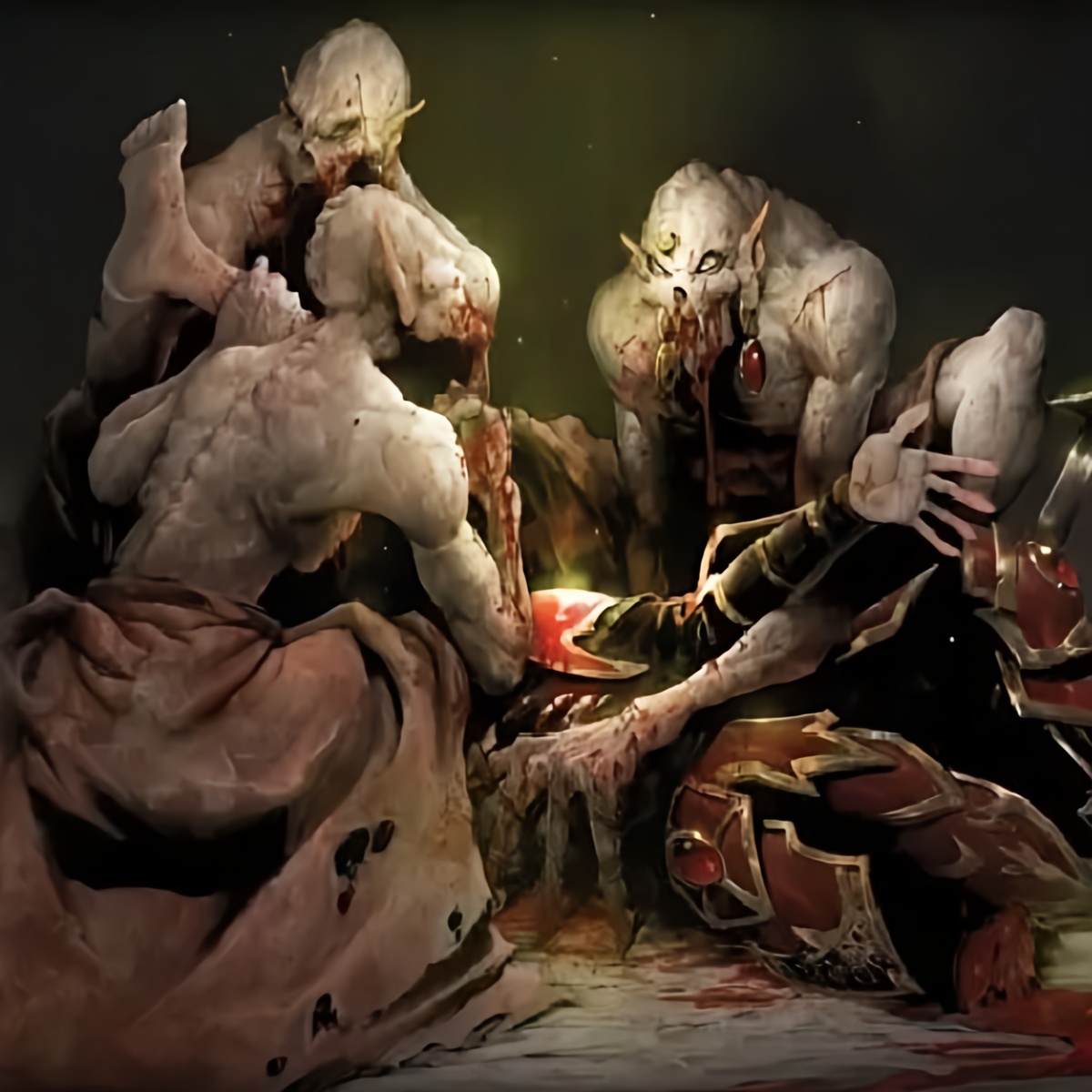
As with all peoples, the Skorne suffer their own unique ailments. Like the blacktongue that torments the children of northern Khador and Llael, or the ruby wastes that seasonally plague the people of Bainsmarket, Skorne throughout their vast empire spit to hear the word "Ravening." Ravening or Karovoul in the Skorne tongue, appears to be a kind of communicable psychological affliction. Similar to the way that some maladies lurk in the victim's blood, ravening spreads too by the exchang eof blood but in the most brutal way. As its name suggests, Ravening is a degenerative drive to cannibalism. The Skorne call those who contract ravening Genzoul, a combination of curse and warning in their tongue without a direct parallel in other languages. Words like "lepeer" elicit similar responses among western Immorese, but lack the same terror as ravening to Skorne. These Genzoul suffer from an obsessive addiction to the flesh of sapients, typically their own race. Degenerating into a feral state as their minds erode, those infectious cannibals attack any who come close. Those they kill become meals; those who escape, having felt their bites, risk becoming Genzoul themselves. Only the patient ministrations of an attentive nurse might stave off the gore-filled madness those infected with ravening face. In the Skorne Empire, the swiftest cure comes at the edge of a sword, and thus, few infected ever recover.
Genzoul are ravenous murderers exclusive to the Iron Kingdoms RPG in all its forms
- And Then John Was a Zombie: Genzouls can infect other living beings via bites, causing them to either slowly corrupt into Genzoul or resurrect as Genzoul after being killed.
- The Berserker: While capable of ambush tactics and laying traps, once the opportunity for prey reaches its apex a Genzoul will attack in a mindless frenzy.
- Carnivorous Healing Factor: Genzoul gain vitality by eating the flesh of sentient creatures.
- Chaotic Evil: Their in-universe alignment, as little more than Skorne Rage Zombies.
- Hyperactive Metabolism: In the Iron Kingdoms RPG - Unleashed, Genzouls have the "Snacking" rule, allowing them to heal by devouring living prey.
- It Can Think: Contrary to their appearance as generic flesh-and-brain-eating zombies, Genzouls still retain enough sentience to lay traps and stage ambushes against their prey. They frequently lie in wait near oases and other places where desperate individuals crossing the Bloodstone Desert will be forced to congregate, and where they will let their guard down so a Genzoul can attack.
- Man Bites Man: As expected of zombies, Genzouls fight primarily with their teeth, biting at foes.
- Mind Control: Those infected but not yet turned into a Genzoul can be subtly influenced by the Genzoul that infected them. In the d20 version of the Iron Kingdoms RPG this is explicitly labelled as an equivalent level of manipulation to the "Suggestion" spell.
- Non-Human Undead: Karovoul, the disease that turns Skorne into undead Genzoul, seemingly cannot infect any other species.
- Our Ghouls Are Creepier: Genzoul are those Skorne infected with karovoul (ravening), a form of psychological infectious disease. The course of this affliction consists of two phases. In the first phase, which takes place while a victim is still alive, the afflicted feels an unaccountable hunger for meat, preferring raw flesh over cooked. It is possible, but extremely difficult, to stave off the disease at this stage through fasting and considerable will. Animal meat has little impact on the hunger of karovoul, and soon the afflicted feel compelled to eat skorne flesh. The disease progresses to the second phase when the Skorne dies. If the corpse is not dismembered and burned, it will rise as a Genzoul within a handful of days. Those who are bitten by Genzoul risk becoming Genzoul themselves.
- Regenerating Health: In the d20 version of the Iron Kingdoms RPG Genzouls heal 3hp every turn until they're killed.
- Supernatural Fear Inducer: In the Iron Kingdoms RPG - Unleashed, Genzouls have the "Terror" special rule, inflicting fear just by proximity to the living.
- Super-Toughness: Despite not wearing any armor, in the d20 version of the Iron Kingdoms RPG, Genzouls instantly gain +4 Armor Class and have their hit dice replaced with d12s (equivalent to Fighters and Barbarians) upon becoming a Genzoul.
- The Virus:The Ravening is a viral disease that causes the creation of Genzouls, and Genzouls can spread it with infected bites and other infectious injuries against the still-living.

—Viktor Pendrake
One of the perils of the Skorne process of exaltation, Kovaas are the result of a Sacral Stone's destruction after its occupant has already been bound. Cracked shards of sacral stones and gilded stonework swirl within a Kovaas' ghostly form as it writhes and spasms in unending agony. Constantly screaming their hatred at the world that spawned them, Kovaas lash out spitefully at anything in their path. Driven to madness by the violent transformation, a Kovaas bears a hateful fury toward the living—those who destroyed or failed to protect its sacral stone and cursed it to an eternity of agony as well as those whose only crime is living when the Kovaas cannot. All are guilty in the Kovaas' twisted psyche, and it seeks to cast them into the searing embrace of the Void.
Kovaas can only be included accompanying Supreme Aptimus Zaal
- Ax-Crazy: Kovaas bear a hateful fury toward the living, care nothing for their own existence and hurl themselves at anything foolish enough to approach. Their madness makes them unpredictable; they may single out and attack a single target, ignoring all others, or they may strike indiscriminately at many different foes. Skorne history records several incidents of released kovaas causing tremendous destruction and killing thousands of people.
- Came Back Wrong: The destruction of a skorne exalted ancestor's sacral stone annihilates its personality and sanity, creating a hateful kovaas that tries to kill anyone still alive around it. The skorne view kovaas as an abhorrent corruption.
- From a Single Cell: A kovaas is all but impossible to permanently destroy. Even if its vessel is shattered and its pieces scattered, its spirit will survive and strive to reconstruct itself as long as a single grain of sand endures.
- Sealed Evil in a Can: Due to the difficulty of destroying a kovaas, high-ranking extollers instead employ specialised rituals to bind its spirit within a new sacral stone, but this will not restore its shattered mind. The new stone essentially becomes a prison and must be sealed away lest the kovaas escapes and continues its slaughter.

While such creatures are both unsettling and blasphemous to most skorne, the raging was have pushed the skorne leadership to accept their use in battle. The supreme archdomina’s decree authorizing the use of these spirits has caused some understandable strain within the ranks, particularly among the extollers, who are disturbed to see spirits put to such twisted and undignified purposes. Due to the work of Void Seer Mordikaar, void spirits have become common among the Army of the Western Reaches. He also taught the mortitheurges and extollers the manner by which they may summon void spirits and harness them as weapons, allowing others to continue the work he began.
All skorne become void spirits upon death, unless their souls are captured in sacral stones and turned into exalted or immortals.
Void spirits are available to Skorne forces as solo models. Normally they can only be included in "The Exalted" theme force, however they can also be included in any theme force that is being run by Mordikaar, as his nature causes a weakness in reality that allows void spirits to more easily return from Urcaen.
- Asshole Victim: Were the skorne not a race of slavering Torture Technician raiders, their souls being condemned to an existence of perpetual torture the second they left Caen might be sad.
- Enemy to All Living Things: Void spirits are those poor skorne souls who have died without being exalted, causing them to go insane with the torment of existence in the Void. Upon returning to the land of the living, their rage and anguish is made manifest in their utter toxicity to all living things. In-game this is reflected in their "Annihilator" unique special rule, which gives them boosted accuracy and damage against the living, so deadly is their touch.
- Flash Step: Their "Void Walk" ability allows them to teleport anywhere within 8" of themselves every time they score a kill.
- Fragile Speedster: If not for its "Incorporeal" special rule rendering it immune to all damage without "Damage Type: Magical," the void spirit's laughable defense and nonexistent armor would see it quickly slain.
- Ghastly Ghost: The briefest of exposures to the Void distorts the souls of dead skorne into the monstrosity seen in their page image.
- Intangibility: Void spirits greatly benefit from their "Incorporeal" special rule, which renders them immune to most attacks and damage types in the game as they pass harmlessly through them.
- Knockback: Their "Poltergeist" special rule allows them to push enemies up to 3" away whenever an attack misses them.
- Natural Weapon: Though they got to keep their clothes, void spirits do not have any weapons. They tear at enemies with their incorporeal fingers, seeking to rend their souls from their bodies.
- Non-Human Undead: It's impossible for a non-skorne, like a human, to become a void spirit after death.
- The Nothing After Death: Experiencing this creates void spirits from otherwise normal skorne souls. Void spirits are the horrific fate all skorne secretly fear, and are why all skorne work to become worthy of exaltation so they can escape it.
- Touch of Death: The void spirit's distended talons are anathema to living souls, dealing free boosted damage against all living models.
Battle Engines

With slow and measured steps, siege animantaraxes march alongside the armies of the mighty Skorne Empire as living siege engines. The ornate houdaas atop their backs bristle with weapons manned by veteran crews of Praetorians and Venators. From the vantage of the rear platforms that tower above the beasts’ lacquered armor, commanding dakars shout their orders and blow sonorous horns to signal the attack. A hail of reiver fire from its double reivers accompany the unstoppable advance of these great beasts. Incoming fire serves only to enrage them, and their handlers gladly indulge the beasts’ anger, watching with grim pleasure as the behemoths smash through their foes with slashes of their powerful clubbed tails. Spears and double-combed reiver guns keep time with the swing of the creatures’ deadly tails, delivering death to everything within reach.
Animantaraxes were known to the Skorne for centuries, and have long been highly prized by those few houses that could afford the cost of capturing them. Acquiring them and maintaining them with adequate supplies of meat would bankrupt a lesser house. The beasts’ incredible durability and strength made them ideal as weapon platforms in the largest house wars in the centuries before unification. House Balaash was feared and envied for the dozen Siege Animantaraxes it kept ready during the Wars of Unification. The Skorne Empire’s expansion north of the Shroudwall Mountains has led to increased availability of the notoriously intractable Animantaraxes. Impossible to breed in captivity, they are captured by teams of paingiver beast handlers supported by low-caste warriors and even cyclopes. These teams are dispatched into the dangerous plains north of the empire’s borders, where a number of the massive beasts have carved out their territories. The Archdomina has ordered the wealthy houses of Malaak to renew these efforts, sparing no expense to send the walking fortresses to the burgeoning fortifications of the Army of the Western Reaches.
- Armor-Piercing Attack: The club tail is similar to the Reckoner's club in that its base power is so strong it ignores almost all armor in the game.
- Beware My Stinger Tail: The animantarax's club tail is its single most powerful weapon, ranged or melee, dealing a base power of 18 and enough to auto-penetrate almost every armor in the game.
- The Juggernaut: Speed 8, "Pathfinder," "Trample," armor 20, "Reposition:3," "Dual Attack," and a staggering five attacks per turn minimum make the animantarax nigh-unstoppable without outright killing the beast. And since it's a battle engine instead of a colossal or gargantuan, it lacks the Subsystem Damage elements that mean it can keep going until Critical Existence Failure.
- Kill Steal: The animantarax is a carrion eater whose great bulk typically scares off any other scavengers. Those who attempt to defend the kill are killed and eaten as well.
- Knockback: Enemies hit by the club tail get knocked down automatically by its sheer mass, assuming they manage to survive the hit.
- Lightning Bruiser: Animantaraxes move faster than almost every skorne unit with a base speed of 8 and "Reposition: 3" allowing them to casually move 11 inches per turn. On top of that they have KhadorWarjack grade armor while packing five attacks per turn, including a power 18 Tail Slap.
- Military Mashup Machine: In-universe, animantaraxes combine the Mana-generating powers of warbeasts with the armor of a colossal and firepower of mobile artillery. Out of universe, animantaraxes are a sort of Living Ship combined with a Walking Tank and a battleship, complete with multiple turrets.
- More Dakka: The fore tower on the animantarax's back is armed with a double reiver, a superheavy version of the artillery piece that Venators have. It not only fires 25% more shots per turn on average, it also retains the "Burst Fire" special rule allowing it to improve accuracy and damage against larger targets through raw quantity of shots.
- Mounted Combat: Animantaraxes are classed as cavalry models, as they are a giant creature ridden by a number of skorne warriors. In melee the animantarax has only two attacks, while the skorne warriors account for three attacks between them.
- Named in the Sequel: In its first appearance in The Legion of Lost Souls (itself the third volume of the very first Iron Kingdoms publication), this creature is simply generically referred to as a skorne war beast (note the space; this predates the concept of warlocks and warbeasts). The name animantarax was not published until ten years later with Hordes: Domination.
- Natural Weapon: In melee the animantarax can use both is club tail and its powerful jaws as a base-power 15 bite.
- Siege Engines: Animantaraxes are used by Skorne forces in this capacity, essentially the living equivalent of a mobile artillery gun.
- Tail Slap: The animantarax's thick tail is capped by a club-like osseous growth that it can use as an improvised hammer to smash armor.
- Tank Goodness: With speed 8 and armor 20, animantaraxes are extremely fast armored weapon systems armed with heavy double reiver cannons.
- Trampled Underfoot: Their sheer mass has given animantaraxes the "Trample" special power attack, allowing them to engage in this trope and run roughshod over squads of enemy infantry thanks to being huge-based.
- Unstoppable Rage: In lieu of the FURY that warbeasts generate, animantaraxes generate "Rage Tokens" when damaged that they can spend the same way.
- War Elephants: Animantaraxes fill the more historically accurate role of this trope compared to the skorne's titan warbeasts, who are more literal "elephants" used for war.