
The latest info on influencer marketing trends, micro influencer news, and the world of social media

Choosing an Amazon influencer marketing platform is less about finding the biggest creator database and more about deciding which parts of the creator workflow your ecommerce team needs help running.
Amazon sellers may need creator discovery, product seeding, UGC production, Amazon storefront content, affiliate commissions, campaign follow-up, or Amazon Attribution. Some platforms specialize in one of those jobs. Others manage several of them together.
This guide compares eight current options and gives sellers a practical framework for choosing based on activation, content, commerce measurement, and campaign accountability.
The most useful buying question is not "Which platform has the most influencers?" It is "Which parts of an Amazon creator campaign will this platform actually own?"
Use the Amazon Commerce Fit Test before comparing feature lists:
This framework matters because Amazon influencer marketing can produce several different assets at once. A creator post can create awareness, a reusable UGC asset, external traffic, and a measurable Amazon shopping session, but only if the campaign and measurement systems are connected.
The accountability criterion is especially easy to underestimate. Stack Influence's verified company model ties platform spend to completed creator posts rather than incomplete participation, which is why the company describes the structure as completions-only. For sellers, the underlying decision rule is broader: compare what happens after a creator says yes, not only how many profiles a platform can surface.
Stack Influence's Amazon growth workflow is one example of a system built around creator activation, product seeding, content completion, and ecommerce campaign execution rather than creator discovery alone.
An Amazon influencer marketing platform is software or a managed service that helps sellers find, activate, coordinate, or measure creators who promote products sold on Amazon. Depending on the platform, the workflow may include creator discovery, product seeding, affiliate commissions, UGC production, Amazon storefront content, payouts, campaign tracking, or Amazon Attribution.
That is different from the Amazon Influencer Program, which gives approved creators a customizable presence on Amazon and a vanity URL where they can curate recommended products. The Influencer Program is an important creator-side ecosystem, but sellers still need a process for deciding which creators to work with and how campaigns will be executed.
Amazon also has a native brand-side campaign layer called Creator Connections, reviewed below. Third-party platforms and managed services can complement Amazon-native programs by adding creator sourcing, seeding, relationship management, content workflows, cross-channel execution, or broader reporting.
If creator identification is your main bottleneck, Stack Influence's guide to finding Amazon influencers explains the discovery side in more depth. If your problem is campaign execution, the comparison below is the more relevant decision.
These eight options represent different ways to run Amazon influencer marketing. They are not interchangeable, so the right comparison is workflow against workflow rather than one universal ranking.
Because this article is published by Stack Influence, Stack Influence appears first. Every option is evaluated against the same five workflow questions: activation, product, content, commerce, and accountability.

Stack Influence is a micro-influencer marketing platform built around gifted-first product seeding and managed campaign execution for ecommerce brands. The workflow connects vetted creator activation, product coordination, campaign communication, UGC generation, completion tracking, and Amazon-focused growth activity. Stack Influence works with roughly 600,000 vetted creators.
The completions-only model is designed to reduce the budget risk created when creators accept a campaign but never complete the agreed social deliverable. Rather than functioning only as a searchable directory, Stack Influence is designed to move a seller from product seeding to completed creator content while the platform handles the operational campaign layer.
Best-Fit Workflow: Stack Influence is especially practical for Amazon sellers that want micro-influencer or nano-influencer product seeding, creator coordination, UGC production, and completed-post accountability managed as one connected campaign.


Amazon Creator Connections is Amazon's native creator-campaign option for brands that want to offer bonus commissions on selected products to eligible Amazon Creators. Brands can define the product set, commission incentive, campaign period, and budget, which makes the program closely connected to Amazon's own commerce environment.
Its main strength is that it is Amazon-native and performance-oriented. Sellers should still decide who will handle creator briefing, off-Amazon content usage rights, product-seeding logistics, and any broader social campaign work that sits outside the native Creator Connections workflow.
Tradeoff: Creator Connections is best understood as an Amazon-native commission layer, not automatically as a replacement for every discovery, seeding, UGC, or creator-relationship workflow a seller may need.

GRIN is a creator-management platform with sourcing, outreach, gifting, affiliate links, codes, CRM, and reporting. Its current pricing page lists Free at $0 with 200 monthly Gia credits, Starter at $200 with 2,000 credits, Growth at $500 with 7,500 credits, Scale at $1,000 with 20,000 credits, and Complete at $1,500 with 30,000 credits. Plans are month-to-month, and credits meter the work its Gia system performs.
That pricing structure is a useful reminder that platform cost should be normalized by workload, not compared only by the lowest advertised price. GRIN's ecommerce workflows can support teams that want recurring creator relationships while keeping significant program ownership in-house, and its public materials also show Shopify integration plus SDK and webhook options for other commerce stacks.
Tradeoff: Amazon sellers should verify how their desired Amazon Attribution, catalog, and marketplace data will connect with the creator-management workflow before treating general ecommerce tracking as Amazon-native measurement.

Levanta is an Amazon-focused affiliate and creator platform. Its Amazon seller platform includes a creator marketplace, creator applications, custom commissions, sample fulfillment, paid placements, partner payouts, and Amazon Attribution API reporting for clicks, add-to-carts, conversions, and new-to-brand sales.
This structure makes Levanta particularly relevant when a seller wants to build a performance-based Amazon affiliate program and recruit creators or publishers around commission economics. It can also connect creator activity with Amazon's Brand Referral Bonus and reduce the manual work involved in partner payouts.
Tradeoff: Levanta's workflow centers heavily on affiliate and revenue-generating partnerships, so sellers should define separately how much organic social content, reusable UGC, creative approval, and creator follow-up they expect the platform or their internal team to manage.

impact.com Seller extends partnership marketing into Amazon. According to the impact.com Seller product page, brands can connect Amazon Seller Central through Amazon Attribution API integration, import their catalog, work with affiliates and influencers, manage reporting and contracting, and automate partner payouts. The company also states that its marketplace includes more than 405,000 vetted affiliates, influencers, and content publishers.
The platform is useful for sellers that want Amazon partnerships and direct-to-consumer programs managed within a broader partnership infrastructure. The same product page routes new customers to a sales demo and says eligible existing impact.com/performance customers can add Seller under their current contract while paying for additional payment-processing volume.
Tradeoff: The system is broad partnership software, so brands whose primary goal is gifted-first product seeding or a guaranteed social-content deliverable should map those operational requirements separately during evaluation.

Referazon is focused specifically on the Amazon influencer ecosystem. Its Amazon influencer platform covers shoppable videos, Amazon Live, influencer search, audience analytics, CRM workflows, sample tracking, and campaign management, making it one of the more Amazon-storefront-specific products in this comparison.
Availability requires a closer look as of September 2026. Referazon's Search & CRM signup page says the Search & CRM product is "Coming Winter 2026," while its shoppable-video service is already promoted on the live site. Sellers should therefore confirm which modules are available now before designing a workflow around announced functionality.
Tradeoff: Referazon is highly specialized around Amazon influencer discovery and on-Amazon creator content, but module availability is changing, so current feature access should be verified at purchase time.

Upfluence is a broader influencer marketing platform for discovery, outreach, campaign management, affiliate activity, creator payments, and ecommerce integrations. Its current pricing and feature page lists Amazon alongside Shopify, WooCommerce, Magento, and BigCommerce, says pricing is custom-quoted by module and program size, and states a 12-month minimum contract.
This can suit ecommerce teams that want Amazon creator activity connected with a wider multichannel influencer program. Upfluence also describes ecommerce integrations, product shipment, affiliation features, and sales analytics within its campaign-management tiers.
Tradeoff: Upfluence's broad multichannel scope means Amazon sellers should verify the exact Amazon reporting, attribution, and storefront workflow they need before committing.

Aspire combines influencer discovery, a creator marketplace, relationship management, product seeding, affiliate programs, content creation, and ROI reporting. The Aspire platform overview also highlights customizable workflows and a Shopify integration, which makes the product relevant to brands running creator programs across social commerce and direct-to-consumer channels.
For an Amazon seller, Aspire can function as the creator relationship and campaign-management layer while Amazon-specific measurement is handled through the seller's marketplace stack. That separation can be useful for teams that already have a mature internal process for creator selection, approvals, and reporting.
Tradeoff: Aspire's public platform materials emphasize broad social creator programs and Shopify rather than a dedicated Amazon-native measurement product, so sellers should confirm how Amazon Attribution data will be connected to their reporting process.
The best choice depends on which part of the creator workflow creates the most work for your team.
The important distinction is operational ownership. Two tools can both call themselves influencer marketing platforms while one primarily helps your team find creators and another manages much of what happens after those creators are identified.
Amazon sellers can combine platforms when creator discovery, campaign execution, affiliate commissions, and marketplace measurement are separate jobs. A layered stack often makes more sense than forcing one tool to cover every workflow.
One practical structure is:
For example, a seller might use Stack Influence for managed creator activation and completed social content, Creator Connections for an Amazon-native commission campaign, and Amazon Attribution for external traffic measurement. These layers solve different problems and can coexist.
The most common buying mistake is treating "influencer platform" as one software category. A creator search database, a micro influencer agency, an affiliate network, a UGC platform, and a managed product-seeding platform can all appear in the same search results even though they transfer very different amounts of work to the seller.
For a deeper view of where manual outreach creates workload, review Stack Influence's influencer outreach guide. Sellers comparing a broader software stack can also use the ecommerce influencer marketing tools guide to evaluate adjacent categories.
An Amazon influencer platform should be measured as a chain from creator delivery to commerce outcomes, not as a single engagement-rate score. The most useful reporting model separates leading indicators from marketplace outcomes.
Amazon Attribution is a free measurement solution for eligible sellers, vendors, and agencies that uses a 14-day last-touch model for non-Amazon marketing and can qualify US seller brand owners for a Brand Referral Bonus averaging 10% of product sales, subject to program eligibility.
If a seller uses 10% only as an illustrative planning rate, $5,000, $15,000, and $30,000 in qualifying attributed sales would correspond to about $500, $1,500, and $3,000 in bonus credit. Actual bonus rates and eligibility can vary, so those values are planning examples rather than guaranteed returns.
Attribution still has limits. A creator may influence a shopper who later returns through another channel, organic ranking may change while other marketing is active, and campaign-period sales movement does not prove one channel caused the result.
Stack Influence's Amazon Attribution guide and influencer measurement guide provide deeper implementation guidance.
No influencer marketing platform can compensate for a weak product page, poor unit economics, unclear creator briefs, or missing compliance controls. Software can reduce operational work, but seller judgment still determines whether the campaign setup makes sense.
Before launching, confirm five things:
Gifted products count as a material connection under the FTC's social media disclosure guidance, so creators need a clear and conspicuous disclosure when endorsing a product they received free or at a discount. A platform may provide workflow support, but the brand should still treat disclosure requirements as part of campaign design rather than a last-minute caption check.
Product seeding also works best when the item and creator have a credible reason to match. Stack Influence's influencer seeding guide explains how product fit, creator selection, logistics, and follow-up shape the execution side, while its Amazon external traffic playbook covers the marketplace economics of sending off-Amazon audiences to a listing.
The right Amazon influencer marketing platform should reduce the specific bottleneck limiting your creator program. For one seller, that is finding relevant Amazon influencers. For another, it is turning product seeding into completed UGC. For another, it is building a commission-based affiliate channel or connecting external traffic with Amazon sales.
Start with the Amazon Commerce Fit Test: activation, product, content, commerce, and accountability. Then identify which parts your team wants to own and which parts should move to a platform or managed workflow.
For ecommerce sellers that want creator sourcing, gifted-first product seeding, campaign coordination, UGC generation, and completed-post accountability connected in one workflow, evaluating a managed micro-influencer campaign is a practical next step.
This article was last updated on September 8th, 2026.
Marketplace rules and platform features move fast, and a navigation overhaul, a price-history expansion, or a shifting holiday forecast can quietly reshape how shoppers find and judge your listings before you notice it happened. Staying current is one of the cheapest forms of protection a seller has.
This guide is updated every week with the latest eCommerce news and seller-relevant platform changes across Amazon, Shopify, Walmart, eBay, and TikTok Shop, newest items first.
Want these updates before they hit this page? Subscribe to The Merchant Memo and get the week's biggest seller news in your inbox first.
Also worth bookmarking:
This page grows every week, so the deeper into the year we get, the more useful it becomes as a single scan of the amazon seller news, tiktok shop updates, and broader ecommerce trends that actually moved margins. Bookmark it and check back after each weekly update lands.
If you're a seller working to fill the gap between organic reach and paid ads, one workflow that touches several trends above, from AI agents rewarding clean, complete listings to creators carrying more of holiday spend, is sourcing UGC and creator content at scale: Stack Influence connects Amazon and Shopify brands with everyday creators for gifted-product collaborations that produce exactly that kind of content.
Want every update like this as it breaks, rather than waiting for it to hit this page? Subscribe to The Merchant Memo for the weekly version in your inbox.
Before spending more to improve your Amazon rankings, identify what is actually missing: visibility, clicks, purchases, or profitable demand. Those problems require different fixes.
For ecommerce sellers learning how to rank on Amazon, the practical starting point is one product and a clear set of relevant searches. Make the listing accurate and available, remove buying objections, then test how qualified shoppers respond.
This guide explains how to prioritize those improvements, apply Amazon’s current listing requirements, use advertising and creator campaigns responsibly, and distinguish genuine search progress from a dashboard that merely looks better.
To improve Amazon search visibility, work through the buyer’s path and correct the earliest point where relevant demand stops progressing. The First Broken Step Method is a prioritization checklist for sellers, not a claim about Amazon’s undisclosed ranking weights.
Apply it to one ASIN, Amazon’s product identifier, and a manageable group of purchase-relevant queries:
Profitability is your business constraint, not a claimed Amazon ranking signal. The checklist prevents a common decision error: increasing traffic before resolving a problem that makes the traffic unproductive.
Start in Manage All Inventory. Check the intended child ASIN, listing status, available inventory, product information, and live buying experience before changing your keyword strategy. Keep a dated record of corrections so later performance changes have context.
For a deeper explanation of the underlying controls, Stack Influence’s guide to the Amazon algorithm and seller-controlled improvements separates catalog, offer, content, and measurement decisions.
Organic keyword position describes where a product appears among unpaid results for a particular search. Best Sellers Rank, or BSR, describes sales performance relative to products in a category. According to Amazon’s BSR explanation, BSR considers recent and historical sales, with recent sales receiving greater weight; page views and customer reviews do not directly determine it.
A campaign can therefore show encouraging sales and category movement without proving improvement for a specific keyword.
During Stack Influence’s three-month Remilia campaign, average monthly unit sales increased from 141 to 306, while BSR moved from #78,412 to #49,807. Those figures document sales and category-rank movement during the campaign, not a measured position for an individual search query.
That distinction determines your reporting plan: track keyword visibility separately instead of asking BSR to answer every ranking question. The campaign example also does not isolate creator activity from other influences on sales.
Choose keywords that describe the product accurately before choosing keywords with attractive search volume. A smaller, relevant search opportunity is more useful for planning than a large audience looking for something you do not sell.
Amazon’s SEO guidance recommends researching Amazon search suggestions, examining competing offers, and using tools such as Product Opportunity Explorer to understand search demand. It also describes backend search terms as a place for relevant synonyms and alternative product names.
Organize your working keyword set around the product’s identity, differentiating attributes, and use case. For a hypothetical commuter backpack, that might mean “laptop backpack,” “15.6-inch laptop backpack,” and “work backpack with luggage sleeve,” provided each description is accurate.
Keep branded searches separate from generic searches from the beginning. Someone searching your brand name presents a different measurement question from someone comparing an entire product category.

For U.S. sellers, older advice about putting everything into a 200-character title needs updating. Under Amazon’s July 27, 2026 title announcement, titles in categories other than media must fit within 75 characters, including spaces, while Item Highlights provides an additional 125 characters.
Amazon’s follow-up title clarification confirms that both fields are search inputs, neither is prioritized over the other, and the combined capacity remains 200 characters. It also describes a phased recommendation process during 2026, not immediate removal of every longer-title listing.
Keep the brand, product type, and most important variation details in the item name. Use Item Highlights for additional distinguishing information rather than repeating the same phrases.
An illustrative item name could be: “Harbor Daily Backpack, Fits 15.6-Inch Laptops, 20 L, Black.”
The supporting highlights could explain the luggage sleeve, organizer pockets, and intended use, assuming those features are accurate. Review generated suggestions against the actual product rather than accepting them merely because they fit the character limits.
Use bullets to answer practical buying questions: what fits, what is included, how the product works, and which limitations matter. Replace vague claims such as “premium quality” with concrete specifications or demonstrable benefits.
Use backend terms for relevant language that does not fit naturally in customer-facing copy. Avoid turning that field into another copy of the title; Amazon specifically advises against redundant or irrelevant terms.
Complete the applicable structured attributes, including size, material, compatibility, and product type. Then inspect the live detail page to confirm the intended information appears correctly.
When catalog cleanup requires outside help, evaluate Amazon listing services by their deliverables, such as attribute corrections, copy, images, and testing support, rather than by a promise to deliver a particular ranking.
Once the listing communicates relevance, examine the buying decision. Identify the question a shopper still cannot answer from your images, specifications, offer, or product explanation.
For the backpack example, useful evidence would show its dimensions, laptop compartment, internal organization, and how the luggage sleeve works. A general claim that it is “great for travel” provides less decision support than showing exactly what it holds.
Creator demonstrations can contribute to that evidence. Plan user-generated content around specific product questions, and confirm that your usage rights cover the placements where the content will appear.
Review total price, delivery promise, stock availability, and the offer shoppers actually see. Amazon’s Featured Offer guidance explains the importance of competitive pricing, delivery, and inventory when competing for the offer associated with the main purchase buttons. Featured Offer visibility is a different issue from the product’s organic keyword position.
Treat Amazon FBA as a fulfillment decision, not a substitute for listing relevance or a compelling offer. Evaluate whether your chosen fulfillment method supports the delivery experience and inventory availability your campaign requires.
Discounts also need an economic purpose. Before reducing price, calculate what remains after product costs, Amazon fees, fulfillment, promotion costs, and an allowance for returns. More orders are not automatically a better business outcome.
Eligible brands can use Manage Your Experiments to compare listing content such as images, titles, bullets, and A+ Content. Access depends on account and brand eligibility, and the product needs sufficient traffic for an experiment.
Write the hypothesis before making the change. For example: “Showing the internal dimensions will help shoppers determine whether their laptop fits.”
Where possible, test that specific change rather than simultaneously replacing every image, changing the price, and launching a new campaign. Otherwise, a positive result will not tell you which decision deserves credit.

Use Amazon advertising to learn which searches produce relevant clicks and purchases. Do not treat a sponsored placement as proof that the product has earned the same position organically.
Amazon’s Sponsored Products targeting guide distinguishes automatic targeting, manual targeting, and negative targeting. Automatic campaigns can surface search opportunities, manual campaigns provide control over selected targets, and negative targeting helps exclude unwanted traffic.
Build a test around the uncertainty you need to resolve. If you do not know which use-case searches attract buyers, discovery is the objective; if a query already produces relevant purchases, test whether a controlled budget can support that demand economically.
Review actual customer search terms, not only the keywords you entered. A keyword is your targeting instruction; the customer’s query is the phrase that triggered the opportunity.
Set the spending boundary before increasing bids. Estimate the contribution available to acquire an order after variable costs, then compare it with observed acquisition cost. Avoid assuming future repeat purchases will rescue an unprofitable first order unless your own customer data supports that assumption.
Continue measuring organic positions independently. Advertising performance can inform your listing and demand strategy, but it does not establish that a particular spend level guarantees organic placement.
Design influencer campaigns around a reason for the audience to care about the product. For micro influencers and nano influencers, evaluate audience relevance, content quality, and the ability to explain a real use case rather than using follower count as the sole selection rule.
A useful creator brief identifies the buyer’s problem, the product feature that addresses it, and the demonstration that makes the connection understandable. Stack Influence’s guide to finding Amazon influencers develops an evidence-first approach to evaluating creator suitability.
Separate content production from distribution in your plan. A UGC video may be useful for a licensed product demonstration even when the creator’s audience is not the primary acquisition channel.
Stack Influence’s product-seeding workflow supports gifted-first creator activation and campaign execution. Its completions-only model ties the platform’s campaign accountability to completed creator posts, not guaranteed sales, reviews, or rankings.
Do not ask compensated creators to leave Amazon customer reviews. Amazon’s customer-review policy explanation prohibits incentives such as free products, discounts, refunds, or other compensation in exchange for reviews. A social-content deliverable and an Amazon customer review are not interchangeable.
For eligible products, Amazon Vine is Amazon’s own program for obtaining independent reviews from invited reviewers. It should not be represented as a way to require positive feedback.
Keep ranking manipulation outside the campaign as well. Amazon’s Seller Code of Conduct prohibits manipulating sales rank through activities such as non-authentic orders or orders paid for or refunded externally. Do not turn creator compensation into a mechanism for manufacturing retail demand.
Creators should disclose a material relationship with the brand, including free products or payment. The FTC’s influencer disclosure guidance explains that these connections should be clear to the audience, even when a brand has not explicitly requested a mention.
Agree on disclosure, content rights, product claims, and deliverables before activation. Send shoppers to the product or storefront destination that matches the content, rather than promising one item and landing them on a confusing collection.
Use content completion to evaluate campaign delivery. Use attributed purchases and business results to evaluate demand. Neither metric alone proves organic ranking improvement.
Track the same product against the same query set over time, while recording advertising, pricing, inventory, and campaign changes. Organic position is the direct visibility measure; query-level performance and profitability help explain whether that visibility is useful.
For eligible brands, Amazon Brand Analytics provides Search Query Performance information on impressions, clicks, cart additions, and purchases. Review branded and non-branded queries separately rather than treating the brand’s total search activity as one uniform audience.
Amazon’s Search Query Performance documentation states that its metrics include organic and Sponsored Products activity originating from search results. It is therefore not an organic-only ranking report.
Use three connected measurement layers:
Compare equivalent reporting periods and keep measurement conditions consistent. Record the marketplace, query, ASIN, and observation method so a change in your collection process does not masquerade as a ranking change.
A higher overall conversion rate does not necessarily mean the listing converts either audience more effectively. The aggregate can improve because a greater share of traffic comes from shoppers who already know the brand.
Consider an illustrative scenario for one ASIN across two hypothetical four-week periods. Each period contains 1,000 search clicks, split into non-overlapping branded and generic groups; assume each click produces at most one purchase.
Overall conversion rises by four percentage points, while both segment-level conversion rates remain unchanged. The example contains no evidence that generic keyword positions improved.
This is why creator-driven brand demand and generic search progress should be reported separately. Either can be valuable, but they answer different questions.
Set up Amazon Attribution before launching eligible off-Amazon campaigns. The tool measures shopping activity associated with tagged traffic and uses a 14-day attribution window, so reporting immediately after a campaign ends can miss later qualifying purchases.
Use distinct tags for the campaign sources or creative groups you need to compare. Treat attributed purchases as evidence of a measured customer path, not proof that every purchase was incremental or that the campaign caused an organic ranking change.
For eligible enrolled sellers, the Amazon Brand Referral Bonus averages 10% of qualifying sales, with the actual amount affected by factors including product category and sales price. It is not 10% of advertising spend and should not be modeled as a guaranteed cash refund.
Include confirmed credits in your campaign economics without counting them twice. Stack Influence’s profit-first external traffic playbook provides a broader approach to connecting acquisition costs, marketplace measurement, and contribution.
Use four weeks as an operating cadence, not a promise that a product will reach page one.
During the first week, establish the baseline. Select the ASIN and query groups, check listing availability, record the offer and inventory position, and capture your starting visibility and sales measurements.
During the second week, repair the first broken step. Correct inaccurate attributes, apply the current title structure, or address the most important unanswered buying question. Document the change and avoid unrelated edits where practical.
During the third week, test a defined source of qualified demand. That could be a targeted advertising campaign or a creator activation built around one product use case, provided the listing, inventory, tracking, and compliance requirements are ready.
During the fourth week, review the evidence and choose the next action. Continue, revise, or stop based on the affected query group and campaign economics, while allowing attribution windows and content experiments to mature. Low-volume products may require a longer observation period before a reliable decision is possible.
Learning how to rank on Amazon means learning which problem to solve next. An unavailable offer needs a different intervention from an unclear listing, and a profitable increase in branded demand is different from a gain in generic organic visibility.
Start with one ASIN, identify the first broken step, and make a change you can measure. Expand only when the evidence supports the next investment.
When the listing is ready for additional demand, evaluate a Stack Influence product-seeding campaign around a specific buyer use case, completed creator content, and measurable traffic. The objective is useful creator participation and a clearer path to sustainable sales, not a ranking promise.
Buying Amazon listing services sounds simple until several proposals use similar language for completely different jobs. One provider may write titles and bullets. Another may repair variation relationships and suppressed listings. A third may produce image stacks and A+ Content, while a growth partner may activate creators after the listing is ready.
That distinction matters for ecommerce sellers because a capable provider can still be the wrong purchase when its scope does not match the actual bottleneck. This guide defines the service category, compares eight active providers, introduces a six-layer evaluation framework, and explains how to judge pricing, measurement, and contract terms.
Amazon listing services are professional workflows that create, repair, optimize, publish, or improve product detail pages and their supporting catalog data. Depending on the provider, the work may include keyword research, titles, bullets, descriptions, images, A+ Content, backend attributes, variation setup, compliance fixes, implementation, and performance monitoring.
Amazon’s current product-listing guide defines a listing as two connected parts: the product detail page and the offers associated with it. The detail page contains information such as the product name, images, and description, while an offer includes pricing, shipping, and promotional information. A polished page can therefore underperform when price, inventory, fulfillment, or offer eligibility is the real problem.
Amazon’s product detail page rules also make catalog accuracy, authorized representation, and policy compliance part of the workflow. Sellers comparing providers should distinguish creative optimization from technical catalog management instead of assuming every agency handles both.
A complete service may include six different job categories:
Sellers who need a detailed do-it-yourself reference can use this Amazon listing optimization guide to audit the title, images, bullets, description, keywords, and conversion assets before deciding which tasks require outside help.
Amazon now provides optional generative AI listing tools that can create drafts from a short description, image, product-page URL, or catalog file. Amazon also states that sellers remain responsible for making any changes required to represent products accurately. A paid service should therefore provide more than a first draft, such as category research, positioning, creative direction, quality assurance, implementation, or experimentation.
A useful proposal should identify which listing layers the provider owns, which layers require separate fees, and which layers remain the seller’s responsibility. The Six-Layer Listing Service Scope Map prevents buyers from comparing a copywriting package with a full catalog-management engagement as though they were interchangeable.
Amazon’s A+ Content design guidance describes Basic A+ Content as a combination of text, images, logos, and other modules available to eligible professional sellers enrolled in Brand Registry. Premium A+ offers additional module types for eligible brands. A proposal mentioning “enhanced content” should specify the exact modules, copy, design, uploads, revisions, and source files included.
For catalog or account-level support, sellers can also use the Amazon Service Provider Network to find vetted third-party providers and filter by service type, location, language, reviews, and other criteria. Amazon states that providers in the network must meet defined standards and are monitored over time, although sellers still need to evaluate the specific engagement and contract.
A review of seven direct listing providers’ official pages on August 29, 2026 scored whether each provider explicitly disclosed support for six components: keyword research, copywriting, images or creative, A+ Content, catalog implementation, and ongoing monitoring or reporting.
This is a public-scope disclosure score, not a quality ranking. A provider may perform work that is not described on its public page, while a disclosed deliverable does not prove the quality, turnaround time, or strategic depth of the work.
Stack Influence is evaluated separately because its workflow addresses creator activation, product seeding, UGC, and external demand rather than the six direct listing-production components. Sellers can pair that execution layer with an internal team, an agency, or one of the Amazon listing optimization tools used to build and maintain the page.
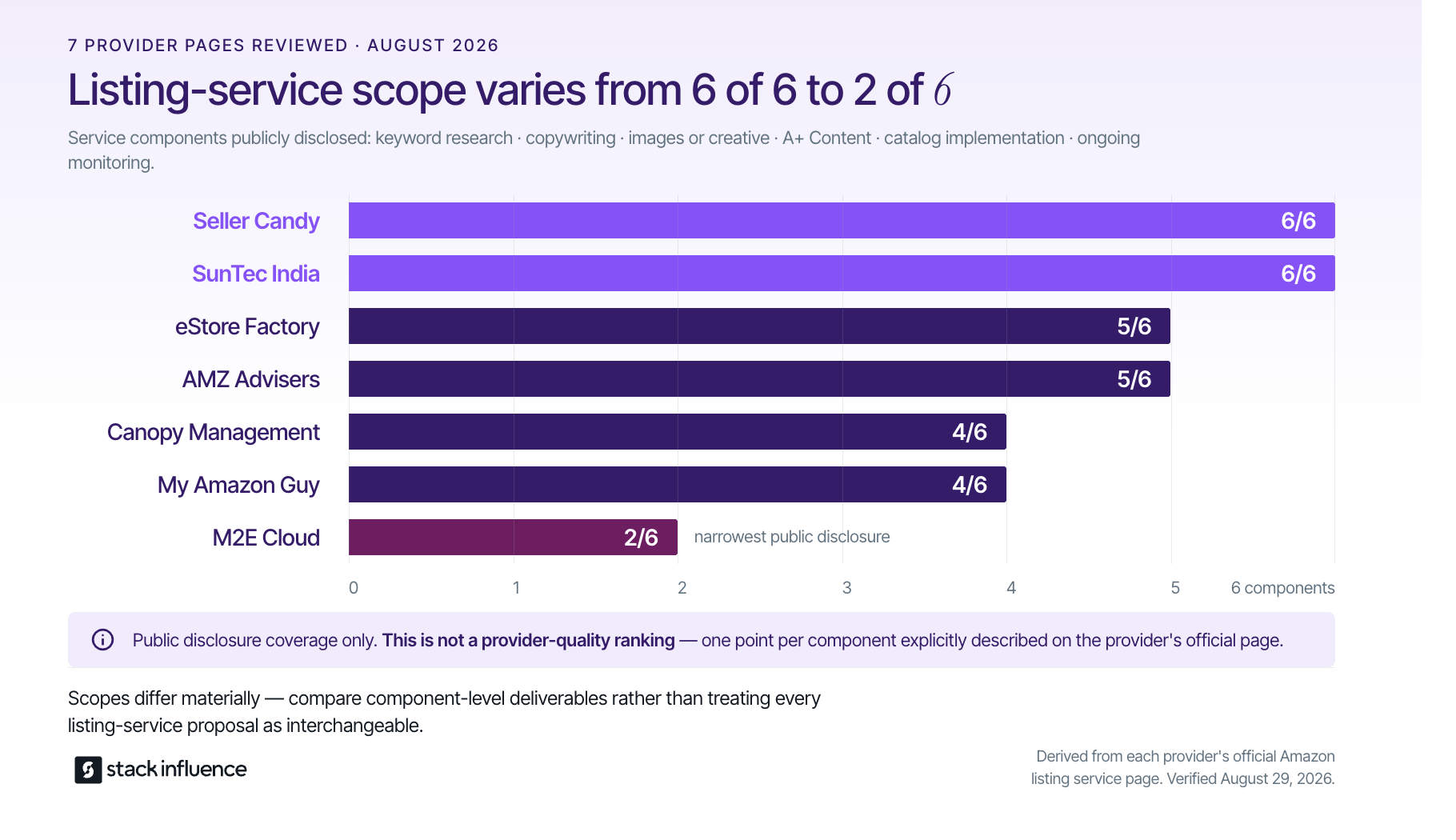
Hire an Amazon listing service when the problem is clearly defined and the cost of delay or internal workload exceeds the cost of specialist help. The strongest triggers are a new catalog launch, suppressed or inaccurate listings, weak click-through, low conversion despite qualified traffic, marketplace expansion, or an overloaded ecommerce team.
The symptoms should determine the scope:
The corrective insight is that a listing rewrite is not the default answer to every performance decline. A seller should compare search impressions, clicks, conversion, pricing, inventory, ad changes, and competitor movement before changing content. The same diagnostic discipline used in an Amazon competitor analysis can prevent an agency from solving the wrong problem.
Amazon sellers should also separate controllable listing inputs from marketplace outcomes. This guide to what sellers can control in Amazon’s algorithm explains why content quality, conversion readiness, offer health, inventory, and qualified traffic are more actionable than trying to reverse-engineer a single ranking formula.
The providers below represent different operating models: recurring Seller Central support, fixed-price listing optimization, creative production, catalog outsourcing, global listing deployment, and post-listing creator activation. Stack Influence appears first as the adjacent growth layer, followed by seven providers whose public pages directly describe listing creation or optimization work.
Stack Influence is a micro-influencer marketing platform built around gifted-first product seeding, vetted creator activation, campaign coordination, UGC generation, and completed-post accountability. The platform works with roughly 600,000 vetted creators and supports ecommerce brands that want to turn a retail-ready Amazon listing into a destination for measurable creator traffic and reusable content.
Its Amazon workflow can connect Amazon influencer marketing solutions, automated product seeding, and UGC for ecommerce. This gives sellers an execution path for creator demonstrations, product education, social content, and external demand after the core catalog, copy, imagery, and offer are stable.
Best-Fit Workflow: Stack Influence is designed for sellers that want creator participation, product seeding, campaign coordination, and completed content managed through one connected workflow. It can complement an internal listing team or listing agency by supplying fresh creative inputs and external traffic rather than functioning as another keyword or copywriting service.

Seller Candy’s Amazon product listing service combines keyword and competitor research, content rewriting, imagery, A+ Content, implementation, monitoring, and support for issues such as inaccurate data or suppressed listings. Its model is built around an ongoing Seller Central task queue rather than a single finished copy document.
The company publicly listed four monthly plans on August 29, 2026: $997, $1,197, $1,500, and $2,500. The plans differ partly by simultaneous task capacity and support access. Sellers should compare the number and complexity of their monthly tasks with that capacity, because a recurring subscription may include considerably more operational support than one ASIN rewrite.
Tradeoff: A seller with one stable product and a narrow copy request may be purchasing more operating capacity than needed. The subscription becomes more relevant when catalog fixes, support cases, uploads, and continuous optimization create a recurring backlog.

My Amazon Guy’s listing optimization package publicly lists a $1,000 base price and describes backend search terms, keyword-led titles, bullets, descriptions, professional graphics, and A+ Content. Its page also displays a $600 Brand Story option, giving sellers more initial price visibility than many custom-quote agencies.
The package is structured around a defined listing overhaul, which can simplify purchasing for a seller that knows which ASIN needs attention. Before ordering, buyers should confirm the number of image concepts, revision rounds, editable files, photography requirements, implementation responsibilities, and post-publication monitoring.
Tradeoff: The public page focuses on the optimization deliverable rather than a recurring catalog-management queue. Sellers needing ongoing support cases, variation repairs, or continuous experimentation should define those responsibilities separately.

eStore Factory’s Amazon listing optimization service describes keyword research, titles, bullets, descriptions, backend terms, product setup, A+ Content, product photography, infographics, and related Amazon account services. Its broader menu can support brands that want to source copy, creative, and marketplace services from one organization.
The reviewed page did not publish a standard package price. Sellers should request an itemized proposal showing which deliverables belong to the listing package and which are separate services, particularly photography, infographics, A+ modules, translations, account management, and Seller Central implementation.
Tradeoff: A broad service menu creates flexibility, but it also makes scope discipline important. Buyers should avoid approving a general “listing optimization” line item without the number of ASINs, images, modules, revisions, and marketplaces in writing.

Canopy Management’s product listing optimization service emphasizes competitor and keyword research, Amazon-focused copywriting, backend terms, photography, videography, A+ Content, and image concepts that can be tested. Its public positioning is particularly creative-heavy, connecting search relevance with visual merchandising.
The reviewed page did not provide a standardized public package price. Sellers evaluating Canopy should confirm whether the engagement includes original photography, product shipping, video, main-image concepts, editable design files, A+ implementation, experiment setup, and reporting after publication.
Tradeoff: The creative breadth may produce a larger engagement than a copy-only refresh. Sellers should define whether they need the complete creative system or a narrower subset before comparing its proposal with lower-scope providers.

SunTec India’s listing optimization service describes keyword research, copy, A+ Content, image editing, category optimization, browse-node work, conversion analysis, policy monitoring, and reporting. It also lists support across numerous Amazon marketplaces, making localization and multi-market catalog work an important part of its public scope.
Pricing is customized rather than presented as a standard public package on the reviewed page. Sellers considering a broad outsourcing engagement should document account permissions, approval stages, marketplace ownership, escalation rules, file security, and the precise actions the provider may perform without advance approval.
Tradeoff: A large operational scope creates more governance requirements. The seller should require an ASIN-level change log and named approvers so catalog, compliance, and creative updates do not become difficult to audit.

M2E Cloud’s Amazon listing service is centered on transforming existing store data into Amazon-ready listings, supplying missing attributes, configuring synchronization, selecting categories, creating new ASINs, and uploading large catalogs. The company also states that its ecosystem supports more than 600 marketplace integrations.
This workflow is especially practical when a Shopify, WooCommerce, Magento, or other ecommerce catalog must be adapted to Amazon and kept consistent across channels. It also supports sellers managing Amazon FBA or FBM listing data alongside inventory and pricing updates.
Tradeoff: The public scope is oriented toward catalog operations and multichannel consistency rather than persuasion-heavy positioning. Sellers needing original photography, A+ design, deep keyword research, or benefit-led copy should confirm whether those tasks require separate creative support.

AMZ Advisers’ Amazon product listing services page discusses keyword and competitor research, titles, bullets, descriptions, images, A+ Content, backend terms, content uploads, analytics, and ongoing performance monitoring. Its listing work sits within a broader Amazon growth and account-management offering.
The reviewed page did not publish a standardized listing package price. Sellers should request an ASIN-level scope that identifies the research deliverables, creative assets, implementation work, monitoring period, revision limits, and whether broader advertising or growth services are included.
Tradeoff: Because the company presents listing optimization as part of a broader growth system, a buyer should distinguish the listing-specific work from account management, advertising, or expansion services when comparing proposals.
Amazon listing services are usually priced per ASIN, through a monthly task subscription, or as a custom project or retainer. Public prices verified on August 29, 2026 include a $1,000 My Amazon Guy listing package and Seller Candy subscriptions from $997 to $2,500 per month, but deliverables differ materially.
Four pricing models commonly appear in proposals:
The two public examples should not be treated as an industry benchmark. Seller Candy’s plans cover a recurring task model, while My Amazon Guy presents a defined listing package. A useful price comparison must normalize the number of ASINs, asset types, revisions, implementation responsibilities, and support period.
Sellers should also calculate the conversion improvement required to recover the service cost. Consider an illustrative scenario with 10,000 monthly sessions, a $30 average order value, and a 25% contribution margin after marketplace fees, fulfillment costs, advertising-related variable costs, returns, and product cost.
The formula is:
Monthly contribution profit = sessions × conversion rate × average order value × contribution margin.
Under these assumptions, a $1,000 project needs an absolute conversion lift of approximately 1.33 percentage points to recover its cost through one month of incremental contribution profit. That means moving from 10% to approximately 11.33%, assuming traffic, order value, margin, inventory, and other conditions remain constant.
This is an illustrative calculation, not a promised outcome or industry benchmark. Sellers should replace every input with ASIN-level data and consider whether the improvement is likely to persist. An Amazon keyword ranking guide can help diagnose search visibility, but the financial case should still end with profit rather than rank movement.
Sellers should measure listing work as a sequence from impressions to clicks, cart additions, purchases, and contribution profit, then isolate whether the listing change plausibly influenced each step. Rankings alone are insufficient because price, inventory, ads, reviews, coupons, seasonality, and competitor actions can change performance during the same period.
Use a Listing Evidence Stack with five layers:
Amazon Brand Analytics provides Search Catalog Performance and Search Query Performance data for eligible brands. Amazon describes metrics including impressions, clicks, click rates, cart additions, purchases, conversion rates, and brand-level query shares, allowing sellers to identify where shoppers leave the path to purchase.
Eligible Brand Registry sellers can use Manage Your Experiments to test titles, images, descriptions, bullets, and A+ Content. Amazon says customers are randomly split between content versions and that sellers can compare sales and conversion results, which creates stronger evidence than an uncontrolled before-and-after comparison.
When creator posts, social ads, email, search, video, affiliate links, or other external channels send traffic to Amazon, Amazon Attribution can measure eligible non-Amazon campaigns. Amazon describes the product as a free measurement solution for eligible participants and specifically includes affiliate and influencer campaigns among the channels it can track.
A verified Stack Influence case study provides an example of why measurement should combine campaign delivery, traffic, and marketplace outcomes. During a three-month Targus campaign, average monthly unit sales increased from 56 to 221 while Best Seller Rank moved from #151,547 to #47,811. The campaign included 120 creator promotions, 275,560 social impressions, and 4,323 engagements.
Those values describe what occurred during the campaign, not proof that creator activity independently caused every marketplace change. Product demand, pricing, advertising, inventory, competition, reviews, seasonality, and other variables may also contribute.
For an uncontrolled update, preserve at least one comparable baseline period and avoid changing price, ads, coupons, copy, and images simultaneously. A 28-day baseline followed by a 28-day observation period is a practical starting point for many sellers, but lower-volume ASINs may need more time to accumulate meaningful data.
The operating principle is simple: connect the listing to the full traffic system. Stack Influence’s guides on how to drive traffic to an Amazon listing and Amazon algorithm controls can help sellers separate content changes from traffic-generation work.
The most overlooked buying criterion is not the number of keywords or graphics. It is whether the seller receives the assets, records, and documentation required to maintain the listing after the engagement ends.
Require the provider to deliver:
A provider should not be the only party that knows what changed. Without a version history, a seller cannot isolate performance, reverse a harmful update, onboard another partner, or determine whether Amazon has overwritten a contribution.
Usage rights deserve particular attention when listing creative includes UGC, creators, models, licensed graphics, or third-party photography. The contract should state where each asset may appear, how long the rights last, whether paid advertising is permitted, and whether editable files are included.
A strong procurement process begins with one hero ASIN and a written diagnosis. Ask every provider the same questions so differences in scope remain visible.
Do not begin with the largest catalog. A paid pilot on one representative ASIN reveals how the provider researches, writes, communicates, handles revisions, implements changes, and interprets data. That evidence is more useful than a proposal filled with broad performance promises.
Amazon listing services create the most value when the provider’s workflow matches a diagnosed constraint. Catalog specialists should solve catalog problems. Creative teams should solve presentation problems. Optimization partners should connect search relevance with conversion, while growth partners should expand proof and demand once the retail foundation is stable.
Start by auditing one hero ASIN through the six-layer scope map. Establish the baseline, define the deliverables, preserve asset ownership, and calculate the contribution-profit lift required to recover the project cost.
When the listing is retail-ready and the next constraint is creator proof, UGC, or measurable external demand, assess whether a managed product-seeding campaign can extend the work beyond the product page. The goal is not to buy the longest service list. It is to build a listing system your team can measure, maintain, and improve.
The wrong influencer software can create more work than it removes. A seller may buy a huge creator database, then discover that outreach, product fulfillment, content approvals, usage rights, payments, and attribution still live in separate spreadsheets. A content creator may join several marketplaces, yet receive few relevant opportunities because the platforms use different participation models.
This guide compares nine of the best influencer marketing tools for ecommerce sellers and content creators in 2026. It explains what each platform actually owns, how creators gain access, where product seeding and UGC fit, what current pricing signals reveal, and how to measure a tool beyond its headline creator count.
An influencer marketing tool is software, a marketplace, or a managed platform that helps brands and creators complete one or more parts of a partnership workflow. Typical functions include creator discovery, outreach, product seeding, campaign management, content approval, UGC storage, affiliate tracking, payments, reporting, and relationship management.
The category includes several different products. Discovery databases help teams build shortlists, while creator marketplaces let brands and creators opt into opportunities. Campaign platforms organize briefs, contracts, approvals, content, and reporting.
Affiliate tools connect creator activity to sales. Managed platforms take responsibility for more of the execution rather than only supplying software.
That distinction matters because a seller learning how to hire influencers systematically may need an end-to-end operating layer, while an experienced creator manager may only need better discovery or analytics. Content creators face the same decision from the other side: some tools expose open campaigns, while others primarily support brand-led outreach.
The Campaign Ownership Test evaluates an influencer tool by the handoffs it controls. Instead of asking whether a platform has “AI discovery” or “analytics,” map who performs each action, what evidence confirms completion, and where the next person receives the information.
Use six layers:
Governance is not optional. The FTC's disclosure guidance says creators should disclose material connections, including free or discounted products, and place the disclosure where people can notice it. A useful platform should make the requirement visible in the brief and review process rather than treating compliance as a final reminder. (Federal Trade Commission)
For creators, the same test reveals whether a platform supports a real working relationship or only stores a profile. A strong creator experience makes the offer, deliverable, compensation, rights, approval process, and payment trigger understandable before work begins.
Published creator-universe figures vary dramatically. Stack Influence's supplied company data lists roughly 600,000 vetted creators; GRIN reports 700,000-plus active creators; Upfluence describes 14 million-plus vetted creator profiles; CreatorIQ publishes 20 million profiles; HypeAuditor lists a 227.2 million-plus database; and Modash indexes 380 million-plus public Instagram, TikTok, and YouTube profiles with more than 1,000 followers. (GRIN - Influencer Marketing Software)
Those numbers should not be ranked as though they measure the same asset. An opted-in creator network indicates potential willingness to collaborate, while a public-profile index maximizes research coverage but does not guarantee that a creator will reply, accept a product, or complete a campaign. Compare the access definition, freshness, filters, activation method, and completion workflow before treating the largest number as the strongest option.
These tools were selected for active 2026 availability, ecommerce relevance, verifiable official documentation, and a meaningful role in the brand-to-creator workflow. This is not a universal scorecard. The reviews are organized around workflow specialization because a managed product-seeding platform, a public discovery database, an enterprise operating system, and a native commerce program solve different problems.

Stack Influence's platform overview describes a micro-influencer workflow built around creator sourcing, vetting, campaign coordination, product seeding, promotion verification, and content tracking. Its automated product-seeding workflow has creators purchase products through the brand's ecommerce store or marketplace listing, then validates the agreed social post before triggering reimbursement. This connects product movement, creator communication, completed-post accountability, and campaign visibility in one operating process.
The platform is designed for ecommerce brands that want more than a list of creator names. Brands can use the resulting UGC workflow to collect creator assets for broader marketing use, subject to the campaign's rights terms. The supplied company data identifies roughly 600,000 vetted creators and a gifted-first, completions-only model, commonly described as influencer insurance because platform spend is tied to completed creator posts rather than incomplete participation.
A verified Stack Influence case study for NYK1 recorded 483 creator promotions, 2.15 million social impressions, and 83,471 engagements during a six-month campaign. Over the measured campaign period, average monthly unit sales increased from 482 to 2,965 and Amazon Best Seller Rank moved from #9,223 to #743. The case is an operational example, not a forecast, and it does not prove that creator activity alone caused every marketplace change.

GRIN with Gia now presents itself as an AI-operated creator marketing platform. Its connected workflow covers finding creators, launching campaigns, negotiating, paying, tracking, and reporting, while the brand team approves higher-value decisions. That is a meaningful shift from software that only gives a team another dashboard to operate.
GRIN reports an opted-in network of more than 700,000 creators, a free creator app, and no commissions for simple affiliate programs. Paid plans start at $200 per month, while more advanced Gia work supports tasks such as gifting workflows and managed partnership activity. The practical tradeoff is governance: brands should configure approval thresholds, offer rules, and payment triggers carefully because the product is designed to move work forward automatically.

Aspire combines creator discovery, a marketplace, contact management, briefs, agreements, content approval, workflow automation, Shopify fulfillment, affiliate links, promo codes, commissions, payments, paid-media permissions, and reporting. It can therefore support product seeding, paid influencer campaigns, affiliate programs, ambassador relationships, and UGC libraries within one broad system.
The Aspire creator marketplace gives creators a path to browse and manage brand opportunities, while brands can combine inbound applicants with direct discovery. Standard subscription tiers were not displayed on the official product pages reviewed, which route buyers toward a demo. Because the feature set is broad, ecommerce teams should scope which modules, integrations, approvals, and services they will actually operate before evaluating the commercial proposal.

The Modash discovery engine indexes more than 380 million public profiles across Instagram, TikTok, and YouTube, including public accounts with more than 1,000 followers. The broader platform adds creator evaluation, contact data, an inbox, relationship management, content tracking, Shopify gifting, affiliate functions, and payments, making it useful for teams that want a research-led self-service workflow.
Modash's coverage is a public social index rather than an exclusively opted-in marketplace. That expands the research universe, but it also means the brand still owns the work of turning a profile into a responsive, qualified partner. For creators, the operational lesson is to keep public bios, contact details, niche signals, and recent content accurate because those public signals determine whether discovery systems can surface the profile.

The Upfluence feature set combines creator search, outreach, campaign status tracking, product gifting, promo codes, affiliate links, payments, and sales reporting. Its ecommerce positioning is especially visible in integrations for Shopify and other stores, while its Amazon Attribution integration supports creator deep links, product sending, fixed or percentage incentives, and marketplace conversion metrics.
Upfluence uses modular, custom-quoted pricing across Find, Scale, and Autopilot, with a fixed platform fee and no percentage of sales. That structure can let brands buy around a particular operating need, but teams should confirm which discovery, management, automation, payment, and data volumes are included in the proposed configuration. Its separate creator API also illustrates how the platform can serve companies building a customized creator-data layer.
Shopify Collabs is a marketplace-style affiliate tool inside the Shopify ecosystem. Merchants can send direct invitations, accept applications, create open-access commission offers, send gifts and codes, track affiliate sales, and pay creators. Existing creators can search for products, build commission links, and participate in merchant programs from the same system.
The app is free to install for eligible Shopify merchants, with a 2.9% merchant processing fee on creator commission payments. A material current constraint is that Shopify was not accepting new creator signups when its help center was checked on August 29, 2026, although existing creators can continue and merchants can still invite creators or accept applications. The workflow is therefore strongest as a Shopify-native affiliate and ambassador layer, especially when the merchant already knows whom it wants to recruit.

CreatorIQ is an enterprise creator-marketing operating system focused on discovery, creator evaluation, campaign execution, measurement, brand safety, global governance, and compliance. Its official pricing overview describes 20 million profiles, creator onboarding, campaign management, payments, ecommerce and affiliate integrations, ad permissions, and organization-wide reporting.
The platform is designed for brands and agencies that need standardized creator data and workflows across teams, markets, and business units. Pricing is request-based rather than a public self-service tier. Smaller ecommerce teams should therefore evaluate not only feature access but also implementation scope, governance needs, integrations, and the internal team that will own the system after launch.

HypeAuditor combines a 227.2 million-plus creator database with audience analysis, fraud indicators, outreach, CRM, media planning, campaign tracking, ecommerce measurement, payments, competitor analysis, and professional services. It is particularly practical when creator vetting and audience quality are central to the buying decision, but the current platform extends beyond analytics into campaign execution.
HypeAuditor's Basic plan starts at $299 per month when billed annually, with higher tiers increasing access to advanced filters, recruitment tools, data volume, and market analysis. Free media plans and campaign-management access are available in a limited form. Buyers should compare usage limits, exports, contact allowances, and required modules against expected campaign volume rather than assuming that every advertised capability has unlimited access.
Amazon Creator Connections is a native Amazon service that connects brands selling on Amazon with eligible Amazon creators. Brands create campaigns by setting a budget, commission rate, and duration; creators choose relevant opportunities; and Amazon provides aggregate campaign performance in the portal. This makes the tool useful for commission-led creator activity close to the Amazon transaction.
Creators generally need participation in the Amazon Influencer Program and the relevant Creator Connections eligibility. The tradeoff is specialization: Creator Connections is an Amazon-native commerce program, not a general multi-channel creator CRM, product-seeding operation, or UGC-rights library. Sellers comparing it with broader platforms should separate native affiliate reach from the creator sourcing, fulfillment, content, and relationship work explained in this guide to finding Amazon influencers.
The best choice depends on which part of the creator program needs an owner. Stack Influence centers managed product seeding and completed content; GRIN emphasizes AI-operated program work; Aspire and Upfluence connect broad ecommerce workflows; Modash and HypeAuditor emphasize discovery and analysis; CreatorIQ serves enterprise governance; Shopify Collabs and Amazon Creator Connections provide commerce-native programs.
Content creators should also compare how opportunities arrive. An open marketplace rewards a complete, searchable profile; direct-outreach systems reward strong public contact signals; and managed product-seeding programs emphasize niche and campaign eligibility. The micro-influencer platform guide for creators explores that creator-side decision in more depth.
Feature lists hide the largest source of tool regret: the work that remains outside the software. Two platforms may both advertise discovery, campaigns, and analytics, yet one still expects the brand to recruit every creator, solve product issues, chase late content, document rights, and reconcile payments manually.
Use four operating models to clarify ownership:
None of these models is automatically superior. The right model depends on whether the team wants software leverage, native commerce access, or execution capacity. A low subscription can still produce a costly program when internal labor is high, while a higher-service model may replace work that would otherwise require several people and tools.
Creators should perform the same ownership check before accepting an opportunity. Confirm who answers product questions, who approves drafts, whether revisions are limited, how long usage rights last, what event triggers payment, and whom to contact when a shipment, link, or deliverable fails.

Influencer marketing tools use several pricing models, including free commerce apps, monthly subscriptions, annual contracts, custom enterprise quotes, creator commissions, payment-processing fees, campaign budgets, and managed-service economics. Compare the total cost of operating the program, not only the lowest advertised software price.
As of August 29, 2026, four of the nine reviewed tools published a directly comparable self-service entry signal. Shopify Collabs' published pricing shows a $0 app subscription plus a 2.9% processing fee on creator commission payments; Modash Essentials pricing starts at $199 per month when paid annually; GRIN's published starting price is $200 per month for paid plans; and HypeAuditor's Basic plan starts at $299 per month when billed annually.
The other five tools did not present a directly comparable standard monthly entry price for this review. Some use custom quotes, some use campaign-specific economics, and some combine software with execution or native marketplace structures. That does not mean they are more expensive; it means buyers need a scoped proposal before making a valid comparison.
Calculate total program cost as the sum of:
A useful influencer marketing platform pricing guide should therefore be treated as a model comparison, not as a single price leaderboard. Ask every vendor for the same campaign scenario, creator volume, channels, rights period, integrations, support level, and payment assumptions.
Measure an influencer tool from delivery through business outcomes. The platform should reduce operational friction, produce usable creator content, create attributable traffic or sales where possible, and improve the team's ability to repeat strong partnerships. Reach and engagement are useful leading indicators, but they are not substitutes for delivery quality, economics, or incrementality.
Use the Delivery-to-Profit Metric Stack:
For Amazon sellers, Amazon Attribution measures non-Amazon marketing channels with a 14-day attribution window and reports clicks, detail-page views, add-to-carts, purchases, units sold, product sales, and new-to-brand activity. Those metrics can connect creator links to marketplace behavior, but they still reflect the attribution model rather than perfect causality.
Shopify and DTC teams can combine unique links, discount codes, UTMs, store analytics, and affiliate reporting. Sellers building a broader commission layer can compare ecommerce affiliate software, while teams designing a full store workflow can use the Shopify influencer marketing playbook to connect recruitment, content, and revenue measurement.
Attribution breaks when shoppers switch devices, use untracked search, share a code, convert after the reporting window, encounter several creators, or buy after seeing reused UGC in ads or email. Review delivery weekly, reconcile attributed outcomes after the platform's conversion window, and run a separate 30- to 90-day review of content reuse, creator retention, branded search, marketplace movement, and repeat purchases. Treat simultaneous sales or ranking movement as an observed outcome unless the campaign design isolates incrementality.
Creators need their own performance view. Track approval rate, effective earnings per deliverable, payment speed, affiliate conversion, repeat invitations, content rights granted, revision burden, and the share of partnerships that produce portfolio-quality work. A creator who measures only follower growth may miss the signals brands use to renew partnerships.
A controlled evaluation is more informative than a long feature demo. Test one real workflow with consistent assumptions, then compare completed work, team effort, creator experience, content quality, attribution, and cost.
Content creators can run a parallel test by completing one profile, applying only to relevant opportunities, and recording response time, offer clarity, deliverable burden, rights, payment timing, and repeat potential. A social media analytics dashboard for creators can keep content performance and partnership economics in the same decision system.
The best influencer marketing tools are not interchangeable. A seller that needs 500 profiles has a different problem from a brand that needs 100 completed product-seeding posts, an enterprise team that needs global governance, or a creator seeking transparent, repeatable brand opportunities.
Start with the Campaign Ownership Test, identify the handoff that fails most often, and evaluate platforms using one real campaign scenario. The right next step is the one that removes measurable friction while improving creator experience, usable content, attribution, and the economics of the program.
Finding creator names is easy. Finding creators who reach the right buyers, can be contacted, accept the offer, deliver usable content, and support measurable business outcomes is much harder.
For ecommerce sellers and content creators, the best influencer search tools now include public-profile databases, opt-in marketplaces, native social-network tools, end-to-end software suites, and managed activation platforms. This guide compares ten current options using a practical standard: how far each workflow carries a partnership from a campaign brief to completed content and commerce evidence.
An influencer search tool is software or a managed service that helps brands identify, evaluate, contact, and sometimes activate content creators. Depending on the product, it may index public profiles, host an opt-in creator marketplace, analyze audience quality, automate outreach, coordinate product seeding, track content, or attribute ecommerce results.
The category includes five distinct operating models:
These models are not interchangeable. A database can produce a list while leaving recruitment and fulfillment to the brand. A marketplace may improve creator intent but cover only opted-in members. A managed platform can replace manual tasks after discovery, while a native tool may offer strong first-party network data but limited cross-channel coverage.
Brands that still need a repeatable manual research process can use the practical system for finding micro influencers alongside any database. The goal is to define the evidence a creator must show before outreach, not merely to produce more profiles.

The best tool is the one that owns the handoffs your team cannot execute reliably. The Five-Handoff Test evaluates a platform by following one creator partnership through five points where campaigns commonly slow down or fail.
A discovery-only tool can perform the first handoff extremely well and still leave four operational problems unresolved. Conversely, a team with an established creator network may care less about database breadth and more about activation, content management, permissions, or reporting.
Procurement also differs across the ten options reviewed here. Three publish paid self-serve subscription pricing: Modash, GRIN, and Heepsy. Four route full-platform buyers through a demo or custom quote: HypeAuditor, Upfluence, Aspire, and CreatorIQ.
TikTok One and Meta Creator Marketing Hub are native network tools rather than conventional cross-platform subscriptions. Stack Influence uses a managed campaign model built around creator activation and completed-post accountability. These four procurement categories describe how buyers enter the workflow, not which product is universally superior.
These ten tools were selected because they are active, relevant to ecommerce creator partnerships, and represent meaningfully different approaches to discovery and execution. The order is not based on a fabricated composite score.
Each review considers:
Stack Influence is a micro-influencer marketing platform built around gifted-first product seeding and managed campaign execution. Its micro-influencer promotions workflow supports creator sourcing, vetting, campaign coordination, communication, completed-post tracking, and UGC generation rather than stopping at a profile shortlist. The supplied company data reports a network of roughly 600,000 vetted creators.
The platform’s automated product-seeding process connects participation with completion accountability. Creators receive or purchase a product, complete the agreed campaign requirements, and receive gifting or reimbursement according to the campaign structure. Brands pay for completed creator posts, a model sometimes described as influencer insurance because campaign budget is tied to completed deliverables rather than unverified outreach or creator drop-off.
Stack Influence also organizes ecommerce UGC collection and campaign assets within the operating workflow. This is particularly practical for Amazon sellers, Shopify brands, and DTC teams that want product seeding, creator content, and execution handled together instead of transferring a search export into spreadsheets, inboxes, shipping tools, and asset folders.
Modash is a self-serve influencer discovery and management platform for Instagram, TikTok, and YouTube. Its influencer discovery product says it covers more than 380 million public profiles with at least 1,000 followers and supports natural-language search, visual search, lookalikes, audience demographics, past brand-partnership review, and fake-follower analysis.
The workflow extends into CRM, inbox integration, content tracking, payments, Shopify gifting, and affiliate management. As of August 29, 2026, Modash pricing lists Essentials at $299 month to month or a $199 monthly equivalent when paid yearly, with usage limits for opened profiles, unlocked public emails, and tracked creators. Creators do not need to opt into the database, and contact visibility depends on information they have made public, so brands still need an effective recruitment offer and follow-up process.
HypeAuditor places deep creator and audience analysis at the center of discovery. Its Influencer Discovery database reports more than 227.2 million profiles and supports Instagram, YouTube, TikTok, X, and Twitch, with filters for creator attributes, audience demographics, growth, niche keywords, and brand mentions. It is especially useful when audience authenticity and fraud screening are major selection risks.
The wider product includes recruitment, campaign management, market analysis, ecommerce monitoring, and payments. HypeAuditor’s pricing page offers free media plans and demo versions, but it does not publish a standard full-platform subscription price. Smaller teams should therefore define which reports, filters, recruitment functions, and usage volumes they need before a sales conversation so they can compare the quote with narrower self-serve tools.
Upfluence combines a creator database with outreach, campaign management, payments, affiliate tracking, and ecommerce integrations. Its influencer search product says users can search more than 14 million creators across Instagram, TikTok, and YouTube, while its broader index also covers Twitch, Pinterest, and X. Filters include niche, engagement, location, keywords, and audience characteristics.
The platform is relevant to DTC and Shopify influencer marketing because discovery can feed product gifting, affiliate programs, creator relationship management, and sales reporting. Upfluence pricing is modular and custom quoted across Find, Scale, and Autopilot, based on selected modules, team size, and program volume. The current page also states a fixed platform fee and a 12-month minimum contract, so buyers should model expected program volume before comparing it with month-to-month products.
GRIN now combines a creator marketing workspace with Gia, an AI operator that can assist with creator discovery, scoring, outreach, gifting workflows, campaign setup, and reporting. The current platform says brands can start free, access a network of more than 700,000 creators, and move to paid plans starting at $200 per month. This makes the 2026 product materially different from older descriptions of GRIN as an annual-contract-only platform.
GRIN pricing is month to month and self-serve, with no required sales call. Gia’s work is metered through credits: browsing and manual actions may be free, while creator finding, scoring, outreach, gifting, and analysis consume credits according to effort. Buyers should estimate recurring AI workload, not only the headline subscription, because credit usage becomes part of the operating cost.
Aspire connects influencer discovery with a creator marketplace, customizable relationship workflows, product seeding, affiliate programs, content production, and ROI reporting. Its platform overview is designed for brands that want to manage several creator-program types in one system rather than purchase a search database alone. The Shopify integration also makes it relevant to ecommerce teams handling gifting and affiliate activity.
Aspire also maintains a substantial creator-facing marketplace workflow. Its creator marketplace lets creators connect social accounts, set categories, rates, and content types, browse campaigns by network or compensation, and manage product selection and deliverables through a portal. Brand pricing is sales led and requires a demo, so prospective buyers need to evaluate implementation scope and contract terms directly.
CreatorIQ is an enterprise creator-marketing platform focused on global discovery, governance, data integration, brand safety, campaign management, payments, and measurement. Its creator search product uses direct social-platform integrations and supports filters such as location, age, gender, engagement, and audience authenticity across major networks.
The product is designed for organizations that need a centralized system of record across brands, regions, agencies, and large creator communities. CreatorIQ’s pricing request page describes global coverage with 20 million profiles, creator onboarding, campaign operations, revenue measurement, and ecommerce or affiliate integrations, but does not publish standard prices. Lean teams should decide whether enterprise governance and integration depth justify a longer procurement and implementation process.
Heepsy offers self-serve discovery using AI search, text matching, lookalikes, direct handle search, audience filters, authenticity checks, lists, outreach, projects, and campaign tracking. Its influencer search tool covers Instagram, TikTok, YouTube, and LinkedIn, while the pricing comparison currently shows search access for Instagram, TikTok, and YouTube. Buyers should confirm channel-specific availability for the exact plan they are considering.
Heepsy pricing includes a free plan and lists Starter at $69 per month when billed annually, with defined monthly allowances for results, advanced profiles, outreach emails, tracked creators, and projects. The limits make the product easy to budget, but teams should calculate how quickly they will consume advanced profile, contact, tracking, and outreach allowances during a real campaign.
TikTok One is TikTok’s native creator-discovery and collaboration environment. Brands can search by creator name or content keyword, then filter by creator location, follower count, language, audience demographics, audience personas, median video views, and engagement. Native first-party signals make the tool useful for TikTok-specific campaigns where recent platform performance matters.
TikTok’s Creator AI Search announcement added natural-language discovery in 2026. Brands can describe a brief, receive a curated list of up to 200 creators, refine recommendations, and invite creators into a campaign, although the official help documentation says AI search is available only to select customers. TikTok One is therefore a specialized option for TikTok creator partnerships, not a cross-network search layer for Instagram, YouTube, Amazon storefronts, or broader ecommerce programs.
Meta Creator Marketing Hub is Meta’s native workflow for discovering and evaluating creators for branded content and partnership ads. Brands can use creator search, recommendations, performance information, campaign tools, and content permissions within Meta’s environment. For Instagram-first partnerships, first-party profile and campaign signals can reduce the data gap associated with third-party estimates.
Eligible creators can use the Meta creator-marketplace setup to become discoverable, communicate interests, build a partnership profile, and browse or respond to brand projects through Meta’s creator-marketplace experience. The main constraint is scope: Meta Creator Marketing Hub is built around Meta properties, branded content, and partnership ads rather than cross-platform discovery, product-seeding logistics, or marketplace sales attribution.
Choose the tool that solves the first handoff your team repeatedly fails to complete, then confirm that the remaining handoffs have an owner. A sophisticated database is wasteful when the bottleneck is creator follow-up or product fulfillment. A managed workflow is most valuable when the team needs completed creator activation, not another export.
Use this comparison as a decision shortcut:
A brand may also combine tools. For example, a public-profile database can support research, while Stack Influence supports managed creator activation and campaign execution. The Five-Handoff Test makes that division explicit so two tools complement each other instead of duplicating cost.
Content creators become easier for brands to find when their public profiles and marketplace listings clearly describe what they create, who they reach, and how a collaboration can begin. Search systems can only retrieve the evidence available to them, so niche clarity, recent work, audience proof, and contactability matter more than stuffing a bio with generic influencer keywords.
Build a partnership-ready creator profile with five signals:
Creators should also distinguish where opportunities originate. Public databases may index an account without creator enrollment, while marketplaces such as Aspire require a profile and applications. Native tools such as TikTok One or Meta Creator Marketing Hub depend on account eligibility and in-platform setup. The creator-focused micro-influencer platform guide explains how opportunity flow, compensation, rights, and deliverables differ across these systems.
A tool’s subscription price is only one part of creator acquisition cost. The larger expense often appears after the shortlist, when a team verifies contacts, writes messages, follows up, negotiates terms, ships products, answers questions, checks disclosures, gathers content, and connects results with revenue.
Consider a clearly illustrative scenario, not an industry benchmark. Assume one month of search software costs $300 and the team spends 10 hours on research and coordination at an internal value of $50 per hour. The pre-fulfillment search and labor cost is $800 before creator compensation, product cost, shipping, paid media, or licensing.
That fixed $800 equals $80 per completed creator at 10 completions, $40 at 20 completions, $20 at 40 completions, and $10 at 80 completions. The calculation shows why utilization and completion change tool economics. A cheaper database can become expensive when the team cannot move profiles through outreach and delivery, while a higher-cost workflow can create value when it replaces enough manual work and produces more completed assets.
Operational cost also includes compliance. The FTC’s endorsement guidance states that free or reimbursed products create a material connection that should be disclosed, and brands should train and monitor people acting on their behalf. Search software does not remove that responsibility.
Test an influencer search tool by running the same narrow campaign brief in every product and auditing the first 20 results. Record qualification, evidence quality, contactability, activation support, and measurement options. A controlled test reveals workflow fit more reliably than a polished demo or a headline database count.
Start with one brief that contains enough constraints to expose weak data. For example: U.S. skincare creators with 10,000 to 75,000 followers, a primarily adult female audience, recent demonstration content, no direct competitor promotion in the previous 90 days, and availability for a product-seeding video.
Review the first 20 results and record:
Do not change the brief between tools. Keep a separate note for missing or estimated data, and verify final candidates through first-party creator analytics before committing meaningful budget. The Instagram influencer qualification guide provides a deeper evidence screen for audience, content, engagement, commercial behavior, operational readiness, and brand safety.
Measure an influencer search tool from qualified discovery through completed business outcomes, not by profiles viewed or names exported. The Search-to-Commerce Metric Stack follows five layers: retrieval quality, recruitment, delivery, content value, and commerce. Each layer explains whether the previous one produced usable progress rather than dashboard activity.
Use these metric groups:
For Shopify and DTC campaigns, creator-specific links should use consistent campaign parameters. Google’s Analytics URL-builder guidance explains that UTM parameters identify referring campaigns and appear in Traffic acquisition reports. Codes can supplement links, but shared codes and cross-device shopping can distort creator-level attribution.
Amazon sellers can use Amazon Attribution to measure non-Amazon channels such as social, video, search, display, and email. Amazon’s current page lists a 14-day attribution window and reports clicks, product-detail views, add-to-cart activity, purchases, units sold, product sales, and new-to-brand metrics. Separate tags by creator, creative, audience, or tactic when the reporting question requires that detail.
Attribution still has limits. A viewer may see creator content, search the brand later, switch devices, share a code, buy through another marketplace, or convert outside the reporting window. Treat tracked sales as evidence of attributable activity, not a complete measure of causation, and review marketplace movement or branded demand as supporting context rather than proof that one post produced every change.
The best influencer search tools do more than surface popular accounts. They help ecommerce sellers and creators move toward a workable partnership with clear evidence, communication, delivery, compliance, and measurement.
Start with the Five-Handoff Test. Identify the first stage your current process cannot execute consistently, then trial the relevant tools with one fixed brief and 20 profiles. For teams whose bottleneck is activation rather than list building, evaluating a managed product-seeding workflow can connect creator participation with completed content and reduce the manual work between discovery and campaign reporting.
Amazon storefront examples are most useful when they reveal more than attractive banners. Ecommerce sellers need to see how brands organize catalogs, explain product differences, and guide shoppers toward the right purchase. Content creators need examples of storefronts that turn a broad stream of recommendations into useful, trusted collections.
This guide reviews 12 live examples across both Amazon Brand Stores and Amazon influencer storefronts. More importantly, it explains the job each page performs, the patterns worth adapting, the mistakes to avoid, and the metrics that show whether a storefront is becoming more useful.

The phrase Amazon storefront describes two different Amazon products. An Amazon Brand Store is a free, multipage shopping destination that eligible brands can build around their own catalog. The Amazon Influencer Program gives accepted creators a personalized page and vanity URL for curated recommendations and commission-earning links.
For sellers, the storefront is a controlled brand and merchandising environment. For creators, it is a shoppable extension of their niche and content. The ownership, eligibility, analytics, and monetization models differ, so teams needing setup instructions should begin with Stack Influence’s Amazon Storefront creation guide for sellers and creators and its comparison of the Amazon affiliate and influencer programs.
The examples below include both formats because searchers often use the same term for each. The comparison is not about which format is superior. It is about how each format reduces browsing effort for a particular audience.
A useful storefront should have one dominant job. Treating every page as a miniature homepage often produces too many banners, vague categories, and no clear next step. The Five Storefront Jobs framework gives sellers and creators a practical way to evaluate examples:
This framework aligns with broader ecommerce usability research. Baymard describes category pages as navigational hubs that help shoppers orient themselves, while Nielsen Norman Group recommends clear, specific, familiar menu labels instead of internal jargon.
For an editorial test, we assigned one primary job to each of the 12 live pages reviewed on August 29, 2026; Orient and Curate each accounted for three examples. Educate, Expand, and Reactivate each accounted for two. This small, selected sample is not a market benchmark. It shows that useful inspiration can come from several storefront jobs rather than one universal design formula.
These eight brand examples were selected for a transferable merchandising lesson, not because every element should be copied. Each Store has a different catalog, customer question, and traffic mix.
The LEGO Amazon Store turns a very large catalog into several recognizable entry points. Current sections include paths based on new releases, bestsellers, themes, and age ranges. That gives a gift buyer, a returning fan, and a parent different ways to begin without scanning one enormous product grid.
The lesson is to organize a deep catalog around decisions shoppers already make. Sellers with many ASINs should test whether product type alone is sufficient or whether age, recipient, skill level, room, activity, or occasion would create a faster path.
The Weber Amazon Store gives prominent space to grill families and accessories. Separate destinations for lines such as Genesis and Q grills help shoppers narrow the appliance choice, while accessory pages support owners who arrive with a different question: what works with the grill I already have?
This is an education pattern disguised as navigation. Brands selling equipment, electronics, replacement parts, or consumables should make compatibility visible before asking shoppers to compare individual products.
The Anker Amazon Store separates product families such as chargers, power banks, and hubs or docks, while also maintaining a destination for new products. That structure matches the way a shopper frames the problem, whether the need is portable power, desk connectivity, or a newer generation of hardware.
The transferable lesson is to name categories by the problem or device ecosystem shoppers recognize. Internal product-line language is useful only when customers already know it.
The Honest Company Amazon Store offers routes connected to life stage and need, including registry, sensitive-skin, mama-care, and wipes destinations. The visitor does not need to understand the full brand taxonomy before finding a relevant collection.
This orientation model is practical for personal care, family, wellness, pet, and household brands. When one shopper could plausibly need several categories, a need-state page can be more intuitive than a department list.
The Nespresso Amazon Store separates Vertuo and Original machines and coffee, then extends the ecosystem through milk frothers and maintenance products. The result helps prevent a high-cost mistake: choosing an item that does not fit the shopper’s current system.
This example shows how a Store can expand basket potential without mixing incompatible products. Sellers should map the core product, compatible replenishment items, accessories, and care products as a connected ownership journey.
The GODIVA Amazon Store is organized around gift-seeking behavior as well as product types. Destinations for gifts, bestsellers, and truffles support visitors who may know the occasion or desired confidence level before they know the exact item.
The larger lesson is that seasonal merchandising should reduce uncertainty, not merely change the hero image. Giftable brands can build useful paths around recipient, occasion, price range, delivery timing, or format, then refresh those paths as demand changes.
The THEFACESHOP Amazon Store is a useful education example because Amazon documented the brand’s 2022 redesign. The revised Store emphasized mobile-first presentation, lifestyle imagery and video, shoppable images, a more prominent value proposition, and dedicated best-selling product and gift-set pages.
The transferable idea is to combine product discovery with enough explanation to support a choice. Beauty and personal-care sellers can use routines, ingredient roles, skin concerns, or product order to make a Store more useful than a catalog mirror.
The Burt’s Bees Amazon Store keeps a recognizable hero category, lip balm, while also exposing gifts and trending collections. That lets the brand serve the shopper who came for a known staple and the shopper who is open to broader discovery.
Sellers can adapt this pattern by using a hero product as the entry point, then expanding into adjacent routines, bundles, or occasions. Stack Influence’s guide to building an Amazon brand explains why this broader product and content system matters beyond a single listing. (Stack Influence)
Creator storefronts depend less on catalog ownership and more on editorial trust. Amazon lets influencers organize recommendations into Idea Lists, so the most useful examples turn the creator’s content themes into shopper-friendly destinations rather than one undifferentiated favorites page.
The Teresa Caruso Amazon storefront uses practical destinations such as kitchen, travel essentials, fashion finds, and daily deals. The labels are broad enough to support frequent recommendations but specific enough for a follower to predict what will appear after the click.
The lesson for lifestyle creators is not to avoid breadth. It is to give that breadth a stable structure. Recurring series on social media should map to recurring storefront collections whenever possible.
The Linus Tech Tips Amazon storefront uses highly specific recommendation lists, including budget builds, tablets, and dash cams. These titles reflect real projects and buying constraints rather than generic categories such as electronics.
Specificity improves trust because the collection has an obvious purpose. It also creates a maintenance requirement. Creators using years, budgets, or compatibility claims in list titles should schedule reviews so old recommendations do not quietly weaken the storefront.
The Deal Guy Amazon storefront organizes recommendations around deal-seeking and price-sensitive intent, including products and gifts under a defined price threshold as well as technology finds. That gives followers a reason to return when shopping for value or a timely recommendation.
This is a reactivation model. Creators using it need a dependable refresh rhythm, because an expired deal or outdated gift list damages the same expectation that made the storefront useful.
The Organized Marie Amazon storefront begins with a clear niche promise and extends it through organization-focused lists, craft essentials, top sellers, seasonal deals, and gifts. Visitors arrive with a strong expectation about the type of problem the recommendations will solve.
This is a strong model for nano influencers and micro influencers whose authority comes from a focused subject. A narrower promise can support more useful curation than a much larger, loosely connected product library.
The best Amazon storefront examples make the next decision obvious. They use recognizable category language, match navigation to shopper intent, connect content with products, and maintain a reason to return. Their value comes from reducing uncertainty, not from adding the greatest number of pages, banners, videos, or recommendations.
Across the 12 examples, five repeatable patterns stand out:
That final point is frequently overlooked. A creator post about one routine should not automatically send every shopper to a broad homepage. Stack Influence’s Amazon external traffic playbook explains how message match and contribution margin should shape the destination decision.

Sellers and creators should measure a storefront as a sequence from arrival to commercial outcome. Traffic alone does not show whether visitors found the right path, and orders alone do not identify why a page worked. A useful scorecard combines delivery, navigation, action, value, and repeat behavior over a consistent comparison window.
For Brand Stores, Amazon’s Store Insights guidance covers visitors, visits, views per visitor, new-to-Store visitors, and estimates of orders, units, and sales attributed within 14 days of a Store visit. For influencer storefronts, Associates reporting surfaces clicks, ordered items, shipped items, conversion rates, and earnings, while Tracking IDs help separate activity.
Use a five-layer measurement stack:
Use a baseline before changing navigation, creative, or traffic. Then compare a similar period after the change while holding campaign mix as steady as practical. Eligible sellers can use Amazon Attribution to separate off-Amazon sources, while distinct creator links or Tracking IDs can prevent several promotions from collapsing into one blended result.
Amazon’s THEFACESHOP case study illustrates why behavior metrics belong beside sales. Average Store dwell time was 57 seconds before optimization, 70 seconds three months after launch of the enhanced Store, and 74 seconds after six months. Bounce rate also moved from 15% to 9% at the three-month point.
Amazon noted that the redesign ran alongside Sponsored Brands and Posts. This is one advertiser’s combined-program result, not proof that a particular tile, image, or design change caused the improvement.
A storefront can look similar to a successful example and still perform a completely different job. A premium video header may help explain an unfamiliar beauty routine, but it may slow down a repeat buyer who only needs the correct refill. A long list of gift ideas may help a deal creator, but it may confuse a technical audience seeking compatibility guidance.
Before transferring a pattern, run a five-question check:
Creator content presents another version of this risk. A brand should not assume that content can be copied into a Brand Store merely because it features the product. Usage rights, Amazon creative requirements, claim substantiation, and disclosure obligations still matter.
Stack Influence’s guide to Amazon-compliant UGC covers the content-use side, while the FTC states that creators should make material brand relationships obvious when recommending products.
A storefront becomes more valuable when the traffic source and landing experience tell the same story. Before launching creator partnerships, sellers should identify the Store page, collection, or ASIN destination that matches each campaign angle. That preparation also makes creator briefs more specific and subsequent attribution easier to interpret.
Stack Influence is a micro-influencer marketing platform built around gifted-first product seeding, vetted creator activation, campaign coordination, UGC generation, and completed-post accountability. The network includes roughly 600,000 vetted creators. The workflow is designed for ecommerce teams that want to move from product selection to creator participation and completed content without treating sourcing, shipping coordination, follow-up, and reporting as disconnected tasks.
For a storefront campaign, the operational sequence is straightforward:
Sellers building a shortlist can use Stack Influence’s evidence-first guide to finding Amazon influencers. Teams ready to operationalize gifting can also review the product seeding guide and Stack Influence’s Amazon marketplace campaign workflow.
The most valuable Amazon storefront examples do not provide a design template. They show how a brand or creator turns a specific audience question into a useful path: finding the right system, choosing for an occasion, discovering complementary products, narrowing a niche, or returning for fresh recommendations.
Start by assigning your storefront one primary job. Study the two examples that solve the closest shopper problem, rebuild one decision path, and measure the result before adding more creative. Ecommerce sellers planning creator-led traffic can then evaluate whether a managed product-seeding workflow would help connect relevant creators, completed content, and the right Amazon destination.
Becoming an Amazon influencer is not simply a matter of creating an account and adding popular products to a page. Amazon evaluates your existing social presence, while shoppers decide whether your recommendations are specific, useful, and credible enough to influence a purchase.
For content creators, the opportunity extends beyond earning affiliate commissions. An effective Amazon storefront can demonstrate product knowledge, strengthen your portfolio, support UGC and brand deals, and show ecommerce brands that you understand purchase-focused content. This guide explains how to become an Amazon influencer, prepare your profile, apply, build a useful storefront, publish stronger content, and measure whether the work is producing meaningful results.
An Amazon influencer is a social media creator accepted into the Amazon Influencer Program, an extension of Amazon Associates. Accepted creators receive a customizable Amazon storefront and vanity URL for recommending products. Creators can earn commissions from qualifying purchases, while Amazon separately determines whether eligible content receives onsite placement.
The Amazon Influencer Program is different from a seller’s Amazon Brand Store. Influencers curate third-party products for their audiences, while Amazon sellers use Brand Stores to present products belonging to their own registered brands.
It also differs from the standard Associates workflow. Both programs use affiliate tracking, but qualifying influencers receive a storefront designed to centralize recommendations and shoppable content. The distinctions are covered in more detail in this Amazon affiliate and influencer program comparison, while this Amazon storefront creation guide explains the seller and creator storefront models.
An Amazon influencer may use the storefront to publish:
The storefront is the destination, not the entire business. Creators still need a reliable distribution channel and content that gives people a reason to visit.

Amazon influencers can earn through two related channels: purchases generated by links they distribute outside Amazon and onsite commissions from eligible content Amazon selects for placement within its marketplace. The storefront supports both channels, but acceptance into the Influencer Program does not guarantee onsite exposure, sales, or a particular income level.
The two earning paths work differently:
Amazon assigns a separate Store ID for onsite earnings, which helps creators distinguish traffic they generated from commissions associated with Amazon’s own placement of their content. Amazon’s onsite earnings guidance also makes clear that Amazon decides which content receives placement.
Commission percentages depend on the product category and applicable commission statement. Selected rates from Amazon’s current U.S. onsite commission rate card include:
These are selected onsite categories, not a complete rate list. Rates, exclusions, and category classifications can change, so creators should verify the current statement before estimating revenue.
For standard affiliate links, Amazon generally applies a 24-hour shopping session. An eligible item added to the shopper’s cart during that session may still qualify when purchased later within Amazon’s stated cart period. Amazon explains the details in its standard affiliate tracking-window guidance.
Commission income is therefore shaped by several variables:
A creator with a smaller but purchase-ready audience can sometimes produce more revenue than a larger account whose followers rarely act on product recommendations. Audience intent matters alongside reach.
Amazon accepts applications from creators using eligible YouTube, Instagram, Facebook, or TikTok accounts. Amazon says its review considers follower count and engagement metrics, but it does not disclose a universal minimum, a fixed engagement-rate threshold, or the precise weighting used to make every acceptance decision.
Separate Amazon guidance for social-network applications says an established page should contain substantive original content and, in most cases, at least 500 organic followers or likes. That language is general Associates review guidance, not a guaranteed Amazon Influencer Program cutoff.
Micro influencers and nano influencers should therefore avoid treating one follower number as the entire qualification strategy. A creator account is better prepared when it shows:
Amazon retains discretion over program acceptance and continued eligibility under its Influencer Program Policy. Creators should review the policy for their marketplace rather than assuming U.S. rules, commission rates, or features apply everywhere.
The most reliable way to prepare is to build evidence in the same order a shopper experiences it. The Proof-to-Purchase Build Sequence moves from a focused public identity to useful content, a credible application, an organized storefront, and measurable purchase behavior.
Choose a niche narrow enough that a new visitor can understand your value within several seconds. “Lifestyle” is usually too broad by itself, while “small-space cooking,” “beginner home fitness,” or “sensitive-skin beauty routines” creates a clearer connection between audience needs and product recommendations.
A niche should satisfy three conditions:
Creators still defining their subject can use this guide to find a niche as an influencer. The goal is not to trap yourself in one category forever. It is to give Amazon, shoppers, and potential brand partners enough context to understand why your recommendations matter.
Create a recent body of public content that demonstrates your niche and communication style. A practical editorial target is 10 to 15 strong posts before applying, although this is a preparation recommendation, not an official Amazon requirement.
Build those posts around different forms of purchase assistance:
This content should help someone make a decision even when no affiliate link is present. That standard produces a stronger public profile and prevents the account from looking like it exists only to distribute links.
Use the eligible social account that gives Amazon the clearest evidence of audience relevance, original content, current activity, and genuine engagement. The account with the most followers is not automatically the account with the strongest application.
Before applying, review:
Avoid changing your identity immediately before applying merely to imitate a successful Amazon influencer. A coherent publishing history is more credible than a sudden collection of product posts with no connection to your established audience.
Once accepted, organize recommendations around decisions instead of creating one large list called “My Favorites.” A useful storefront shortens the distance between a shopper’s problem and the right group of products.
Strong list concepts include:
Start with four to seven tightly defined collections. Expand only when you have enough knowledge and content to make the next collection useful.
Use performance data to decide what to publish next. If a demonstration attracts clicks but few orders, the product, audience fit, price, or explanation may need work. If a comparison repeatedly produces purchases, create additional content around the same decision.
The same feedback can strengthen a creator portfolio. A storefront that shows consistent niche alignment, useful product education, and reliable publishing gives Amazon sellers and DTC brands more evidence than a media kit containing only follower totals.

To become an Amazon influencer, prepare an established public account, apply through Amazon’s official program page, connect an eligible social profile, complete the requested account information, and wait for Amazon’s decision. After acceptance, finish payment and tax setup, create the storefront, and treat onsite content eligibility as a separate milestone.
Follow this sequence:
Existing Amazon Associates can generally use their current Associates account when joining the Influencer Program, although Amazon may create additional Store IDs for different forms of activity.
Amazon does not publish one dependable approval timeline for every creator. Avoid making campaign promises or announcing your storefront until access is confirmed and the account is operational.
Influencer Program acceptance gives a creator access to storefront tools, but it does not guarantee that every uploaded video will appear on product detail pages. Content must meet Amazon’s moderation standards, and Amazon retains control over onsite eligibility, selection, placement, and continued display.
Think of post-acceptance progress as four separate gates:
As of August 2026, Amazon’s official video upload guidance says approved videos appear on the creator’s storefront. Once 10 videos pass moderation and onsite commission signup is complete, videos may also become discoverable on relevant product detail pages. The wording is “may,” not “will,” so creators should not treat 10 uploads as guaranteed distribution.
Build product videos to reduce a specific uncertainty. Useful subjects include:
The goal is not to make every product sound perfect. Honest context improves usefulness and can protect long-term audience trust. The creator-focused Amazon storefront guide provides additional organization ideas, while this Amazon product tester guide explains how legitimate product testing differs from misleading “free product” offers.
Amazon influencers should measure content as a connected system: production creates attention, attention creates qualified traffic, traffic may produce orders, and repeated performance creates portfolio value. A viral view count is a leading indicator, not proof of commission income or commercial influence.
Use a five-layer measurement stack:
The IAB creator measurement landscape describes creator measurement as fragmented across platforms, transactions, and brand reporting. Creators should preserve source-level records rather than trying to reduce every outcome to one social metric.
Consider an illustrative scenario, not an Amazon benchmark. Suppose a product video receives 10,000 views and 3% of viewers click, creating 300 clicks. Assume a $60 average shipped order value and a 3% commission rate.
Commission sensitivity would look like this:
This calculation shows why views alone are insufficient. Under the same traffic assumptions, movement from 2% to 12% purchase conversion produces six times as many orders and six times as much commission income.
Attribution also has limits. A viewer may discover a product through one video, research it elsewhere, and purchase through another route. Conversely, an attributed sale does not prove one post independently caused the order, because price, reviews, availability, competing listings, and prior exposure may all affect the decision.
Review performance over consistent 30-day and 90-day windows. Short windows are useful for testing hooks and formats, while longer windows are better for identifying repeatable product categories, seasonal patterns, and partnership value.
An Amazon storefront can become evidence for opportunities beyond affiliate commissions. Creators can use well-produced demonstrations, comparisons, and routines when pursuing product seeding, UGC video assignments, brand ambassador work, sponsorships, and longer creator partnerships.
The strongest signal is not simply “I have an Amazon storefront.” It is “I can explain a product, reach a relevant audience, complete deliverables, and produce content that helps people make decisions.”
Creators evaluating commercial opportunities should compare expected commission income with other forms of compensation and value. The guides to how much micro-influencers make and micro-influencer platforms for creators explain several common partnership models.
Stack Influence connects ecommerce brands with roughly 600,000 vetted creators through a gifted-first product-seeding model. Its campaign workflow is built around creator activation, UGC generation, coordination, and completed-post accountability.
That workflow is separate from Amazon’s affiliate program, but it can help creators develop product experience and campaign discipline. Creators can review current creator opportunities and see how gifted campaigns work for creators before deciding whether product seeding supports their content goals.
Amazon influencers must follow Amazon’s operating agreement, content standards, linking rules, and disclosure requirements, along with applicable advertising laws. Creators must clearly identify affiliate and brand relationships, avoid misleading claims, and keep disclosures close enough to the recommendation that viewers are unlikely to miss them.
Amazon’s affiliate disclosure guidance requires clear and conspicuous disclosure near affiliate links. Amazon also requires the statement, “As an Amazon Associate I earn from qualifying purchases,” to be associated with the creator’s account or site.
The FTC’s disclosure guide for social media influencers explains that a material connection includes payment, free products, discounted products, employment, family relationships, and other benefits. A free item received through product seeding still requires disclosure when the creator discusses it.
Use these compliance habits:
Learning how to become an Amazon influencer is not a one-time approval project. It is the process of developing a clear niche, publishing credible product content, organizing recommendations around buying decisions, and using performance evidence to improve both affiliate content and creator partnerships.
Start by choosing one purchase-focused niche and publishing 10 to 15 useful posts that demonstrate it. Apply with your strongest eligible account, build several tightly organized storefront collections, and measure outcomes beyond views. A storefront that repeatedly helps people make decisions can become a durable creator asset, even as individual products, commission rates, and platform features change.
TikTok Shop search is not a smaller copy of Google or Amazon. A shopper can move from a video to a search, from a search to a product card, and from a product card to checkout without leaving the platform.
For ecommerce sellers and content creators, learning how to SEO TikTok Shop means connecting the words shoppers use with an accurate listing, useful content, strong product proof, and reliable operations. Keyword placement matters, but it is only one part of the system.
This guide explains how to research demand, structure titles and backend terms, create query-aligned videos, measure search performance, and run a focused 30-day optimization sprint.
TikTok Shop SEO is the process of making a product easier to match, understand, and buy across TikTok search and commerce surfaces. It combines search-demand research, listing relevance, creator content, conversion quality, and operational reliability. The practical goal is qualified discovery that produces profitable orders, not simply more views or a longer keyword list.
TikTok's March 2026 search update reported billions of daily searches, growth of more than 40% year over year, one in four users searching within 30 seconds of opening the app, and two in three discovering useful things beyond their original intent. A Sprout Social Q2 2025 Pulse Survey found that 41% of Gen Z respondents turned to social platforms first for information.
That behavior makes TikTok Shop SEO broader than ordinary video SEO. TikTok SEO can help a video surface for a topic, while TikTok Shop SEO must also help the correct product appear, earn the click, answer the shopper's objection, remain available, and convert through the linked commerce experience.
TikTok Shop SEO therefore spans four jobs: content discovery, product matching, commercial proof, and reliable delivery after visibility increases.
To SEO TikTok Shop effectively, run one repeating loop: mine shopper demand, align the product listing, reinforce the same concepts in content, improve conversion proof, and feed performance data back into the next test. Each stage solves a different failure point, so skipping one usually turns visibility into weak clicks or clicks into weak sales.
Start with evidence from TikTok rather than a generic keyword tool. TikTok Shop's Search Insights reports Search GMV, Search Orders, Search Impressions, search click-through rate, search conversion rate, category rankings, hot keywords, trending keywords, low-competition keywords, and searches that occur after people watch videos.
Build a keyword map around five types of intent:
Content creators can use Creator Search Insights to explore searched topics, content gaps, and searches by followers. Sellers should compare those content themes with Seller Center data so the video idea and the product listing answer the same demand.
Use Google Trends only as a secondary signal for seasonality, regional language, or comparisons among broader terms. Google Trends is normalized Google search interest, not TikTok search volume, so it should validate timing rather than replace first-party TikTok data. The Stack Influence guide to SEO tools for social media provides additional ways to combine platform-native and cross-channel research.
The title should state what the product is before it tries to persuade. TikTok's current product-title guidance recommends 40 to 150 characters and a structure that can include brand, product content, application scope, product type, and main features. It also warns against repetitive variants, inventory claims, discounts, and subjective language such as “best” or “great value.”
A practical title formula is:
[Brand] + [Product Type] + [Primary Use Case] + [Size or Variant] + [Defining Feature]
A weak title might read, “BEST BOTTLE 50% OFF BLUE RED GREEN LOW STOCK.” A clearer version is, “NorthPeak Insulated Water Bottle for Hiking, 32 oz, Leak-Resistant Stainless Steel.”
Treat the rest of the product detail page as part of search relevance. TikTok's listing-quality guidelines define a Good-tier listing around an accurate title, at least five high-resolution images above 600 by 600 pixels, a valid description longer than 80 characters or an image in the description, and complete category-specific information. Missing category details can cap a listing at Fair.
Use these numeric thresholds as a pre-publish QA check:
TikTok's newer Search terms and Product highlights fields add two relevance layers. Search terms hold accurate backend synonyms, while Product highlights display three to five concise benefits on the product page.
For Shopify brands, the TikTok sales channel can sync catalog, inventory, fulfillment, and orders. Audit the imported category, title, attributes, images, variants, and product status inside Seller Center before treating the listing as search-ready.

A listing and a video should describe the same product reality. When the listing targets “leak-resistant hiking water bottle” but creators repeatedly frame the product only as a “cute gym accessory,” TikTok receives fragmented context and shoppers receive an inconsistent promise.
Give creators a query brief rather than a rigid script. The brief should include:
The creator can then express the idea in an original voice through the spoken hook, demonstration, on-screen text, caption, and correct product card. The goal is vocabulary continuity, not mechanical repetition.
Commercial relationships must remain clear. The Federal Trade Commission's influencer disclosure guidance says free or discounted products count as a material connection, disclosures should be hard to miss, and video disclosures should appear in the video rather than only in the description. Sellers should include disclosure expectations in every creator brief and monitor published content.
Creator relevance matters as much as follower count. The Stack Influence guide to finding TikTok influencers who fit your brand explains how to search by customer problem, content format, category, and commerce intent instead of building a list around popularity alone.
Search relevance earns an opportunity, but the product page must confirm the promise. A shopper should immediately see the product's size, use context, substantiated benefits, instructions, and correct variation.
Improve conversion proof in this order:
Do not diagnose every low conversion rate as an SEO problem. Price, weak proof, slow delivery, variation confusion, category mismatch, policy friction, or an unqualified query can all produce clicks without orders. The TikTok Shop seller revenue playbook explains why sellers should evaluate contribution margin and operations alongside traffic and GMV.
Close the loop with a simple diagnosis model:
Change one major element at a time when possible and keep a dated test log. Search Insights can show whether performance changed, but it cannot prove that a title edit alone caused the result when content volume, pricing, inventory, promotions, or creator activity also changed.
The Query Continuity Score is a five-point editorial audit for finding disconnects between demand, listings, content, and checkout. It is a planning tool, not a TikTok ranking factor or an industry benchmark.
Give one point for each condition:
A score of zero to two indicates fragmentation, three or four indicates a specific gap, and five indicates continuity from discovery through checkout. The score does not guarantee ranking or sales.
The Stack Influence video content optimization guide can help turn a query theme into a clearer hook, demonstration, caption, and content series without replacing the creator's voice.
Scaling query continuity across many creators is an operational problem as much as an SEO problem. Stack Influence is a micro-influencer marketing platform built around gifted-first product seeding, vetted creator activation, UGC generation, campaign coordination, and completed-post accountability. The company works with roughly 600,000 vetted creators, and its TikTok creator campaign workflow connects product seeding with creator content and ecommerce execution.

Measure TikTok Shop SEO as a chain, not a single ranking. Track demand signals, search impressions, click-through rate, conversion rate, orders, Search GMV, contribution margin, and the content or product-card source. A higher rank is useful only when the added visibility attracts the right shopper and the resulting orders remain economically worthwhile.
Use a five-layer metric stack:
The relationship matters more than any isolated number. Expected orders equal search impressions multiplied by click-through rate and conversion rate.
Consider this clearly labeled illustrative scenario, not a platform benchmark:
The example shows why title and image work should not be separated from product-page proof. With the same 10,000 impressions, modest improvements at both stages increase expected orders from 8 to 18 in the illustrative model.
TikTok says sellers may see higher search exposure within seven days after adopting recommended title keywords. Use that as an early checkpoint, then compare 14- to 28-day periods when traffic, inventory, pricing, and content cadence are stable enough to interpret.
Attribution will remain imperfect. Organic search, creator content, affiliate activity, LIVE, promotions, paid media, seasonality, and external traffic can overlap. Use Seller Center source filters, a change log, SKU-level margin reporting, and consistent comparison windows, then describe results as associated with the measured period rather than proof that one edit caused every outcome.
Start the sprint with one product that has enough inventory, compliant claims, acceptable margins, and visual demonstration potential.
Sellers still building the account should complete the operational foundation in the TikTok Shop creation guide before testing visibility. A listing cannot produce dependable learning when verification, tax, fulfillment, or product approval remains incomplete.
Brands selling across marketplaces should also separate TikTok Shop orders from any Amazon halo effect. The Stack Influence guide to a TikTok Shop and Amazon strategy explains why discovery and demand capture need different measurement layers.
Several common tactics create activity without building a durable search system:
A broader guide to selling on TikTok Shop can help teams connect SEO work with product selection, affiliate activation, content, and overall shop operations.
The strongest answer to how to SEO TikTok Shop is to connect shopper language, listing relevance, creator explanation, product proof, checkout, and measurement. A keyword earns value only when the product matches the intent and the experience converts that attention responsibly.
Start with one SKU and one query cluster. Improve the listing, publish several original content angles, measure the full search-to-sale chain, and expand only after the evidence shows where useful demand is forming. Ecommerce teams that need more content volume can then evaluate a managed micro-influencer workflow around the same standards.
Finding TikTok creators is easy. Finding creators who fit a product, can complete a brief, and can be measured is not. For ecommerce sellers and content creators, a TikTok influencer search tool can mean four different products: a native TikTok discovery system, a Shop affiliate finder, a third-party database, or a managed campaign platform.
Each category stops at a different point in the workflow. Some tools produce a list of profiles. Others support invitations, product seeding, content approvals, affiliate tracking, payments, or completed-post accountability. This guide compares nine current options through a Search-to-Outcome Test so brands can choose based on the campaign job, while creators can understand how brands discover and evaluate them.
A TikTok influencer search tool is software or a managed workflow that helps brands identify, evaluate, contact, and sometimes activate TikTok creators. Depending on the product, it may use TikTok-native data, public profile indexes, opt-in creator marketplaces, or vetted campaign networks. The critical difference is how far the workflow continues after discovery.
Most options fall into four categories:
A team still deciding where to look should begin with the broader guide on how to find TikTok influencers who fit your brand. This comparison addresses the next decision: which tool or operating model should own the work.
Published database totals differ dramatically. Modash currently advertises 250 million-plus public TikTok profiles, HypeAuditor documents 104 million-plus TikTok accounts, and Tokfluence reports 15 million-plus accounts. Dividing the displayed headline figures, 250 by 15, produces a 16.7-to-1 spread in stated counts.
Those totals are not an apples-to-apples quality ranking. Vendors may differ in minimum profile thresholds, public versus opt-in coverage, update frequency, available contact data, geography, audience estimates, and what counts as an active creator. A large result set is useful only when the tool can narrow it to people who match the product, buyer, format, market, and campaign requirements.
Evaluate a stated creator count alongside five questions:
The Search-to-Outcome Test evaluates a platform by the campaign work it completes, rather than by the number of profiles it displays. Apply the same five dimensions to every demo, free trial, or native tool so a polished search interface does not hide a weak handoff to outreach, fulfillment, or measurement.
Search relevance and evidence quality identify possible partners. Activation and execution determine whether those profiles become content. Outcome measurement shows whether the program delivered the job it was hired to do. The micro-influencer recruitment and vetting guide provides a deeper profile-review checklist for teams building this middle layer themselves.
These nine options solve different parts of the Search-to-Outcome Test. Stack Influence begins with managed ecommerce activation, TikTok One and TikTok Shop Affiliate Center use native platform workflows, and the remaining products range from broad public databases to opt-in marketplaces and TikTok-specific search software.
Stack Influence is a micro-influencer marketing platform built around gifted-first product seeding and managed campaign execution. Its overall network includes roughly 600,000 vetted creators, and its TikTok influencer solutions connect creator activation with product coordination, content requirements, UGC generation, and campaign tracking. The completions-only model is designed so campaign fees are tied to completed creator posts rather than treating every shipped product as a completed outcome.
Unlike a profile-only database, Stack Influence carries the workflow through creator communication, product seeding, content submission, approval, and completed-post accountability. The TikTok workflow can also support creator-content reuse and the collection of Spark Ad authorization codes, while ecommerce brands can coordinate campaigns around TikTok Shop, Amazon, or Shopify destinations.
Best-Fit Workflow: Stack Influence is especially practical when the operating bottleneck begins after discovery. It is designed for ecommerce teams that want vetted creator participation, gifted-first activation, UGC production, and completion tracking managed as one campaign instead of separate spreadsheet, shipping, inbox, and follow-up tasks.
TikTok One is TikTok’s native creator collaboration environment for advertiser projects. Its creator search supports usernames, content keywords, and natural-language AI search for selected customers. Brands can filter by creator details, audience demographics, median video views, and engagement rate, then examine performance trends, organic and sponsored content, and collaboration history before saving a shortlist or sending a project invitation through TikTok One creator search.
The principal advantage is proximity to TikTok’s own creator and content signals. TikTok One is particularly useful for creative projects, paid creator collaborations, and teams that want discovery and invitations within TikTok’s environment. The tradeoff is channel scope: Amazon, Shopify, Instagram, YouTube, product fulfillment, and off-platform attribution still require separate systems or processes.
TikTok Shop Affiliate Center’s Find Creators feature is built for sellers seeking creators who can promote Shop products. The tool uses personalized recommendations plus filters based on category, audience, engagement, and performance. Sellers can inspect creator profiles, send Target Collaboration invitations, message creators, or save them into Manage Creators through TikTok Shop Find Creators.
This workflow is designed for creator discovery that connects directly to TikTok Shop products, invitations, affiliate participation, and Shop sales data. Some detailed metrics are available only when creators authorize data sharing, and access is tied to the TikTok Shop seller ecosystem. Brands sending traffic only to Amazon or Shopify are solving a different destination and attribution problem.
Modash is a software-led influencer discovery and campaign platform that says its TikTok database includes more than 250 million public profiles. Searchers can use AI or structured filters, review audience demographics and content performance, find contact information, inspect past collaborations, and continue into management, tracking, gifting, affiliate, and payment workflows. The company offers a 14-day trial without a credit card through its TikTok influencer database.
As of August 2026, Modash pricing lists its Essentials plan at $199 per month when paid annually or $299 on a monthly basis, with higher plans based on usage and program scope. Modash is well suited to teams that want broad public-profile coverage and software control. The practical tradeoff is ownership: the brand still needs a clear search brief and an internal process for reviewing, contacting, negotiating with, and operating the relationships it selects.
HypeAuditor emphasizes creator analytics, audience quality, and fraud-risk signals. Its July 2026 help documentation states that TikTok Influencer Discovery searches more than 104 million accounts, updates the database daily, and provides more than 24 filters. Its broader discovery product includes audience demographics, location, creator size, and Audience Quality Score, making TikTok Influencer Discovery useful when verification depth is central to the buying decision.
HypeAuditor’s pricing page offers free starting access for selected planning and campaign functions plus demos of other features, while paid access depends on the product configuration. The tradeoff is modular complexity. Teams should confirm which discovery, report, recruiting, campaign, and ecommerce functions are included in the plan they are evaluating rather than assuming every analytics feature sits in one entry package.
Upfluence combines AI-assisted creator search with influencer and affiliate program management. Its official search page currently states that users can search more than 14 million creators, describe a desired creator in natural language, identify creators already inside a customer database, and compare profiles across TikTok and other major networks. The Upfluence creator search is particularly relevant to ecommerce teams that want discovery connected to customer data and cross-platform creator programs.
Upfluence uses modular, custom-quoted pricing with a fixed platform fee. Its current plans can include Amazon, Shopify, WooCommerce, Magento, and BigCommerce connections, product shipment, sales analytics, outreach, CRM, and payments. The company states that its minimum contract is 12 months and that trials are configured after an initial call, so teams seeking a short self-serve experiment should account for the evaluation and commitment process.
Aspire is an influencer marketing suite for ecommerce brands with discovery, campaign management, creator marketplace, content, affiliate, and measurement workflows. Its AI Creator Discovery tool accepts plain-language descriptions and searches Instagram and TikTok marketplace profiles. Profiles include platform-verified engagement, audience demographics, typical views, recent content, and past brand partnerships, and users can move a creator directly from Aspire’s AI discovery into a project or group.
Aspire also gives content creators an opt-in marketplace profile where they can connect accounts, state categories and rates, and apply to relevant opportunities. Joining the creator marketplace is free, while Aspire directs brand buyers to a demo rather than listing a standard public rate on the reviewed product pages. The tradeoff for a buyer is implementation scope: Aspire is a broad program system, so a team seeking only a quick TikTok list should decide whether it will use the downstream campaign modules.

Collabstr is an opt-in creator marketplace that supports TikTok, Instagram, UGC, YouTube, Amazon, and other creator services. Its marketplace currently reports more than 1.2 million vetted creators across supported categories and allows brands to search by platform, niche, audience, budget, engagement, and demographics. Brands can also publish briefs, communicate, approve deliverables, track performance, and handle payments through Collabstr’s creator marketplace.
Search is free to start, and creator pricing is visible before an order. This makes Collabstr approachable for one-off creator bookings, UGC projects, and creators who want to package their services for direct purchase. The tradeoff is coverage model: an opt-in marketplace represents creators who have listed or joined the platform, rather than every public TikTok account a web-scale database may index.
Tokfluence is a TikTok-specific search product rather than a broad cross-network influencer suite. It reports more than 15 million TikTok accounts and over 20 search criteria, with profile analytics, contact information, lists, exports, campaign tracking, and semantic search. Brands that want a focused TikTok research interface can begin with Tokfluence instead of navigating a larger multichannel system.
As of August 2026, Tokfluence lists a free plan and a Pro plan at $99 per month. The free plan includes unlimited searches and saved lists with limited profile views and email reveals, while Pro expands contact access and tracking. The tradeoff is specialization: teams running extensive Instagram, YouTube, Amazon, Shopify, product-seeding, or payment operations will need additional tools or internal processes around the TikTok search layer.
Choose according to the point where your team needs the tool to take ownership:
The comparison is not a universal ranking. A seller seeking TikTok Shop GMV should weight native commerce history heavily. A DTC brand building a cross-channel ambassador program should weight relationship management and ecommerce integrations. A product-seeding team should weight shipping, content rights, communication, and completion controls.
Ecommerce sellers should test every shortlisted tool with the same campaign brief, creator criteria, profile-review sample, and required handoff. Compare qualified creator yield and operational effort, not the number of search results. A fair pilot reveals whether the tool produces relevant partners and whether your team can move them from discovery to completed, measurable work.
Use this evaluation sequence:
The influencer outreach guide helps standardize the message and follow-up step. Keeping outreach consistent prevents one tool from appearing stronger merely because its shortlist received a better offer or more personalized pitch.
Content creators become easier to discover when their profiles make the niche, audience, market, content format, and commercial readiness explicit. Brands and search tools need repeated evidence that a creator covers a subject, reaches the intended buyers, and can integrate products reliably. One viral video or a broad “lifestyle” label provides too little context.
Creators can improve search visibility and evaluation readiness by:
TikTok One lets brands search content keywords and evaluate median views, audience details, and past sponsored content, which makes consistent positioning more searchable than a generic creator label. The guide to getting brand deals on TikTok and Instagram and the content creator’s TikTok marketing guide expand the portfolio and outreach side.
Creators should also disclose material brand relationships clearly. The Federal Trade Commission states that free or discounted products count as something of value, so gifted product mentions can require a disclosure even when the creator was not paid cash. Review the FTC’s social media disclosure guidance before publishing brand content.
Subscription price is only one part of a TikTok influencer program’s cost. The larger operational burden often appears between a qualified shortlist and a usable post: contact research, outreach, negotiation, shipping, product issues, briefs, reminders, rights, approvals, disclosure checks, payment, and content collection.
A database-led workflow gives the brand direct control over those steps. A managed campaign model takes ownership of more of them. Neither category should be judged as a substitute for the other because they answer different workflow questions. The Search-to-Outcome Test makes the handoff visible before a team commits to software or sends inventory.
For gifted creator campaigns, document who owns each stage of product seeding: creator qualification, address collection, order confirmation, shipment, delivery exceptions, content deadline, approval, disclosure, usage rights, reimbursement, and completion. Sellers running a direct store should also connect these decisions to their Shopify influencer marketing workflow.
Measure a TikTok influencer search tool through a linked metric stack: search quality, activation, delivery, content, and commerce. Leading indicators show whether the workflow is moving; outcome metrics show whether creators completed the intended job. Use consistent windows and avoid treating one viral post, short-term sales change, or rank movement as proof of causation.
Track the following layers:
TikTok Shop’s reporting windows vary by tool. Manage Creators shows a creator’s Shop performance over the previous 90 days, normalized to three months for comparison. Affiliate Seller Analytics supports date filters up to six months. Affiliate Partnerships Overview, which focuses on agency partner performance, covers the past year and updates daily.
Amazon sellers sending TikTok traffic to marketplace listings need a separate attribution layer. Amazon Attribution is Amazon’s free measurement solution for eligible advertisers and can report how non-Amazon channels, including social and influencer campaigns, contribute to Amazon discovery, consideration, and purchases. Use separate tags by creator, campaign, or creative when the reporting design and link placement allow it.
Attribution will still have gaps. View-through behavior, organic searches after exposure, shared links, cross-device purchases, creator content reused in ads, marketplace rank movement, and repeat purchases may not resolve cleanly to one creator. Report observed associations and attributed conversions without claiming that the search tool alone caused every commercial change.
The right TikTok influencer search tool is the one that matches the point where your team needs support. Native tools stay close to TikTok data and commerce, while databases expand research and cross-platform analysis. Marketplaces connect brands with opt-in creators. Managed platforms extend the workflow into product seeding, UGC, and campaign completion.
Start with one campaign brief, apply the Search-to-Outcome Test, and pilot two or three approaches against the same criteria. Content creators can use the framework in reverse to make their niche, audience evidence, portfolio, and reliability easier for brands to find. Ecommerce teams seeking managed creator activation can evaluate Stack Influence against their requirements for product coordination, content completion, and reusable UGC.
A launch date is not a strategy. It is the moment every weak link becomes visible: an unclear promise, an untested checkout, creator content that arrives late, missing attribution, or inventory that cannot support demand.
A brand launch campaign solves that coordination problem. For ecommerce sellers and content creators, the work is not simply generating attention on one day. It is building enough market proof before launch, directing that proof into a reliable buying path, and learning fast enough to improve the campaign after the first wave.
This guide provides a launch framework, practical calendar, creator roles, channel sequence, attribution model, and go or no-go audit.
A brand launch campaign is a coordinated program that introduces a new brand, presents a materially changed brand identity, or brings a brand into a new market. It aligns positioning, ecommerce operations, creator and customer proof, channel distribution, and measurement across prelaunch, launch, and postlaunch activity.
A brand launch is broader than a product announcement. Aha!’s marketing launch planning guide notes that brand launches often require longer-term planning because the company is committing to a new strategy, goals, values, and identity. (Aha!)
Common versions include:
A product can sit inside any of these campaigns, but the central question is larger: what should buyers believe about the brand, and what evidence makes that belief reasonable? Stack Influence’s creator-led product launch strategy addresses the narrower product and creator layer.
The Launch Proof Chain treats a launch as six connected proofs rather than a pile of tactics. A campaign is only as reliable as its weakest link because attention magnifies whatever the customer encounters next.
Audience proof shows that a specific buyer recognizes the problem, language, and buying context. A broad demographic label is not enough to guide a launch message.
Document three things before creative production begins:
Use interviews, support conversations, category reviews, search language, creator comments, landing-page behavior, and small message tests. The goal is to find a defined group with a recognizable reason to care.
Offer proof turns positioning into a testable purchase decision. One short brief should state the buyer, problem, promised outcome, differentiator, evidence, and offer.
A complete launch offer answers:
An incentive can reduce first-purchase friction, but it cannot repair weak positioning. The offer still needs a reason to matter after the promotion ends.
Commerce proof confirms that interest can turn into a completed, supportable order. For Shopify brands, that means checking the mobile product page, successful and failed payments, refunds, cancellations, fulfillment, contact details, policies, and shipping rates before traffic arrives. Shopify’s official checklist for testing and launching a store includes these operational checks before go-live. (Shopify Help Center)
Amazon sellers need the same discipline in marketplace form: an active offer, accurate listing content, usable variation structure, in-stock inventory, compliant claims, and a destination that matches the creator’s promise. Stack Influence’s Amazon brand-building guide expands on the listing, storefront, traffic, and measurement layers.
Run a complete mobile test order. Name the owner for checkout alerts, support questions, and the inventory threshold that pauses amplification.
Proof inventory is the set of demonstrations, explanations, comparisons, FAQs, and creator assets that make the offer easier to believe. One hero video rarely answers every objection.
Plan a mix of proof jobs:
Two verified Stack Influence launch case studies show why proof delivery and commerce outcomes should be reported together. During a three-month new-product campaign for Targus, 120 creator promotions coincided with average monthly unit sales increasing from 56 to 221, about 3.9 times, while Amazon Best Seller Rank moved from #151,547 to #47,811. During a three-month Snow new-product launch, 90 promotions coincided with average monthly units moving from 34 to 215, about 6.3 times, while Best Seller Rank moved from #177,297 to #57,682. These campaign-period observations do not isolate creator activity as the sole cause.
The lesson is not to forecast the same movement. It is to report content delivery, marketplace activity, and business outcomes as different parts of one campaign record.
Distribution proof shows that each channel can deliver the right evidence at the intended moment. Specify the channel’s job, asset, audience, destination, owner, and measurement convention.
Creator posts may introduce lived experience, email may explain the offer, paid media may amplify validated creative, and the product page may resolve final objections. Stack Influence’s product launch ideas for ecommerce teams can help populate tactics after those jobs are clear.
Creators must also receive products early enough to use them honestly, while links, codes, and destinations must work before publishing.
Learning proof exists when the team knows what will be measured, who owns the data, and what decision follows each result. Configure baselines, campaign names, creator tags, dashboards, and reporting windows before launch.
Write decision rules in plain language:
Teams can develop several links in parallel, but more distribution should not hide uncertainty in the audience, offer, or commerce path.

A brand launch campaign should run long enough to build proof before the public announcement and observe behavior after it. For an ecommerce brand with finished positioning, stable supply, and a working storefront, a 10 to 14-week operating window is practical. More complex rebrands, regulated categories, retail rollouts, and unfinished products often need several additional months.
Atlassian’s product launch timeline guide recommends beginning full product-launch planning at least four to six months before the target date. The shorter operating calendar below assumes product development, supply planning, legal review, and core brand decisions are already sufficiently advanced. (Atlassian)
Content creators should build a production buffer for product experience, scripting, filming, revisions, disclosure, file delivery, and post authorization.
Creators are most valuable in a brand launch campaign when each partnership has a defined proof job, not merely a posting slot. The creator’s role is to translate an unfamiliar offer into a credible experience the audience can understand.
Four useful creator roles are:
A strong influencer brief should identify the proof job, factual product information, claims that cannot be made, format, due date, disclosure, call to action, review process, content rights, and any paid-use authorization. Creative freedom works best inside clear factual and operational boundaries.
For U.S.-facing campaigns, the Federal Trade Commission’s Disclosures 101 guide says creators should disclose financial, employment, personal, or family relationships and should treat free or discounted products as material connections. The disclosure should be easy to notice and appear with the endorsement. (Federal Trade Commission)
Content creators should use the product long enough to form an honest view, separate personal experience from supplied claims, and clarify usage rights before recording.
Stack Influence supports this activation layer through automated product seeding. Its gifted-first workflow connects ecommerce brands with roughly 600,000 vetted creators and supports creator sourcing, coordination, UGC collection, and completed-post accountability rather than treating every outreach attempt as a completed result.
Best-Fit Workflow: The model is especially practical when a seller wants to turn launch inventory into distributed creator proof without manually managing every creator follow-up.

A launch channel needs one primary job and one measurable handoff. More channels do not help when each repeats the same announcement or sends people to the wrong destination.
Assign roles such as:
Sequence those roles deliberately. Publish the owned explanation, release creator proof in waves, identify messages producing qualified response, then amplify the strongest assets. Retarget engaged visitors with a different proof angle.
TikTok’s official Spark Ads documentation says brands can use organic creator posts with the creator’s authorization, and engagement generated by the promotion remains attributed to the original post. That makes authorization scope and timing part of launch planning, not an afterthought. (TikTok For Business)
A broader content syndication workflow can extend approved creator assets across paid social, email, product pages, and marketplace content. The agreement must match the actual channels, term, editing permissions, and creator-handle use.
Measure a brand launch campaign as a chain of readiness, response, commerce, and durable-asset signals. Set baselines before launch, tag every meaningful route, and compare cohorts and periods consistently. Reach, revenue, marketplace rank, and creator activity should be interpreted together because a launch changes several variables at once.
Use the Four-Layer Launch Ledger:
Readiness and response are leading indicators. Commerce and retention are outcomes. Compounding value shows what remains after the launch budget stops.
Google Analytics’ URL builder guidance explains that UTM parameters identify the campaigns referring traffic in Traffic acquisition reporting. Use consistent source, medium, campaign, and content values for each creator, wave, email, and paid variation. (Google Help)
Amazon sellers can use Amazon Attribution for eligible off-Amazon activity. Amazon says its reports use a 14-day attribution window and can include clicks, detail page views, add-to-cart activity, purchases, units sold, product sales, and new-to-brand metrics. (Amazon Ads)
Attribution still has limits. Dark social, device switching, marketplace search, delayed purchases, reused content, and simultaneous campaigns can obscure the path. Compare tagged performance with the prelaunch baseline, but describe correlation unless the design supports a stronger causal claim.
An influencer marketing strategy should also separate creator delivery from audience response and commerce. A creator can produce a valuable launch asset even when the post is not the campaign’s largest traffic source.
Many launch failures are handoff failures disguised as marketing problems. The message, creator, destination, inventory, rights, and measurement system may each work alone while arriving in the wrong order.
Watch for these failure modes:
Run a binary audit against the six Launch Proof Chain links 72 hours before the affected launch wave. Mark each link verified with a value of 1 or unresolved with a value of 0.
In an illustrative campaign, Audience, Offer, Commerce, and Distribution are verified at 1 each. Proof Inventory and Learning remain unresolved at 0 each. The campaign therefore has 4 verified links out of 6, or 66.7% proof coverage.
That percentage is not an industry benchmark. It creates decision visibility. Because the unresolved links affect usable evidence and measurement, the team should delay the affected creator wave or narrow launch scope until both are fixed.
Treat order fulfillment and measurement ownership as hard gates. When timing slips, reduce channel count, geography, creator volume, or product range before lowering claim accuracy, disclosure, checkout, rights, or measurement standards.
A strong brand launch campaign does not try to make every channel loud at once. It proves the buyer, offer, commerce path, content, distribution, and learning system, then creates enough feedback to improve after launch day.
Ecommerce sellers should audit one launch against the six links and fix the first unresolved handoff. Content creators should define the proof job they can perform credibly and the asset they will deliver.
Teams that want creator sourcing, gifted-first product seeding, campaign coordination, UGC collection, and completed-post accountability managed together can evaluate Stack Influence as the execution layer. The goal is not a louder announcement. It is a launch that leaves the brand with customers, usable content, and a repeatable learning system.
Amazon storefront creation begins with a distinction that many guides miss: Amazon uses “storefront” to describe two different products. Ecommerce sellers can build a Brand Store for their own catalog, while approved content creators can build an Influencer storefront containing products they recommend.
Those storefronts have different eligibility rules, ownership models, revenue goals, and analytics. This guide explains both paths, then shows sellers and creators how to structure, launch, promote, and measure a storefront that helps shoppers make their next decision.

A seller Brand Store and a creator Influencer storefront may look similar to shoppers, but they perform different jobs. Amazon describes Brand Stores as free, multi-page brand destinations for Brand Registry sellers, vendors, and agencies. The Amazon Influencer Program gives approved creators a customizable page for curating recommendations and earning commissions.
Creators deciding between the last two models can use this Amazon affiliate versus influencer comparison to understand how direct links, storefront curation, and creator commissions fit together.
The published recurring platform costs are also different. Amazon currently lists its Professional selling plan at $39.99 per month plus selling fees, while creating and maintaining the Brand Store itself costs $0. Brand Registry is free, although obtaining a trademark can create separate legal and filing costs. Amazon’s Associates policies state that the program is free to join, so the creator storefront path has no published monthly program fee.
Ownership matters after launch. A seller controls its Brand Store, but a creator controls the creator’s Influencer storefront. A brand partnership may secure specific content deliverables or usage rights, but it does not automatically transfer ownership of the creator’s Amazon page, audience, or broader product recommendations.
The Storefront Decision Path is a five-part framework for turning a storefront from a product collection into a usable shopping destination. It applies to both brands and creators, although each storefront uses different content and reporting tools.
For a skincare seller, the path might move from “Sensitive-Skin Essentials” to cleanser, moisturizer, and treatment pages. For a home creator, it might move from “Small-Space Organization” to kitchen, closet, bathroom, and renter-friendly Idea Lists.
The framework prevents a common mistake: treating product quantity as proof of storefront quality. A useful storefront reduces decision effort. A large storefront without orientation can increase it.
Amazon sellers create a Brand Store by using a Professional selling plan, enrolling an eligible brand in Brand Registry, building pages through Amazon’s Store builder, previewing the mobile and desktop experiences, and submitting the finished store for moderation. The builder is no-code, but account, trademark, branding, and catalog requirements come first.
Do not wait until launch day to decide where outside traffic should land. A broad creator campaign may need the homepage, while content focused on one product problem should usually link to the most relevant category page or product detail page.
Content creators build an Influencer storefront by applying to the Amazon Influencer Program with an eligible social account, completing approval, configuring their public page, creating focused Idea Lists, adding useful shoppable content, and promoting tracked recommendations. Approval depends on Amazon’s assessment, not one universally guaranteed follower threshold.
A creator storefront should reflect the creator’s actual editorial point of view. Filling it with unrelated products may create more links, but it weakens the reason a follower would return for the next recommendation.
The strongest storefront designs make products easier to locate, compare, and understand. Large banners and polished UGC can support that goal, but visual production cannot compensate for confusing navigation or an unclear first screen.
For seller Brand Stores, a practical homepage order is:
Amazon recommends giving important categories homepage tiles because mobile navigation collapses into a dropdown. Its purchase-friction guidance also recommends eight products for a homepage product grid, since larger grids can create excessive scrolling on mobile.
For creator storefronts, list names should combine a recognizable product need with useful context. “Travel Tech Under $50,” “Beginner Home-Gym Equipment,” and “Products I Use for Curly Hair” communicate more than “Tech,” “Fitness,” or “Beauty.”
Sellers incorporating creator assets should also confirm usage rights, campaign terms, product accuracy, and Amazon content requirements before placing UGC in a Brand Store. An Amazon-compliant UGC guide can help teams separate content production from the rights and approval work required for reuse.
Seller and creator storefronts work best as connected destinations, not interchangeable assets. The seller’s Brand Store organizes the brand catalog, while creator storefronts curate recommendations through an independent creator voice.
Before activating Amazon influencers, a seller should prepare:
Stack Influence is a micro-influencer marketing platform built around gifted-first product seeding, vetted creator activation, campaign coordination, UGC generation, and completed-post accountability. Its approved company materials state that the platform works with roughly 600,000 vetted creators, helping ecommerce brands manage the execution layer between creator selection, product delivery, content completion, and campaign tracking.
Brands can use this guide to start finding Amazon influencers and their storefronts, then evaluate a managed Amazon creator campaign workflow when creator sourcing, product seeding, communication, and completion tracking need to operate as one process.
The operational sequence matters. Finish the retail destination first, assign the measurement route second, activate creators third, and refresh the Store with approved assets after performance and content quality can be evaluated.

The Storefront Signal Ladder separates early behavior from business outcomes. It prevents sellers and creators from treating one click, one sale, or one short reporting window as a complete performance explanation.
Amazon Brand Store Insights includes visitors, visits, views per visitor, first-time Store visitors, orders, units, and estimated sales generated within 14 days of a visitor’s last Store visit. Source tags can be created for different marketing routes, with no stated quantity limit or expiration.
Amazon Associates reporting surfaces clicks, ordered items, shipped items, conversion rates, earnings, and performance by Tracking ID. Creators should separate recurring channels or campaigns when possible so a high-performing Instagram Story, YouTube description, or email placement does not disappear inside one blended total.
Sellers measuring off-Amazon campaigns can use an Amazon Attribution guide to plan tagged paths beyond Store Insights. Teams using paid Amazon traffic should also connect landing-page decisions to the wider Amazon marketing services workflow.
Amazon currently publishes two related 90-day Store-refresh benchmarks. One official optimization guide reports that Brand Stores updated within 90 days had 11% more repeat visitors and 13% higher attributed sales per visitor, based on Amazon internal 2024 data. Another official purchase-friction guide reports 9% more repeat visitors and 10% higher attributed sales per visitor, based on Amazon internal global data dated October 24, 2024.
The defensible synthesis is a directional range: 9% to 11% more repeat visitors and 10% to 13% higher attributed sales per visitor in Amazon’s reported comparisons. Those figures show an association with recent Store updates, not a guaranteed lift or proof that refreshing alone caused the difference.
Use this review cadence:
Attribution becomes less certain when price changes, ad spend, inventory, reviews, seasonality, creator output, or promotions change simultaneously. Treat the reporting chain as evidence for decisions, not automatic proof of causation.
Most storefront problems begin before the design is submitted. They come from selecting the wrong store type, failing to define the shopper’s next decision, or sending traffic without a measurement plan.
Avoid these mistakes:
A storefront should become easier to use as the catalog grows. If every new product makes navigation harder, the architecture needs revision before more traffic arrives.
Successful Amazon storefront creation is not primarily about filling a template. Sellers need a Brand Store that explains and organizes their catalog, while content creators need an Influencer storefront that turns trusted recommendations into focused shopping paths.
Choose the correct storefront type, build around recognizable buyer needs, connect every traffic source to a measurement convention, and keep the destination current. Sellers planning creator-led traffic can then evaluate whether managed product seeding and campaign coordination would help turn storefront readiness into consistent creator participation and reusable content.