We've moved! Check out News from Google for all the latest updates.

Akilah’s “Afrocentric life” doodle wins Doodle 4 Google 2016

March 21, 2016
Today’s blog post is by the winner of this year’s Doodle 4 Google competition, 10th grader Akilah Johnson. Given the contest’s theme—“What makes me...me”—who better than the young artist herself to answer that question? - Ed.

When I was younger, I attended Roots Public Charter School and Roots Activity Learning Center in Northwest Washington, D.C. These schools promote a strong connection to African heritage, and an Afrocentric lifestyle; we regularly celebrated important African American people and I learned a lot about my history as an African American. As I grew older, I realized that the black people that came before us have made us into what we are today. So of course I had to include them in my doodle on the theme “What makes me...me.”

My goal with my art was to not only turn heads but souls as well—not only for someone to see it and be amazed by it but also to have them understand and connect with it. My drawing explores childhood themes and then moves into reflections on our society. Everything surrounding the word "Google" depicts my characteristics. Of all the things I chose to include, the six most special to me are the Symbol of Life (the ankh), the African continent, where everything began for me and my ancestors, the Eye of Horus, the word "power" drawn in black, the woman's fist based on one of my favorite artist’s works, and the D.C. flag—because I’m a Washingtonian at heart and I love my city with everything in me!
I've always been encouraged to pursue art, especially by my teachers—first Baba Camera from Roots, and now my art teacher Zalika Perkins. But participating in Doodle 4 Google gave me an understanding of why art matters and why MY art matters—because it speaks to people. No matter our differences, everyone is touched by art in some way. Winning this competition opened my eyes to the many types of art and the many ways it can resonate with people. I’m excited to keep creating art that matters.

https://blogger.googleusercontent.com/img/b/R29vZ2xl/AVvXsEg1P4I9HT_4QuKe_j_DtQtFmGAFVEMvQGvXPfnrYbTCc5cT1Ej8sGCd8JV399-Ac4_YnhXLtgUORzTkwFTUniwFAnZxNA-kulvL0u5XccIlsbpuoBXRYDXOTLcSUorSKVZO-R6G/s1600/Akilah+Johnson-DC.jpg

#OneDayIWill: On International Women’s Day, share your dream with the world

March 7, 2016
Over the years, Doodles have commemorated the achievements of women in science, civil rights, journalism, sports, arts, technology and beyond. It’s always an honor to pay tribute to women who have changed the course of history, sometimes in the face of seemingly insurmountable obstacles. But for this year’s International Women’s Day, we wanted to celebrate the Doodle-worthy women of the future. So we gathered our cameras and pencils and visited 13 countries where we asked 337 women and girls to complete the sentence, “One day I will…” This is what they told us:
Our video Doodle was created by three women on the Doodle team (Liat Ben-Rafael, Lydia Nichols, and Helene Leroux) and features original music by Merrill Garbus (tUnE-yArDs).

From toddlers to grandmothers, the women in San Francisco, Rio de Janeiro, Mexico City, Lagos, Moscow, Cairo, Berlin, London, Paris, Jakarta, Bangkok, New Delhi and Tokyo all sparkled with personality. Each new city brought more “One day I will”s, more signature dance moves, more hugs, more high-fives. The aspirations we heard were as varied as the women and girls who shared them, from the very personal—swim with pigs in the Bahamas—to the very global—give a voice to those who can’t speak—and everything in between. When it was done, we found that our own “One day I will…”s had grown bigger and richer, inspired by the women we’d met.

Even women who are already accomplished aren’t done dreaming. Jane Goodall shared her hope to one day discuss the environment with the Pope, while Nobel Prize Winner Malala Yousafzai and activist Muzoon Almellehan continue to work fearlessly toward a future where every girl can go to school.
In most filming locations we worked with a female-only crew to help create a celebratory and encouraging environment. To see more from all our locations, see the 12 city videos on g.co/iwd.

It’s not always easy to put into words what you want to achieve. When we asked women and girls on the street to articulate their aspirations, they often had to pause and think about it for a few minutes. Whether their responses were detailed or broad strokes, concrete or abstract, funny or heartwarming, it was inspiring to see them take the time to dream.

Now it’s your turn. Share your aspiration with #OneDayIWill and get one step closer to where you’re going. You never know, you could be the subject of a doodle yourself someday...

https://blogger.googleusercontent.com/img/b/R29vZ2xl/AVvXsEifS0wPGlmAU7AMunfauriqbJF_mMyIyykCdUqyEXSvGf7_ViBX7oWRBlrStrDkhXL3ByipDLLdj86yI6_lXv2aj-QZvJg_gpvECYpx34FKOdPNl0ARVe4MJuaRcjCCE0bcZfcH/s1600/IWD_B.jpg

From antiques to pizza, see what went into making this year’s masterpieces for Doodle 4 Google

February 5, 2016
Last October, we kicked off our annual Doodle 4 Google art competition, asking students to create a doodle to tell the world “What makes me…me.” This time around, we added a little twist: for the first time in eight years of Doodle 4 Google, there were no restrictions on the medium or materials kids could use to create a doodle. Kids took us up on the challenge. A quarter of all finalists used some non-traditional media—from clay and wood to origami, photographs and sheets of music—in their submission.

Today, Googlers are hosting surprise assemblies at schools from Waterville, Maine to Waipahu, Hawaii to celebrate the winners of each state and thank the teachers and parents who have encouraged them along the way. And for the first time ever, we’re announcing winners for Washington, D.C., Guam and Puerto Rico. See all 53 State and Territory Winners on our website.


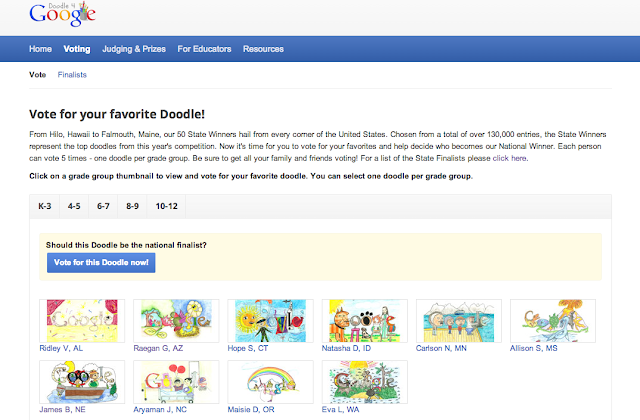
Now, our finalists need your votes for a shot at having their doodle make it onto the Google homepage. Starting today through Feb 22, head to the Doodle 4 Google site to vote for your favorite artwork for each grade group. On March 21, we’ll announce the winner and four runners-up—and you’ll see the winning doodle on google.com.

Check out this year’s talented set of finalists and vote for your favorite!

https://blogger.googleusercontent.com/img/b/R29vZ2xl/AVvXsEhKyuDQOlVNSr6RbdUEORCiaRvK39cxGUWVBydBaCtCImZRXeT1DbAEDV9L93zo4eH5NYxXSSwwdPt3wPQ9qb9OFKl6AuG_EgrWQ7zkTmg3qzZpy02yYWSRgXyuxX9lEI3ooY9z/s1600/GOP-d4g_hero_1.jpg

Doodle 4 Google is back! Show the world what makes you unique

October 19, 2015
Today we’re kicking off the 2015 Doodle 4 Google art competition, where creative and curious students across the U.S. vie to take over the Google homepage for a day with their artwork. This year’s theme, “What makes me…me,” invites students K-12 to express themselves in the form of a doodle highlighting what makes them unique.

But wait don’t get out those pencils just yet. This year, there’s a twist.

Doodle 4 Google is now in its eighth year (if Doodle 4 Google were a kid, it’d be a third grader)—so we decided to mix things up a bit to let kids’ imaginations really run wild. For the first time, there are no constraints on medium: students can cook, build, cut, spin, paint, or mold their doodle–basically use any material they like as long as they incorporate the letters G-O-O-G-L-E. The Doodle team itself has used a variety of unexpected materials over the years; for example, one Earth Day, we grew a bed of flowers to spell out the doodle. So we figured: let’s open the doors for all the creative kids out there do the same.
Here you can see how I decided to express “me”! I made my doodle out of clay, baked it in the oven, and painted it with acrylic paint. The succulent was taken from my garden. See more tips from my team of Doodlers on the Doodle 4 Google website.

We anticipate a whole lot of creative use of pottery, crochet, cookie dough and more by students (although of course we want all the drawings and paintings too!), so we figured we need some help picking out the winning artwork. We have an amazing group of guest judges: professional basketball player Stephen Curry, astronaut Dr. Yvonne Cagle, director and author BJ Novak, professional soccer player Alex Morgan, Emmy-award winner Julie Bowen and animator Glen Keane (more on the judges on our site).

Together, with the Doodle Team, we’ll pick one National Winner who will have their artwork displayed on the Google homepage for millions to see, receive $30,000 towards a college scholarship, and meet and work with the Doodle team on a visit to Mountain View, Calif. Plus, their school will get to spend $50,000 on technology.

Submissions are open until December 7. And for teachers, check out some classroom ideas and activities to get your young artists ready to Doodle!


Today we’re kicking off the 2015 Doodle 4 Google art competition, and this year there's a twist.

A doodle salute for Sally Ride

May 25, 2015
Today’s guest blog post is from Tam O’Shaughnessy—life partner of astronaut Sally Ride, and co-founder & CEO of Sally Ride Science. Over the past few months, Tam worked with our Doodle team to create a doodle for Sally’s 64th birthday. In this post, she tells us more about Sally’s life, her flight aboard the space shuttle Challenger, and her passion for helping kids stay excited about science and technology. -Ed.

As the first American woman in space, Sally Ride—who would have been 64 today—captured the nation’s imagination as a symbol of the ability of women to break barriers. But her historic flight represented just one aspect of a remarkable and multifaceted life. She was also a physicist, a science writer, and an inspirational advocate for keeping kids excited about science as they go through school.

Sally was born on May 26, 1951, in Los Angeles. She grew up playing with a chemistry set and small telescope—and playing football in the streets with the neighborhood kids. Later she considered playing professional tennis, but decided instead to study science.

In 1977, Sally was finishing her Ph.D. in physics at Stanford University when she saw an article in the student newspaper saying that NASA was looking for astronauts—and for the first time was allowing women to apply. Sally didn’t hesitate to send in her application, and became one of six women selected as part of the new crop of astronaut candidates. On June 18, 1983, she soared into history as the first American woman in space.

A look behind the scenes of today's Sally Ride doodle, narrated by the artist of the doodle, Olivia Huynh, and Tam O'Shaughnessy

Looking back at Earth through the window of the space shuttle, Sally was moved by the view of our beautiful blue planet wrapped in its thin blanket of air. She realized how important it is for all of us to take care of our fragile home in space, and became an environmentalist. Many years later, we wrote books for young adults about Earth’s changing climate.

After leaving NASA, Sally became a professor of physics at the University of California, San Diego. She loved being a scientist, but she was concerned that many young people—especially girls and minority students—abandon their early interest in science and math.

Studies show that the reason kids turn away from STEM (science, technology, engineering, and math) is not that they don’t like it or aren’t good it. Instead, young people get turned off because society sends false messages about who scientists are, what they do, and how they work. So Sally decided to use her high profile to motivate young people to stick with their interest in science and to consider pursuing STEM careers.

In 2001, Sally and I and three friends started Sally Ride Science to create programs and publications that bring science to life and show young people that STEM is fascinating, creative, and fun. Since then, we’ve trained thousands of teachers on how to spark and sustain interest in STEM and reached millions of students with our books and programs.

Sally died almost three years ago on July 23, 2012, from pancreatic cancer. But I know she would be honored by today’s Google Doodle. With whimsy, it expresses Sally’s sense of fun and adventure, and her ability to inspire young people. And who knows—maybe her Doodle will motivate some girl or boy somewhere in the world to become a scientist and adventurer just like Sally.

Sally said it best . . .
Everywhere I go I meet girls and boys who want to be astronauts and explore space, or they love the ocean and want to be oceanographers, or they love animals and want to be zoologists, or they love designing things and want to be engineers. I want to see those same stars in their eyes in 10 years and know they are on their way!

What Girls are Good For: Happy birthday Nellie Bly!

May 4, 2015
In 1880, the Pittsburgh Dispatch published an article titled "What Girls Are Good For.” In dismissive terms, the column’s author wrote that women shouldn't be allowed to work because their place was at home.

Days later, a pseudonymous rebuttal appeared in the paper. The response, by a 16-year-old girl whose real name was Elizabeth Jane Cochran, argued how important it was for women to be independent and self-reliant. Within a decade, the author of that response would become known worldwide as Nellie Bly: a hard-hitting young journalist who went undercover at a lunatic asylum and traveled around the world in a record-breaking 72 days.

Throughout her life and career, Nellie Bly spoke up for the underprivileged, the helpless and minorities, and defied society’s expectations for women. We love her adventurous spirit, and we share her belief that women can do anything and be anything they want (we like to think if she were around today she’d be a fellow fan of trailblazing women like Ada, Anita and Ann). So when it came time to honor Nellie with a Doodle, we wanted to make it special. Karen O of the Yeah Yeah Yeahs wrote, composed and recorded an original song about Nellie, and Katy Wu, the artist who created this doodle, created an animation set to Karen O’s music celebrating this intrepid investigative reporter.

Nellie was born on May 5, 1864 in a suburb of Pittsburgh, Pa. After her response was published in the Dispatch in 1880, the editor, George Madden, tracked her down and hired her as a reporter. At the time, women reporters commonly used pen names; hers came from a song by fellow Pittsburgher Stephen Foster. She spent several years at the paper before moving to New York for a job at New York World, which was owned by Joseph Pulitzer. In 1887, she went undercover at the Women's Lunatic Asylum on Blackwell's Island to write an exposé about the conditions there. Her resulting book, “Ten Days in a Mad-House,” made her famous.

But Nellie is best known for her trip around the world. Inspired by Phileas Fogg, the hero of Jules Verne’s novel, “Around the World in 80 Days,” Nellie set sail from New York in November 1889 determined to beat Fogg’s time. Traveling by steamships and sailboats, she sent dispatches back to her newspaper as she circled the globe. Instead of sitting idly and just observing, she was always a part of the action and conversation, despite the fact that public spaces were typically reserved for men at the time.
Storyboard for today's Nellie Bly video doodle, by Katy Wu

When creating the Doodle, we took inspiration from Karen O’s lyrics and Nellie’s journey around the globe. Throughout the video, Katy used newspaper as a unifying theme—with paper tearing, folding and crumpling as the story goes along. And though the video is mostly black and white, she added some color to represent Nellie's energy and vibrancy.

Back in the 19th century, Nellie fearlessly showed a generation of people “what girls are good for.” We’re excited to tell her story in today’s Doodle—and we hope Nellie inspires women and girls everywhere to follow in her footsteps and show the world what they can do.

Which animal are you? Take the Google Doodle Earth Day Quiz

April 22, 2015
You can search Google for answers to all kinds of animal questions: What does an aye-aye eat? Where do narwhals live? How long is a toco toucan's beak? And this Earth Day, you can turn to Google for the answer to something that you’ve always needed to know: which animal are you???
Clicking on this year’s Earth Day logo (or searching for “Earth Day quiz”) presents one of the Internet’s favorite pastimes: a totally scientific and 1,000% accurate personality quiz. Take the time to answer a few questions to determine and share your Earth Day animal. And, of course, you’re only a search away from learning more about nature’s precious pals and interesting inhabitants (FYI: kakapo is the heaviest parrot).

If you need proof of the accuracy of our quiz, look no further than the testimonials of some of our wildlife-loving, quiz-taking friends like Ed Norton, Jared Leto, and Maggie Q. Dame Jane Goodall took the quiz and had this to report:

Once you’ve gotten to know your deepest self (and animal avatar), we hope you’re inspired to help make a real difference this Earth Day. For the month of April, we’re partnering with our friends at Google.org, who will match donations to the following animal-loving organizations up to $20,000. That means every $1 you donate to one of these great groups is worth $2 to protect wildlife around the world. Chip in what you can at the Jane Goodall Institute, Maasai Wilderness Conservation Trust, World Wildlife Fund, WildAid, Zoological Society of London and Virunga Fund.

Happy Earth Day!

25 years ago today ... The fall of the Berlin Wall

November 8, 2014
I was seven years old when thousands of East German signature cars arrived in my hometown of Hamburg and filled the air with odd-smelling blue smoke. I saw strangers hugging each other, tears in their eyes, their voices tired from singing. I was too young to understand it all, but I had a very strong sense that life was different now--and that different was better.

A quarter-century later, it is our obligation to tell this story to all those who couldn't be there, who could not feel the spark of the peaceful revolution and, more importantly, who are fortunate enough not to know the feeling of an incarcerated, divided existence, trapped behind concrete walls.  It is a story that demands to be told today, and for generations to come.   


I’m excited to have been part of making this doodle commemorating such a pivotal moment in history — to learn more about the making-of, check out the doodle team’s post here.  We should all take the time to celebrate 25 years of unity.

Doodle 4 Google 2014: An inventive doodle for clean water

June 9, 2014
On google.com today, you may have noticed an intricately drawn version of our logo showing an unusual water purifier, surrounded by a variety of fantastical creatures. This doodle is the result of our seventh annual Doodle 4 Google competition, where we asked kids, grades K-12, to tell us what they’d invent to help make the world a better place. Today, out of more than 100,000 submissions, 250 state finalists, 50 state winners, and five national age group winners, we’re excited to present the 2014 U.S. Doodle 4 Google winner—11-year old Audrey Zhang of New York!

In the spirit of our theme around inventiveness, we asked Audrey to spend a day with the doodlers following our awards ceremony to help animate her illustration. In her new role as animator and film director, the ever detail-oriented Audrey made sure that each light would flicker and that the water was clean enough to (virtually) drink in. She was especially passionate about the illustration’s dragons—about whom (oh, by the way) she is also writing a novel.
In addition to seeing her finished work on our homepage today, Audrey received a $30,000 college scholarship and $50,000 Google for Education technology grant for her school. And to help make Audrey’s vision of water purification a reality, we donated $20,000 in her name to charity:water, a charity that brings clean water to developing nations, to provide clean water to schools in Bangladesh.
"To make the world a better place, I invented a transformative water purifier. It takes in dirty and polluted water from rivers, lakes, and even oceans, then massively transforms the water into clean, safe and sanitary water, when humans and animals drink this water, they will live a healthier life." - Audrey Zhang, 11

Audrey’s doodle was one of many amazing contributions to Doodle 4 Google this year. We encourage you to take a look at the outstanding national grade group winners, who we announced at an event with all 50 state winners at the Googleplex back in May.
Every year we do this, and every year we’re amazed. The thousands of young Doodlers who enter the contest are annual reminders of that special combination of curiosity and imagination that seems to come only from young people. Their ideas—like Audrey's—inspire us to do more and be better. Congratulations to all our Doodle 4 Google winners!

Bringing the Rubik's Cube to the next generation of problem solvers

May 19, 2014
As a designer, it's always humbling when you encounter a perfect piece of design. Good design attracts our attention with its beauty, doesn’t need a user manual, is universally understood by anyone in the world, and is simple without sacrificing functionality.

In 1974, the world gave us one such piece of perfect design—the Rubik's Cube. Budapest-based educator and inventor Ernő Rubik created the puzzle originally to help his students better understand spatial geometry. Released to the public in the 1980s, it quickly became an international obsession, bigger than hairspray and breakdancing combined. But the Rubik’s Cube is more than just a toy; it’s a puzzle waiting to be solved and a question waiting to be answered. Over the past 40 years, the cube has puzzled, frustrated, and fascinated so many of us, and has helped spark an interest in math and problem solving in millions of kids. That’s part of why so many of us at Google love the cube, and why we're so excited to celebrate its 40th birthday this year.

As everyone knows (right??), there are 519 quintillion permutations for the Rubik’s cube, so May 19 seemed like a fine day to celebrate its 40th anniversary. To kick things off, we’re using some of our favorite web technologies (HTML5 and Three.js among others) to bring the cube to the world in the form of one of our most technically ambitious doodles yet. You can twist and turn it by dragging along its sides, but with full respect to all the speedcubers out there, we’ve included keyboard shortcuts:
Using the same technology that’s behind the doodle, we built Chrome Cube Lab, a series of Chrome Experiments by designers and technologists that reinterpret Rubik’s puzzle with the full power of the web. Create your own music with experiments 808Cube and SynthCube; make a custom, shareable cube of your own photos and GIFs with ImageCube; or send a scrambly message with the Type Cube. You can visit some of these experiments at the Liberty Science Center’s Beyond Rubik’s Cube exhibition, and if you'd like to explore the cube even further, consider borrowing the cube’s source code to build an experiment of your own.

We hope you enjoy getting to know the cube from a few new angles.

See how Doodle 4 Google state winners would make the world a better place—and vote for your favorite

April 29, 2014
In February, we asked K-12 students across the country to doodle about the one thing they’d invent to make the world a better place—and we were amazed by their curiosity and creativity. For many students, environmental issues were top of mind, resulting in impressive and artistic doodles depicting water and air purification or turning garbage into flowers. Another common theme was really smart robots; they clean up garbage or help students with their homework. Others created possible solutions for solving obesity or eliminating world hunger. And we saw some thoughtful ideas around time travel and goggles that help you see the world from another person’s point of view so you can truly understand them.

From more than 100,000 creative ideas, we’ve selected the best one from each state with the help of our guest judges. Today, we’re celebrating the 50 state winners—little ones just six years old to high school seniors—at their schools from Fort Paine, Ala. to Moorcroft, Wyo., and from Anchorage, Alaska to Plant City, Fla. We’ll reveal the winning artists in front of their classmates, teachers and parents and, in some places, their local mayors or elected officials.

Now it’s your turn to cast a vote for your favorite Doodle. Starting today through May 9, you can go to the Doodle 4 Google site to help select one winner for each age group. On May 21, we’ll host all 50 state winners at our headquarters in Mountain View, Calif., where we’ll reveal the five age group finalists as well as the national Doodle 4 Google winner.
Then, for the first time ever, the national winner will get to hang out with our team in Mountain View and animate their doodle. You’ll see the spiffed-up version on our homepage on June 9. For now, don’t forget to vote!

Celebrating inspiring women around the world

March 8, 2014
Picture the women in your life—the women you admire. Your grandma. Your daughter. Toni Morrison. Maria Klawe. Temple Grandin. Malala. Somaly Mam. International Women's Day is an opportunity to celebrate these phenomenal women and all the others around the world—to recognize their impact on society, and to focus on what still needs to be done to achieve gender equality. Today, Google is joining in and showcasing inspiring women of the past and present through a series of events, new content on the Cultural Institute and—of course—a doodle. Join us in celebrating women worldwide!

Celebrating technical women on stage at global Women Techmakers events
To help increase visibility, community and resources for technical women, we’re launching a series of 100+ Women Techmakers events in 52 countries to celebrate and support passionate techmakers around the world. Starting today and throughout March, the event series will feature panel discussions with talented female technology leaders, hands-on career planning workshops, networking opportunities and more. To learn more about the program and find an event near you, visit g.co/womentechmakers.
Shining a light on women in history and their collective impact
The Google Cultural Institute is launching Women in Culture, a new channel featuring exhibits that tell stories of women—some familiar and some lesser-known—and their impact on the world. Starting today, you can browse 18 new exhibits, from both new and existing Cultural Institute partners, including:
Since history has so often been biased, leaving out or sidelining contributions from women, the channel is also integrated with the rest of the Cultural Institute collections, making it easier for people to discover even more amazing stories about women throughout history.

A homepage homage
Women have been underrepresented in the history-telling of almost all fields: science, school curricula, business, politics—and, sadly, doodles. In addition to our continued effort for doodle diversity and inclusion, today’s truly International Women’s Day doodle features a host of more than 100 inspiring women from around the world, including the President of Lithuania, a brave Pakistani education activist, the most recorded artist in music history, an ever-curious explorer and dozens more.

Happy International Women’s Day!

It’s time to Doodle 4 Google! How would you make the world a better place?

February 4, 2014
Before there was an airplane, there were doodles of flying machines, and before there was a submarine, there were doodles of underwater sea explorers. Ideas big and small, practical and playful, thought-provoking and smile-inducing, have started out as doodles. And we’re ready for more!

Doodle 4 Google is the chance for young artists to think and dream big. Our theme this year, "If I could invent one thing to make the world a better place…” is all about curiosity, possibility and imagination.
Creating the best doodle comes with major perks: this year—for the first time ever—the winner of the competition will become an honorary Google Doodler for a day and animate his or her Doodle for the homepage with the Doodle team. The winning Doodle will then be featured on the Google homepage for a day for millions to see. If that’s not cool enough, the winner will also receive a $30,000 college scholarship and a $50,000 Google for Education technology grant for his or her school.

If you feel like your young artist may need a little nudge to get their creative juices flowing, we’re partnering with Discovery Education to offer videos and activities for teachers and parents as well as a virtual field trip to Google’s headquarters. We’re also offering interactive “Meet the Doodler” Connected Classrooms sessions where kids can meet Google Doodlers, learn about their process from idea to a Doodle, and ask questions along the way.

Mark your calendar to send in your kids’ submissions by March 20. Judging starts with Googlers and a panel of guest judges, including astronaut Ron Garan, author of the Percy Jackson Series Rick Riordan, Google[x] Captain of Moonshoot Astro Teller, directors of The LEGO Movie Chris and Phil, President of RISD school Rosanne Somerson, robotics designer Lee Magpili, and authors Lemony Snicket and Mary Pope Osborne.

On April 29, we’ll announce the 50 state finalists and open up a public vote to select the national winner. These 50 kids will all get to visit Google’s headquarters in Mountain View, Calif. on May 21 for a day full of creative workshops and other fun activities—and the winning (animated!) doodle will be revealed on google.com in June.

Participating is easier than ever. Teachers and parents can download entry forms on our Doodle 4 Google site. Doodles can be uploaded digitally to our site or mailed in. We encourage full classrooms to participate too! There’s no limit to the number of doodles from any one school or family... Just remember, only one doodle per student.

That’s all I’ve got. Now get to doodling!

“Coming Home” by Wisconsin student wins U.S. 2013 Doodle 4 Google competition

May 22, 2013
After 130,000 submissions and millions of votes cast, Sabrina Brady of Sparta, Wisc. has been named the 2013 U.S. Doodle 4 Google National Winner. Her doodle, “Coming Home,” will be featured on the Google homepage in the U.S. tomorrow, May 23.

Students across all 50 states amazed us with their creative interpretations of this year’s theme, “My Best Day Ever...” From scuba diving to dinosaurs to exploring outer space, we were wowed by the ways young artists brought their best days to life in their doodles.

Sabrina’s doodle stood out in the crowd; it tells the story of her reunion with her father as he returned from an 18 month deployment in Iraq. Her creative use of the Google letters to illustrate this heartfelt moment clearly resonated with voters across the country and all of us at Google.

In addition to seeing her artwork on the Google homepage, Sabrina—who is in 12th grade at Sparta High School—will receive a $30,000 college scholarship, a Chromebook computer and a $50,000 technology grant for her school. She will attend Minneapolis College of Art and Design this coming fall, where she will continue her artistic pursuits. Congratulations Sabrina!


In addition to the National Winner, voters across the country helped us determine the four National Finalists, who will each receive a $5,000 college scholarship:
  • Grades K-3: Reagan Gonsalves (Grade 1, Santan Elementary School, Chandler, Ariz.) for her doodle “My best day ever is learning about nature.” Reagan says, “My best day ever is to be around the pretty animals and plants in nature, because I love to know about what is around me. I love to watch hummingbirds drink nectar out of flowers. I love to read books on nature and how plants and animals grow.”
  • Grades 4-5: Audrey Zhang (Grade 4, Michael F. Stokes Elementary School, Levittown, N.Y.) for her doodle “...When I discover paradise!” Zhang says, “My best day ever will be when I discover paradise. In paradise, I could play with dragons, romp with leopards, and chat with fairies...It would be the best day ever when I could finally live in a mystical, dreamy realm.”
  • Grades 6-7: Maria Iannone (Grade 7, Chestnut Ridge Middle School, Sewell, N.J.) for her doodle “The best day ever.” Maria says, “Where I live, it's difficult to view the night sky very well. Having an interest in astronomy, a day where I can observe the things I study on my own time would satisfy me.”
  • Grades 8-9: Joseph Han (Grade 8, Falmouth Middle School, Falmouth, Maine) for his doodle “Late-afternoon bliss.” Joey says, “For me, ‘the best day ever’ doesn't consist of ambitious dreams, but rather the enjoyment of a day spent in carefree euphoria. Being in the woods is something that evokes such happiness in me. The lighthearted joy of rafting, fishing or catching fireflies is what I've attempted to capture.”

After the awards ceremony, all 50 of our State Winners will unveil a special exhibition of their artwork at the American Museum of Natural History in New York City, where their doodles will be displayed for the public to view from May 22 - July 14.

Thanks to all who voted and helped us select the 2013 Doodle 4 Google winners. Even more importantly, thank you to all of the students who submitted their artwork and the parents and teachers who continue to inspire and support their young artists. Until next year... happy doodling!

The 2013 Doodle 4 Google state winners are in and it’s time for you to vote!

May 1, 2013
Students from across the country sent in more than 130,000 doodles for our 2013 U.S. Doodle 4 Google competition. Today, we’re proud to share with you our 50 amazingly talented state winners. Exploring their “Best Day Ever...” from life down under to flying from planet to planet in outer space, we were wowed by the imaginations and talent of young aspiring artists from coast to coast.

To reveal the local winners in all 50 states, we’ve sent Googlers to their schools, where they’re celebrating the winning artists along with their parents, classmates, teachers and friends.

Now it’s time to make your voice heard. Starting today and through May 10, we’re inviting the public to vote for their favorite doodle from each of the five different grade groups. Your votes will determine the five national finalists, from which the national winner will be selected and announced at our May 22 awards ceremony in New York City.


We’ll display the winning doodle on the Google homepage on May 23 for millions to see. In addition, you’ll be able to see all 50 doodles created by our state winners in person at a special exhibition at the American Museum of Natural History in New York City from May 22 to July 14.

We’d like to send a special thank you to the parents, teachers and administrators who supported young artists and helped students across the country bring their “Best Day Ever” to life. We’ve loved looking at each and every entry that came in this year, and we hope you all enjoy the talent and creativity these 50 students have shared with us.

Following the lead of nature’s engineers

April 22, 2013
It’s no surprise that Google appreciates engineers. And this Earth Day, we’re looking at some of our favorite engineers from nature to see how they can teach us to treat the environment better. We’ve created a website where we can see the beauty and ingenuity of the natural world through photos from National Geographic. We also want to provide easy ways to be greener in our own lives, so this site shows us how we can all be like those organisms by taking simple actions to care for the environment.


For instance, until recently I’d never heard of a remora. Turns out that these fish latch on to other ocean creatures such as whales and turtles to catch rides. In a way, these fish are using their own form of mass transit. To be like the remora and travel with a lighter footprint, we can plan trips using rapid transit. Or we can be inspired by bears—the true experts on “sleep mode”—to save energy in our own lives by adjusting our home thermostat and using energy efficient appliances.

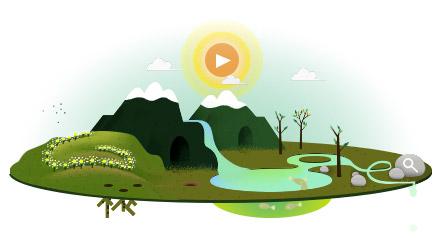
Our doodle today also acknowledges the interconnections of the natural world. You can interact with elements of the environment to affect the seasons, weather and wildlife.


As another way to move from awareness to action, we’re hosting a Google+ Hangout On Air series focused on pressing environmental issues. We’ll kick it off today at 12pm ET with a Hangout on Air connecting NASA (live from Greenland), National Geographic explorers from around the world, and Underwater Earth (live from the Great Barrier reef). Throughout the week, we’ll hold daily Hangouts on Air covering topics such as clean water and animal conservation.

This Earth Day and every day, let’s take a moment to marvel at the wonder of nature and do our part to protect the natural ecosystem we all depend on. A salute to nature’s engineers!

Doodle 4 Google: A stately competition

February 21, 2013
Are you a young artist from California? Alabama? Or Indiana (like me!)? Well, get doodling with the topic “My Best Day Ever…” for a chance to see your very own artwork on the Google homepage—and help represent your piece of the union.

Today marks the 30-day countdown to the March 22 submission deadline for the U.S. Doodle 4 Google competition. And in the spirit of friendly competition, we’re inviting you to rally fellow students and teachers in your state to take part in Doodle 4 Google’s 30-day Race to the Finish with an interactive map that shows the top submitting states. States are ranked in order of submissions relative to student population size.


Whether your state tops the submissions race or not, you still have the chance to become the individual state winner. The 50 state winners will win an all-expenses paid trip to New York City in May for the final awards ceremony, where we’ll reveal the winning doodle. The national winner will see his or her doodle on the Google homepage, win a $30,000 college scholarship and a $50,000 technology grant for his or her school. Download an entry form today to get doodling!

Fun fact for those of you who can’t get enough doodles: we run Doodle 4 Google competitions in many countries worldwide, year-round. Vote for your Irish favorites now—the winner will appear on www.google.ie on April 16.

As always, happy doodling!

Honouring computing’s 1843 visionary, Lady Ada Lovelace

December 9, 2012
Last year, a group of us were lucky enough to visit the U.K. Prime Minister’s residence at 10 Downing Street, as part of the Silicon Valley Comes to the U.K. initiative. While there, we asked about some of the paintings on the wall. When we got to a large portrait of a regally dressed woman, our host said “and of course, that’s Lady Lovelace.” So much of world history leaves out or minimizes the contributions of women, and so “of course” most of us had no idea who she was. You can imagine our surprise when we learned she was considered by some to be the world’s first computer programmer—having published the first algorithm intended for use on Charles Babbage’s Analytical Engine.

Lady Ada Lovelace, painted by Margaret Carpenter in 1836, from the U.K. Government Art Collection. Photo thanks to Wikimedia Commons.

Augusta Ada King, Countess of Lovelace, was born nearly two centuries ago in 1815. Her mother, mathematician Anne Isabelle Milbanke, was determined Ada would not fall prey to the same immoralities as Ada’s father, the “mad, bad and dangerous to know” poet Lord Byron. Thus, in an attempt to thwart any similar tendencies, she had Ada tutored in science and mathematics from a young age. It’s fair to say this did not completely work, as Ada went on to lead a rather colourful life. However it did fortuitously result in Ada becoming a mathematician like her mother, and pursuing what she termed “poetical science.”

After a chance encounter when aged 17, Ada became friends with Charles Babbage and grew fascinated by his idea to build an “Analytical Engine.” In 1843 Ada published a description of Babbage's machine. While partly a translation of an Italian work, Ada added voluminous self-penned notes, which made up the bulk of the document. Included in her notes were step-by-step instructions for how the machine could calculate a sequence of Bernoulli numbers, prepared in collaboration with Babbage. In effect, this was the world’s first published algorithm.

Most importantly, the notes set out Ada's far-reaching vision for what the Analytical Engine signified. While Babbage saw it as a mathematical calculator, Ada understood it had much more potential. She realised it was, in essence, a machine that could manipulate symbols in accordance with defined rules, and—crucially—that there was no reason the symbols had to represent only numbers and equations.
“The Analytical Engine weaves algebraic patterns just as the Jacquard loom weaves flowers and leaves.” Ada Lovelace, 1843
As Ada eloquently argued, such a device could do far more than mathematics. She even mused about its potential to compose music:
“Supposing, for instance, that the fundamental relations of pitched sounds in the science of harmony and of musical composition were susceptible of such expression and adaptations, the engine might compose elaborate and scientific pieces of music of any degree of complexity or extent.”
This was an astounding conceptual leap from calculation to computing. Ada envisaged a day when a single machine would be capable of a myriad of tasks, limited only by the creativity of its programmer. At the time—nearly a century before the first computers were built—it was a flash of brilliance.

After our visit to Downing Street, we returned to the U.S. determined to learn more about Ada, and to revive her memory. Today, her birthday, is an apt moment. In addition to this post, Google is honouring Ada with a doodle in recognition of her prophetic vision for computing.

Design of doodle by Kevin Laughlin

Unfortunately, Babbage's machines were never built in his lifetime, and Ada's vision of computing was lost to obscurity for more than a century. It wasn’t until 1991 that the Science Museum London built Babbage’s Difference Engine from his original drawings. That machine is now on show there, and a second one is now at the Computer History Museum in California. Plans are now afoot to build a replica of the Analytic Engine—so perhaps Ada’s algorithm will at last be run on the machine for which it was intended.

Ada's experience is sadly all too familiar. Too often, the contributions of women in science and technology are left untold, and to fade from view. While Ada’s story has been rediscovered, many others remain little known. That's why initiatives such as Ada Lovelace Day are so valuable, as a catalyst for raising the profile of women in science, past and present. Several wonderful biographies of Ada have been written already, and biographer Walter Isaacson has turned his attention to Ada as part of his next book.

Visibility is also the reason why we launched the Women Techmakers series on GDL, to help shine a light on the roles and contributions of the many talented technical women in our industry today. We hope our series will complement other efforts to raise the profile of women, such as the new AOL/PBS supported website and documentary Makers.com or the work of Academy Award-winning actress Geena Davis on SeeJane to improve gender balance and reduce stereotypes in childrens’ television globally.

We hope today's doodle inspires people to find out more about Ada, and about the contributions made by women in general to science and technology.

A tribute to Turing, the father of modern computing

June 22, 2012
“The past is a foreign country—they do things differently there.” It’s a saying that rings especially true in the world of technology. But while innovating requires us to focus on the future, there are times when it’s important to look back. Today—the 100th anniversary of Alan Turing’s birth—is one such moment.

Statue of Alan Turing at Bletchley Park

Turing’s life was one of astounding highs and devastating lows. While his wartime codebreaking saved thousands of lives, his own life was destroyed when he was convicted for homosexuality. But the tragedy of his story should not overshadow his legacy. Turing’s insight laid the foundations of the computer age. It’s no exaggeration to say he’s a founding father of every computer and Internet company today.

Turing’s breakthrough came in 1936 with the publication of his seminal paper “On Computable Numbers” (PDF).  This introduced two key concepts, “algorithms” and “computing machines”—commonplace terms today, but truly revolutionary in the 1930’s:
  • Algorithms are, in simplest terms, step-by-step instructions for carrying out a mathematical calculation. This is where it all started for programming since, at its core, all software is a collection of algorithms.
  • A computing machine—today better known as a Turing machine—was the hypothetical device that Turing dreamed up to run his algorithms. In the 1930’s, a “computer” was what you called a person who did calculations—it was a profession, not an object. Turing’s paper provided the blueprint for building a machine that could do any computation that a person could, marking the first step towards the modern notion of a computer.
Considering the role computers now play in everyday life, it’s clear Turing’s inventions rank among the most important intellectual breakthroughs of the 20th century. In the evolution of computing, all paths trace back to Turing. That’s why Turing is a hero to so many Google engineers, and why we’re so proud to help commemorate and preserve his legacy.

In 2010, Google helped Bletchley Park raise funds to purchase Turing’s papers so they could be preserved for public display in their museum. More recently, we’ve been working closely with curators at London’s Science Museum to help put on a stunning new exhibition “Codebreaker - Alan Turing’s Life and Legacy.” This tells the story of Turing’s vast achievements in a profoundly moving and personal way, through an amazing collection of artifacts—including items loaned by GCHQ, the U.K. government intelligence agency, never before on public display. Topics addressed include Turing’s early years, his code-breaking at Bletchley Park, his designs for the Pilot Ace computer, his later morphogenesis work, as well as his sexuality and death. The exhibition opened on June 21 and is well worth a visit if you’re passing through London in the next year.


And finally, we couldn’t let such a momentous occasion pass without a doodle. We thought the most fitting way of paying tribute to Turing’s incredible life and work would be to simulate the theoretical “Turing machine” he proposed in a mathematical paper. Visit the homepage today— we invite you to try your hand at programming it. If you get it the first time, try again... it gets harder!

Turing was born into a world that was very different, culturally and technologically, from ours—but his contribution has never been more significant. I hope you’ll join me today in paying tribute to Alan Turing, the forefather of modern computing.

A tribute to Bob Moog, sonic doodler

May 22, 2012
In the mid-1960s, Dr. Robert Moog unleashed a new universe of sounds into musicdom with his invention of the electronic analog Moog Synthesizer. The timbre and tones of these keyboard instruments (true works of art in and of themselves) would come to define a generation of music, featuring heavily in songs by The Beatles, The Doors, Stevie Wonder, Kraftwerk and many others.

When people hear the word “synthesizer” they often think “synthetic”—fake, manufactured, unnatural. In contrast, Bob Moog’s synthesizers produce beautiful, organic and rich sounds that are, nearly 50 years later, regarded by many professional musicians as the epitome of an electronic instrument. “Synthesizer,” it turns out, refers to the synthesis embedded in Moog’s instruments: a network of electronic components working together to create a whole greater than the sum of the parts.

With his passion for high-tech toolmaking in the service of creativity, Bob Moog is something of a patron saint of the nerdy arts and a hero to many of us here. So for the next 24 hours on our homepage, you’ll find an interactive, playable logo inspired by the instruments with which Moog brought musical performance into the electronic age. You can use your mouse or computer keyboard to control the mini-synthesizer’s keys and knobs to make nearly limitless sounds. Keeping with the theme of 1960s music technology, we’ve patched the keyboard into a 4-track tape recorder so you can record, play back and share songs via short links or Google+.


Much like the musical machines Bob Moog created, this doodle was synthesized from a number of smaller components to form a unique instrument. When experienced with Google Chrome, sound is generated natively using the Web Audio API—a doodle first (for other browsers the Flash plugin is used). This doodle also takes advantage of JavaScript, Closure libraries, CSS3 and tools like Google Web Fonts, the Google+ API, the Google URL Shortener and App Engine.

Special thanks to engineers Reinaldo Aguiar and Rui Lopes and doodle team lead Ryan Germick for their work, as well as the Bob Moog Foundation and Moog Music for their blessing. Now give those knobs a spin and compose a tune that would make Dr. Moog smile!

Update May 30: We're so glad you enjoyed last week's synthesizer doodle for Bob Moog. Worldwide, you recorded 57 years' worth of synthesized tunes—more than 54 million songs! And those songs were played back 3.6 million times. You can still play on our doodle site. Even if you've composed a song already, create another one—the range of sounds you can create with the knobs is virtually limitless.

Morty Proxy This is a proxified and sanitized view of the page, visit original site.