


Portal:Scotland

-

 The Quiraing on the Isle of Skye.
 -
 Glasgow, West.
 -

-

-
 The Falkirk Wheel boat lift.


| Main Page | Selected articles 1 | Selected articles 2 | Selected biographies | Selected quotes | Selected pictures | Featured Content | Categories & Topics |
Introduction
 |

|
|

|
Scotland is a country that is part of the United Kingdom. It contains nearly one-third of the United Kingdom's land area, consisting of the northern part of the island of Great Britain and more than 790 adjacent islands, principally in the archipelagos of the Hebrides and the Northern Isles. In 2022, the country's population was about 5.4 million. Its capital city is Edinburgh, whilst Glasgow is the largest city and the most populous of the cities of Scotland. Scotland shares a land border with England to the south-east and is surrounded by the Atlantic Ocean to the north and west, the North Sea to the north-east and east, and the Irish Sea to the south. The legislature, the Scottish Parliament, elects 129 members to represent 73 constituencies. The Scottish Government is the executive arm of the devolved government, headed by the first minister, who chairs the cabinet and is responsible for government policy and international engagement.
The Kingdom of Scotland emerged as a sovereign state in the 9th century. Independence from England was maintained partly through an alliance with France. In 1603, James VI succeeded to the thrones of England and Ireland, forming a personal union of the three kingdoms. On 1 May 1707, Scotland and England combined to create the new Kingdom of Great Britain, with the Parliament of Scotland subsumed into the Parliament of Great Britain. In 1999, a Scottish Parliament was re-established, and has devolved authority over many areas of domestic policy. The country has its own distinct legal system, education system and religious history, which have all contributed to the continuation of Scottish culture and national identity. Scottish English and Scots are the most widely spoken languages in the country, existing on a dialect continuum with each other. Scottish Gaelic speakers can be found all over Scotland, but the language is largely spoken natively by communities within the Hebrides; Gaelic speakers now constitute less than 2% of the total population, although state-sponsored revitalisation attempts have led to a growing community of second language speakers.
The mainland of Scotland is broadly divided into three regions: the Highlands, a mountainous region in the north and north-west; the Lowlands, a flatter plain across the centre of the country; and the Southern Uplands, a hilly region along the southern border. The Highlands are the most mountainous region of the British Isles and contain its highest peak, Ben Nevis, at 4,413 feet (1,345 m). The region also contains many lakes, called lochs; the term is also applied to the many saltwater inlets along the country's deeply indented western coastline. The geography of the many islands is varied. Some, such as Mull and Skye, are noted for their mountainous terrain, while Tiree and Coll are flatter.
Selected article

Edinburgh Castle (Scottish Gaelic: Caisteal Dhùn Èideann) is a historic castle in Edinburgh, Scotland. It stands on Castle Rock, which has been occupied by humans since at least the Iron Age. There has been a royal castle on the rock since the reign of Malcolm III in the 11th century, and the castle continued to be a royal residence until 1633. From the 15th century, the castle's residential role declined, and by the 17th century it was principally used as a military garrison. Its importance as a part of Scotland's national heritage was recognised increasingly from the early 19th century onwards, and various restoration programmes have been carried out over the past century and a half.
Edinburgh Castle has played a prominent role in Scottish history, and has served variously as a royal residence, an arsenal, a treasury, a national archive, a mint, a prison, a military fortress, and the home of the Honours of Scotland – the Scottish regalia. As one of the most important strongholds in the Kingdom of Scotland, the castle was involved in many historical conflicts from the Wars of Scottish Independence in the 14th century to the Jacobite rising of 1745. Research undertaken in 2014 identified 26 sieges in its 1,100-year history, giving it a claim to having been "the most besieged place in Great Britain and one of the most attacked in the world". Few of the present buildings pre-date the Lang Siege of 1573, when the medieval defences were largely destroyed by artillery bombardment. The most notable exceptions are St Margaret's Chapel from the early 12th century, which is regarded as the oldest building in Edinburgh, the Royal Palace, and the early 16th-century Great Hall. The castle is the site of the Scottish National War Memorial and the National War Museum. The British Army is still responsible for some parts of the castle, although its presence is now largely ceremonial and administrative. The castle is the regimental headquarters of the Royal Regiment of Scotland and the Royal Scots Dragoon Guards and houses their regimental museums, along with that of the Royal Scots.
The castle, in the care of Historic Environment Scotland, is Scotland's second most visited tourist attraction, with 2,044,963 visitors in 2025 and over 70 percent of leisure visitors to Edinburgh visiting the castle. As the backdrop to the Royal Edinburgh Military Tattoo during the annual Edinburgh Festival, the castle has become a recognisable symbol of Edinburgh in particular and of Scotland as a whole. (... Read the full article)
Selected quotes
-

" ... Avarice, the spur of industry ... "
— David Hume
" ... No enemy is half so fatal as a friend estranged ... "
— John Davidson -
" ... Men are immortal till their work is done ... "
— David Livingstone
" ... America would have been a poor show had it not been for the Scots ... "
— Andrew Carnegie -
" ... Doctors, like minicab drivers, are the other idiots to whom we trust our lives ... "
— James Kennaway
" ... When shall I see Scotland again? Never shall I forget the happy days I passed there amidst odious smells, barbarous sounds, bad suppers, excellent hearts and the most enlightened and cultivated understandings ... "
— Sydney Smith -
" ... Every new opinion, at its starting, is precisely in a minority of one ... "
— Thomas Carlyle
" ... Every man at the bottom of his heart believes that he is a born detective ... "
— John Buchan -
" ... A ripple of laughter is worth an ocean of tears. To laugh is to be free of worry ... "
— Harry Gordon
" ... It has long been an axiom of mine that the little things are infinitely the most important ... "
— Sir Arthur Conan Doyle -
" ... No man can become rich without himself enriching others ... "
— Andrew Carnegie
" ... The old cathedrals are good, but the great blue dome that hangs over everything is better ... "
— Thomas Carlyle -
" ... Diffused knowledge immortalizes itself ... "
— James Mackintosh
" ... The cloven-foot of self-interest was now and then to be seen aneath the robe of public principle ... "
— John Galt -
" ... I could not be a traitor to Edward, for I was never his subject ... "
— William Wallace
" ... People in Scotland have a queer idea of the arts. They think you can be an artist in your spare time, though nobody expects you to be a spare-time dustman, engineer, lawyer or brain surgeon ... "
— Alasdair Gray -
" ... Custom, then, is the great guide of human life ... "
— David Hume
" ... Perpetual devotion to what a man calls his business, is only to be sustained by perpetual neglect of many other things ... "
— Robert Louis Stevenson -
" ... He's very clever, but sometimes his brains go to his head ... "
— Margot Asquith speaking of F. E. Smith
" ... When we try to pick out anything by itself, we find it hitched to everything else in the Universe ... "
— John Muir -
" ... I must follow them. I am their leader ... "
— Bonar Law
" ... None can destroy Scotland, save Scotland's self ... "
— Lord Belhaven, opposing the union of 1707 -
" ... Books are a finer world within the world ... "
— Alexander Smith
" ... All men who have turned out worth anything have had the chief hand in their own education ... "
— Sir Walter Scott -
" ... There is only one word for aid that is without strings, and that word is blackmail ... "
— Colm Brogan
" ... It is unfortunate, considering that enthusiasm moves the world, that so few enthusiasts can be trusted to speak the truth ... "
— A. J. Balfour -
" ... He is an egregious dissembler and a great liar. Away with him, he is a greeting divil ... "
— Robert Blair (On Oliver Cromwell, to a fellow Covenanter)
" ... What is prudence in the conduct of every private family can scarce be folly in that of a great kingdom ... "
— Adam Smith -
" ... You ought to be roasted alive, though even then you would not be to my taste ... "
— J. M. Barrie speaking to George Bernard Shaw
" ... We are often unable to tell people what they need to know because they want to know something else ... "
— George MacDonald -
" ... Authors and captured criminals are the only people free from routine ... "
— Eric Linklater
" ... The world is neither Scottish, English, nor Irish, neither French, Dutch, nor Chinese, but human ... "
— James Grant -
" ... A well-written Life is almost as rare as a well-spent one ... "
— Thomas Carlyle
" ... Some people think football is a matter of life and death. I’m very disappointed with that attitude. I can assure you it is much, much more important than that ... "
— Bill Shankly -
" ... The secret of long life is always be doing something you enjoy ... "
— Tom Weir
" ... War is a quarrel between two thieves too cowardly to fight their own battle ... "
— Thomas Carlyle -
" ... Of all vices, drinking is the most incompatible with greatness ... "
— Sir Walter Scott
" ... The hardest thing in life is to know which bridge to cross and which to burn ... "
— David Russell -
" ... I have forgot a great deal more than most other men know ... "
— Lord Monboddo
" ... I tell you truly, liberty is the best of things; never live under the halter of slavery ... "
— William Wallace -
" ... Come along inside. We'll see if tea and buns can make the world a better place ... "
— Kenneth Grahame
" ... All speech, written or spoken, is a dead language, until it finds a willing and prepared hearer ... "
— Robert Louis Stevenson -
" ... Before anything else, preparation is the key to success ... "
— Alexander Graham Bell
" ... A good pun may be admitted among the smaller excellencies of lively conversation ... "
— James Boswell -
" ... In my end is my beginning ... "
— Mary, Queen of Scots
" ... The task of leadership is not to put greatness into humanity, but to elicit it, for the greatness is already there ... "
— John Buchan -
" ... Talk that does not end in any kind of action is better suppressed altogether ... "
— Thomas Carlyle
" ... Surplus wealth is a sacred trust which its possessor is bound to administer in his lifetime for the good of the community ... "
— Andrew Carnegie -
" ... Without humility there can be no humanity ... "
— John Buchan
" ... I don't pretend to understand the Universe - it's a great deal bigger than I am ... "
— Thomas Carlyle

In the news

- 19 March 2026 –
- An Iranian man and a Romanian woman are arrested by Police Scotland for attempting to enter Royal Navy base HMNB Clyde. (AP) (BBC News)
- 8 March 2026 –
- A fire occurs in a historic building adjoining the Glasgow Central railway station in Scotland, United Kingdom. The building collapses, destroying a number of businesses and shops. The fire also causes the disruption and cancellation of many train services, with Glasgow Central promptly shutting down until further notice. (BBC News)
Selected biography

John Napier of Merchiston (/ˈneɪpi.ər/ NAY-pee-ər; Latinized as Ioannes Neper; 1 February 1550 – 4 April 1617), nicknamed Marvellous Merchiston, was a Scottish landowner known as a mathematician, physicist and astronomer. He was the 8th Laird of Merchiston. Napier is best known as the discoverer of logarithms. He also invented the Napier's bones calculating device and popularised the use of the decimal point in arithmetic.
Napier's birthplace, Merchiston Tower in Edinburgh, is now part of the facilities of Edinburgh Napier University. There is a memorial to him at St Cuthbert's Parish Church at the west end of Princes Street Gardens in Edinburgh. (... Read the full article)
Selected picture
-

Crofters cottage and sheep, Cairngorms National Park -

Rannoch Moor (/ˈrænəx/ ⓘ; Scottish Gaelic: Mòinteach Rai(th)neach) is an expanse of around 50 square miles (130 km2) of boggy moorland to the west of Loch Rannoch in Scotland, from where it extends into westerly Perth and Kinross, northerly Lochaber (in Highland), and the area of Highland Scotland toward its south-west, northern Argyll and Bute. Rannoch Moor is designated a Site of Special Scientific Interest (SSSI) and a Special Area of Conservation.
Photo credit: Chjris Combe -

St John's cross in the Abbey museum
One of the oldest and most important religious centres in western Europe, Iona Abbey is considered the point of origin for the spread of Christianity throughout Scotland. Iona Abbey is located on the Isle of Iona, just off the Isle of Mull on the West Coast.
Photo credit: Dennis Turner -

The Room de Luxe at the Willow Tearooms
The Willow Tearooms are tearooms at 217 Sauchiehall Street, Glasgow, designed by internationally renowned architect Charles Rennie Mackintosh, which opened for business in October 1903.
Photo credit: Dave souza -

Reconstructed crannóg on Loch Tay
A crannóg (pronounced /krəˈno:g/ or /ˈkrɑno:g/ or /ˈkranag/) is an ancient artificial island or natural island found in Scotland and Ireland, used for a settlement. The name may also refer to a wooden platform erected on shallow loch floors.
Photo credit: Dave Morris -

Inveraray Bridge on Loch Fyne
Loch Fyne (Scottish Gaelic: Loch Fìne, meaning "Loch of the Vine or Wine", is a sea loch on the west coast of Argyll and Bute. Although there is no evidence for grapes growing there, it was more metaphorical, such as meaning that the River, Abhainn Fìne, was a well-respected river.
Photo credit: Michael Parry -

View of Canisp and Suilven from nearby Clachtoll
Canisp and Suilven seen from the coastal fishing and crofting village of Clachtoll in Sutherland county, on the north western edge of Scotland.
Photo credit: Louis_Daillencourt -

The second chamber of the Smoo Cave, Durness in Sutherland, Scotland -

A walker slacklining at the Old Man of Hoy
Walker Alex Schulz slacklining at the Old Man of Hoy, a 449-foot (137-metre) sea stack on Hoy, part of the Orkney archipelago .
Photo credit: AlexSchulz91 -

National Museum of Scotland, main hall
The National Museum of Scotland is one of Scotland's national museums, on Chambers Street, in Edinburgh. The original Royal Museum began in the 19th century and was added to in the 1990s when a new building known as The Museum of Scotland was added, both merging in 2007 into The National Museum of Scotland.
Photo credit: Shimgray -
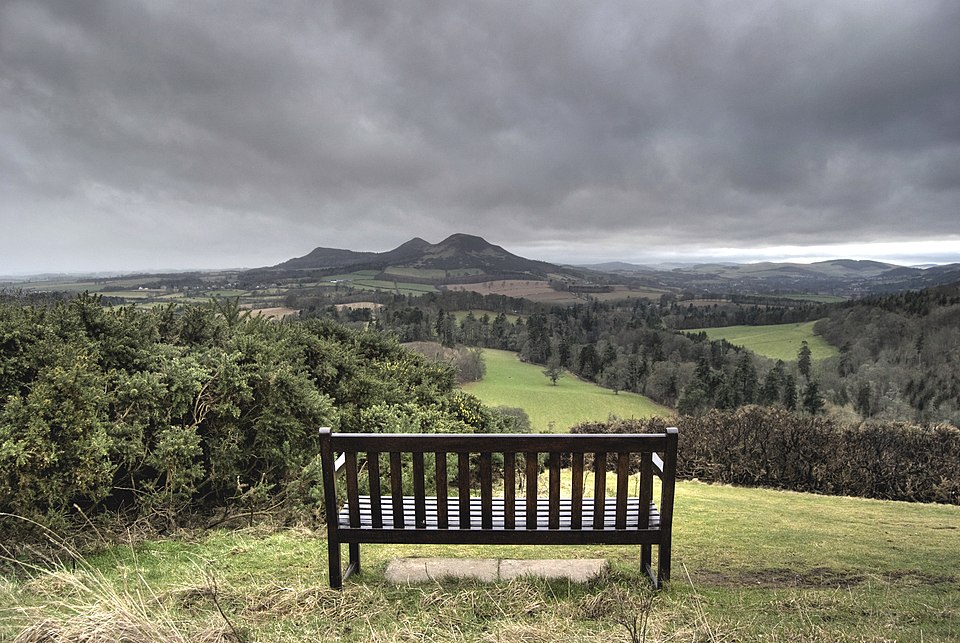
Scott's View
Scott's View refers to a viewpoint in the Scottish Borders, overlooking the valley of the River Tweed, which is reputed to be one of the favourite views of Sir Walter Scott. The viewpoint can be located directly from a minor road leading south from Earlston just off the A68 and by travelling north from the village of St. Boswells up the slope of Bemersyde Hill. The view is around 3 miles east of Melrose.
Photo credit: Semi-detached -

The Dunmore Pineapple, a folly in Dunmore Park, near Airth in Stirlingshire
,
The Dunmore Pineapple, a folly in Dunmore Park, near Airth in Stirlingshire
Photo credit: George.Gastin -
-

Eilean Glas lighthouse
Eilean Glas Lighthouse, built by engineer Thomas Smith, was one of the original four lights to be commissioned by the Commissioners of the Northern Lights and the first in the Hebrides (the others were Kinnaird Head, Mull of Kintyre and North Ronaldsay).
Photo credit: Richard Baker -

Wellington Church, University Avenue, Glasgow
Wellington Church, a 19th-century church on University Avenue in Glasgow with the frontage in the neoclassical style of a Greek temple.
Photo credit: Mymuk -
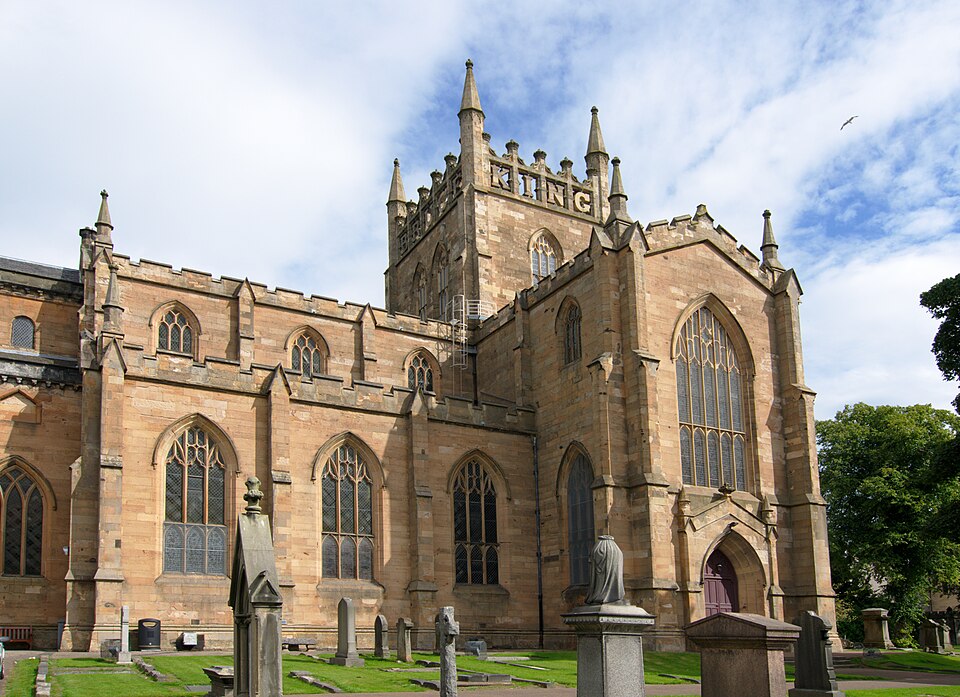
Dunfermline Abbey, east side viewed from the south
Dunfermline Abbey is a large Benedictine abbey in Dunfermline, Fife. It was administered by the Abbot of Dunfermline. The abbey was founded in 1128 by King David I, but the monastic establishment was based on an earlier foundation dating back to the reign of King Máel Coluim mac Donnchada (i.e. "Malcolm III" or "Malcolm Canmore", r. 1058-93).
Photo credit: Mussklprozz -

Aerial view of Pennan village
Pennan (Scots: Peenan) is a small village in Aberdeenshire] consisting of a small harbour and a single row of homes. Pennan became famous for representing the fictional village of Ferness, being one of the main locations for the film Local Hero.
Photo credit: Tadpolefarm -

Detail of the V&A museum from the west with the Tay Bridge beyond
Detail of the V&A museum, Dundee from the west with the Tay Bridge beyond.
Photo credit: Richard Szwejkowski -

Glasgow University main building with Dumgoyne and the Campsie Fells in the background
Autumnal view of Glasgow University main building with Dumgoyne and the Campsie Fells in the background
Photo credit: Ian Dick -

Freezing temperatures in Braemar
Braemar is a village in Aberdeenshire, around 58 miles (93 km) west of Aberdeen in the Highlands. Sitting at an altitude of 339 metres (1,112 ft), Braemar is the third coldest low lying place in the UK, after the villages of Dalwhinnie and Leadhills. It has twice entered the UK Weather Records with the lowest ever UK temperature of -27.2oC, on 11 February 1895, and 10 January 1982.
Photo credit: Paul Chapman -
-

The Old Man of Storr
The Old Man of Storr is a rock pinnacle, the remains of an ancient volcanic plug. It is part of The Storr, a rocky hill overlooking the Sound of Raasay on the Trotternish peninsula of the Isle of Skye.
Photo credit: Wojsy -

View over Edinburgh, with the Dugald Stewart Monument in the foreground
Calton Hill is a hill in central Edinburgh, just to the east of the New Town. The hill is home to several iconic monuments and buildings: the National Monument, Nelson's Monument, the Dugald Stewart Monument, the Royal High School, the Robert Burns Monument, the Political Martyrs' Monument and the City Observatory.
Photo credit: Andrewyuill -

Glasgow Necropolis
The Glasgow Necropolis is a Victorian cemetery in Glasgow. It sits on a hill above, and to the east of, St. Mungo's Cathedral. It was conceived as a Père Lachaise for Glasgow, and subsequently established by the Merchants' House of Glasgow in 1831. Fifty thousand individuals have been buried in approximately 3500 tombs.
Photo credit: Finlay McWalter -

Traigh Iar (Horgabost beach), Harris, which is part of Lewis and Harris, the largest island in the Outer Hebrides, .
Photo credit: Gordon Hatton


Did You Know...

- ... that a lane behind a tenement in Edinburgh is decorated as a Wild West town?
- ... that Colin Mackay, the political editor at Scottish Television, was "very sad" when Colin MacKay, the political editor at Scottish Television, died?
- ... that Thorpe's secluded hills provided refuge from Scottish raiders and English Civil War troops?
- ... that historically, lichens like Umbilicaria torrefacta have been used to naturally dye traditional Scottish tartans and textiles?
- ... that Thomas Kerr protested the Iraq War with his SNP-supporting aunt, later campaigned for Labour, joined the Conservatives, and defected to Reform UK?
- ... that Scottish politician Tam Dalyell opposed devolution, warning it would become a "motorway without exit to a separate state"?
- ... that Ian Begg, known for his work on restoration of castles in Scotland, designed and built his own 20th-century tower house to live in?
- ... that Davy Russell won a 2025 Scottish election despite being dubbed the "invisible man" by an opponent?
Get involved


For editor resources and to collaborate with other editors on improving Wikipedia's Scotland-related articles, see WikiProject Scotland.
To get involved in helping to improve Wikipedia's Scotland related content, please consider doing some of the following tasks or joining one or more of the associated Wikiprojects:
- Visit the Scottish Wikipedians' notice board and help to write new Scotland-related articles, and expand and improve existing ones.
- Visit Wikipedia:WikiProject Scotland/Assessment, and help out by assessing unrated Scottish articles.
- Add the Project Banner to Scottish articles around Wikipedia.
- Participate in WikiProject Scotland's Peer Review, including responding to PR requests and nominating Scottish articles.
- Help nominate and select new content for the Scotland portal.
Do you have a question about The Scotland Portal that you can't find the answer to?
Post a question on the Talk Page or consider asking it at the Wikipedia reference desk.
Related portals


Other language versions
Associated Wikimedia
The following Wikimedia Foundation sister projects provide more on this subject:
-
 Commons
Free media repository -
 Wikibooks
Free textbooks and manuals -
 Wikidata
Free knowledge base -
 Wikinews
Free-content news -
 Wikiquote
Collection of quotations -
 Wikisource
Free-content library -
 Wikispecies
Directory of species -
 Wikiversity
Free learning tools -
 Wikivoyage
Free travel guide -
 Wiktionary
Dictionary and thesaurus


